Blog/Social media & mental health/Explainer
Social Media and Loneliness: Does Scrolling Make You Lonelier?
What the research says about which comes first, why a message and a feed work so differently, and how to use your phone to feel less alone.


In this article
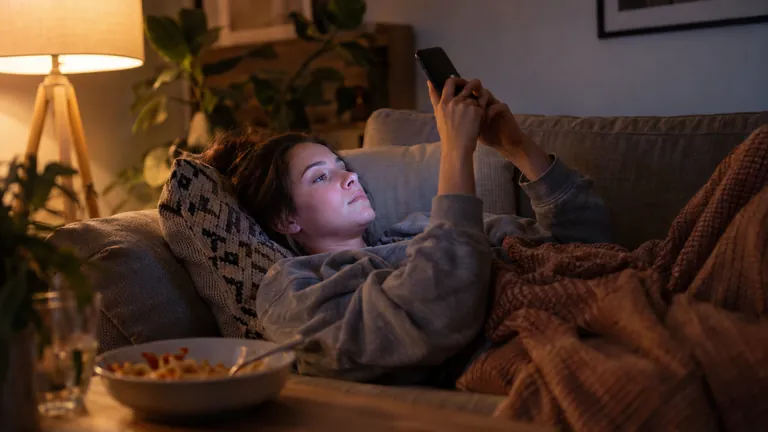
You open Instagram on a quiet evening because you'd like to feel a little less alone, and half an hour later you put the phone down feeling lonelier than when you started. You're not imagining it, and you're not unusual. Social media can pull people closer or leave them more isolated, and the research is now fairly clear about what tips it one way or the other.
Does social media make you lonely?
Sometimes, and less than the headlines suggest. The studies agree on more than you might expect once you look at how people use the apps, not only how long.
- The heaviest users feel more isolated. In a national survey of 1,787 Americans aged 19 to 32, people in the top quarter for time on social media, more than two hours a day, had twice the odds of feeling more socially isolated as people who spent half an hour or less [1].
- Across dozens of studies, the link is weak. A 2022 meta-analysis pooled 82 papers with 48,383 participants and found a real but tiny correlation between social media use and loneliness: 0.05, on a scale where 1 is a perfect match. The type of use mattered: passive use, scrolling without taking part, and what the authors call abnormal use were the kinds linked with loneliness [2].
- Hours say less than habits. A British study has followed a group of twins since they were five. When 1,632 of them were in their mid twenties, time on social media wasn't linked with how lonely they felt. Compulsive use was, and so was being harassed online. Asked directly, 71% said social media made no difference to their loneliness, 13% said it made them less lonely and 16% said it made them lonelier [3].
So the number in your Screen Time report tells you less than you'd think. What you do in the apps, and whether you can stop when you want to, tells you more.
Which comes first, the loneliness or the scrolling?
Both, it seems, and each feeds the other.
A 2025 meta-analysis gathered 26 longitudinal studies, which follow the same people over time, with 24,798 participants in all. It looked at loneliness and problematic media use, the kind of screen use people struggle to control, and found the arrow pointing both ways: loneliness predicted more problematic use later, and problematic use predicted more loneliness later. On the strictest estimates, each effect was small, a correlation of about 0.1 [4].
A 2018 review in Perspectives on Psychological Science proposes how that loop works [5]. Lonely people tend to prefer interacting online, and they're more likely to use the internet in a way that takes the place of time with people offline. The authors draw the line by where the time online leads. Used as a "way station" on the route to strengthening the relationships you have and starting new ones, it's a useful tool for reducing loneliness. Used to escape the social world and withdraw from the "social pain" of interaction, it makes loneliness worse.
Social media helps when it leads you to people. It hurts when it stands in for them.
That's the trap of the lonely scroll. It feels like company, because there are people on the screen, but none of them is talking to you.
A message is not a feed
The same phone can do two very different things. Scroll past a hundred friends' posts and you're watching. Write to one of them and you're talking.
A study of 1,910 Facebook users linked their own reports of well-being to the site's records of what they did there. Receiving what the authors call targeted, composed communication from close ties, words someone wrote for them rather than a tap, went with improvements in well-being. Seeing friends' posts made for everyone, and getting one-click feedback such as likes, did not [6].
The British twins study found a similar pattern by app. Of the eight platforms it asked about, WhatsApp was the only one whose users were less lonely than non-users, and the more often they used it, the less lonely they were. Users of Facebook, Instagram, Twitter and Snapchat were no more and no less lonely than people who didn't use them [3]. It's one survey, so it can't say whether messaging eases loneliness or connected people simply message more, but it points the same way: the use that looks like talking to someone is the use that goes with feeling less alone.

What cutting back can and can't do
If the feed is part of the problem, using less of it should help, and in one trial it did. At the University of Pennsylvania, 143 students were split at random: one group kept Facebook, Instagram and Snapchat to 10 minutes each a day, about 30 minutes in all, while the other carried on as usual. After three weeks, the limited group's loneliness and depression had fallen significantly compared with the control group [7].
A break on its own isn't a cure, though. In a 2025 study of young adults across the US, the 295 who chose to take a week off five platforms reported depression symptoms about a quarter lower afterwards, anxiety 16% lower and insomnia about 15% lower. Their loneliness didn't change significantly [8]. There was no randomized control group, so the study can't say for certain what caused the improvements, but the loneliness result is telling. A quieter phone doesn't fill an evening with people. Something else has to.
Where the time with friends went
The American Time Use Survey, a nationally representative survey of Americans aged 15 and older, asks people to go through one day, activity by activity, and say who was with them. On average, time spent with friends in person fell from 60 minutes a day in 2003 to 34 in 2019, before the pandemic, and to 20 in 2020. Time spent alone rose from 285 minutes a day in 2003 to 309 in 2019 and 333 in 2020 [9].
The survey can't say why. It measured time in person, not phones, and plenty else changed over those years. But it shows what the scroll competes with. Friendships are built from ordinary hours together, and those hours have been getting scarcer.

How to use social media without feeling lonelier
- Write to one person instead of posting to everyone. Reply to a story with a real sentence, send a voice note, call someone on your walk home. In the Facebook study, receiving words written for you by people you're close to went with feeling better [6], and writing them is how that exchange starts.
- Turn the feed into a plan. When a post reminds you of someone, use it as the way station it can be [5]: suggest coffee on Saturday or a walk this week. If you share the plan with Unrotten's Coach, it checks in on it later, so the idea doesn't die in the scroll.
- Give the feed a budget. About 30 minutes a day was enough to reduce loneliness in the Penn trial [7]. A limit you set yourself is easy to bend at 11 p.m.; a daily limit in Unrotten holds it for you. Once it's used up, Apple's Screen Time shield locks the apps you chose until the day resets.
- Notice the scroll you didn't choose. In the British study, compulsive use was linked with loneliness when hours weren't [3]. If you catch yourself opening the apps without deciding to, especially when you feel low, that's the habit to work on first.
- Put the phones away when you're together. In an experiment with more than 300 people sharing a meal with friends or family, those who kept their phones on the table enjoyed it less and felt more distracted than those who put them away, even though the phones were out for only about 11% of the meal [10]. Our guide to phubbing has more on phones at the table.
- Know when it's more than a quiet week. Loneliness that lasts for weeks, or that comes with low mood, is worth talking about with a doctor or therapist. You don't have to wait until it feels serious.

Let the phone lead somewhere
The lonely scroll is an understandable thing to reach for. It's the quickest way to see familiar faces at 10 p.m., and it asks nothing of you. But the research keeps finding the same pattern: the apps help when they carry you toward someone and hurt when they become the place you stay.
Keep the feed small, keep the messages personal, and let your phone be the way station rather than the destination. For the wider evidence, read our guides to social media and mental health and to fear of missing out.
Questions people ask
Does social media make you lonely?
It can, but the link is weaker than headlines suggest, and it depends on how you use it. A meta-analysis of 82 papers found only a tiny correlation between social media use and loneliness overall, concentrated in passive use and what its authors call abnormal use. In a British study of young adults, time on social media wasn't linked with loneliness, but compulsive use was.
Why do I feel lonely after scrolling social media?
Scrolling is watching, not talking. Passive use is one of the kinds linked with loneliness, and researchers think feeds can also show you the plans you weren't part of and make other people's lives look fuller than yours. Lonely people are also more likely to reach for the feed in the first place, so the two can feed each other.
Can social media help with loneliness?
Yes, when it leads you to people. Researchers describe it as a way station: used to keep up with friends, make plans and meet new people, it can reduce loneliness, while used to escape and withdraw from people it tends to deepen it. Messages written for you by people you're close to went with better well-being in a study of 1,910 Facebook users.
How much social media is too much if you feel lonely?
There's no official limit. In a University of Pennsylvania trial, students who kept Facebook, Instagram and Snapchat to 10 minutes each a day, about 30 minutes in all, were less lonely after three weeks than students who used them as usual.
Will quitting social media cure loneliness?
Not by itself. In a 2025 study of US young adults, the 295 who took a week off five platforms reported less depression, anxiety and insomnia afterwards, but their loneliness didn't change significantly. Cutting back seems to help most when the time it frees goes to real people.
References
- Primack BA, Shensa A, Sidani JE, Whaite EO, Lin LY, Rosen D, et al. "Social Media Use and Perceived Social Isolation Among Young Adults in the U.S." American Journal of Preventive Medicine. 2017;53(1):1-8. doi:10.1016/j.amepre.2017.01.010 · Read our plain-English summary ↩
- Zhang L, Li C, Zhou T, Li Q, Gu C. "Social Networking Site Use and Loneliness: A Meta-Analysis." The Journal of Psychology. 2022;156(7):492-511. doi:10.1080/00223980.2022.2101420 ↩
- Matthews T, Arseneault L, Bryan BT, Fisher HL, Gray R, Henchy J, et al. "Social media use, online experiences, and loneliness among young adults: A cohort study." Annals of the New York Academy of Sciences. 2025;1548(1):194-205. doi:10.1111/nyas.15370 · Read our plain-English summary ↩
- Fam JY, Männikkö N. "Loneliness and Problematic Media Use: Meta-Analysis of Longitudinal Studies." Journal of Medical Internet Research. 2025;27:e60410. doi:10.2196/60410 ↩
- Nowland R, Necka EA, Cacioppo JT. "Loneliness and Social Internet Use: Pathways to Reconnection in a Digital World?" Perspectives on Psychological Science. 2018;13(1):70-87. doi:10.1177/1745691617713052 ↩
- Burke M, Kraut RE. "The Relationship Between Facebook Use and Well-Being Depends on Communication Type and Tie Strength." Journal of Computer-Mediated Communication. 2016;21(4):265-281. doi:10.1111/jcc4.12162 ↩
- Hunt MG, Marx R, Lipson C, Young J. "No More FOMO: Limiting Social Media Decreases Loneliness and Depression." Journal of Social and Clinical Psychology. 2018;37(10):751-768. doi:10.1521/jscp.2018.37.10.751 · Read our plain-English summary ↩
- Calvert E, Cipriani M, Dwyer B, Lisowski V, Mikkelson J, Chen K, et al. "Social Media Detox and Youth Mental Health." JAMA Network Open. 2025;8(11):e2545245. doi:10.1001/jamanetworkopen.2025.45245 · Read our plain-English summary ↩
- Kannan VD, Veazie PJ. "US trends in social isolation, social engagement, and companionship, nationally and by age, sex, race/ethnicity, family income, and work hours, 2003-2020." SSM - Population Health. 2023;21:101331. doi:10.1016/j.ssmph.2022.101331 ↩
- Dwyer RJ, Kushlev K, Dunn EW. "Smartphone use undermines enjoyment of face-to-face social interactions." Journal of Experimental Social Psychology. 2018;78:233-239. doi:10.1016/j.jesp.2017.10.007 · Read our plain-English summary ↩
Written by
Maren AshbyCOO, Unrotten
Maren Ashby is the COO of Unrotten, the iPhone app that helps people take their attention back from the feed. She writes about the research on phones, sleep and focus, and about the small, practical changes that make a phone easier to put down.