Blog/Social media & mental health/Explainer
Social Media Anxiety: Why Feeds Make You Anxious, and What Helps
The checking, the comparison, the fear of missing out and the news at midnight: what the research links to anxiety, and the small changes that calm it.

In this article
You open Instagram to unwind and close it with a tight chest and a busy head. You're not imagining the link: studies tie social media, the compulsive kind above all, to more anxiety, and in trials, short breaks have eased it. Here's what drives social media anxiety, and the changes that calm it.
Can social media cause anxiety?
The evidence says it can feed anxiety, and that anxiety can feed it back.
- More time, more anxiety. In a nationally representative US sample of 563 people aged 18 to 22, more time on social media went with more anxiety symptoms, and with higher odds of scoring above the level that suggests an anxiety disorder [1].
- More platforms, more anxiety. In a national sample of 1,787 US adults aged 19 to 32, people who used 7 to 11 platforms had about three times the odds of more anxiety symptoms as people who used 2 or fewer, even after accounting for their total time on social media [2].
- Compulsive use most of all. A 2025 meta-analysis of 32 studies with 26,166 students found that social media addiction went with anxiety at a correlation of 0.31, and with fear of missing out at 0.41, on a scale where 1 is a perfect match [3].
Those are snapshots, so they can't say which came first. A 2022 systematic review found that the relationship between social media and anxiety is often bidirectional: compulsive use can raise anxiety, and anxious people turn to their feeds more. Using it late at night, feeling emotionally invested in it, and scrolling passively instead of taking part may all matter [4].
Trials get closer to cause and effect. In a randomized trial, 154 adults with an average age of 30 either stopped using Facebook, Instagram, Twitter and TikTok for a week or carried on as usual. The week off reduced anxiety and depression and raised well-being [5]. In a University of Pennsylvania trial that capped Facebook, Instagram and Snapchat at 10 minutes each a day, anxiety and fear of missing out fell in both groups, the students who cut back and the ones whose use was simply tracked, which suggests that keeping an eye on your own scrolling helps by itself [6].
Why social media makes you anxious
The checking loop
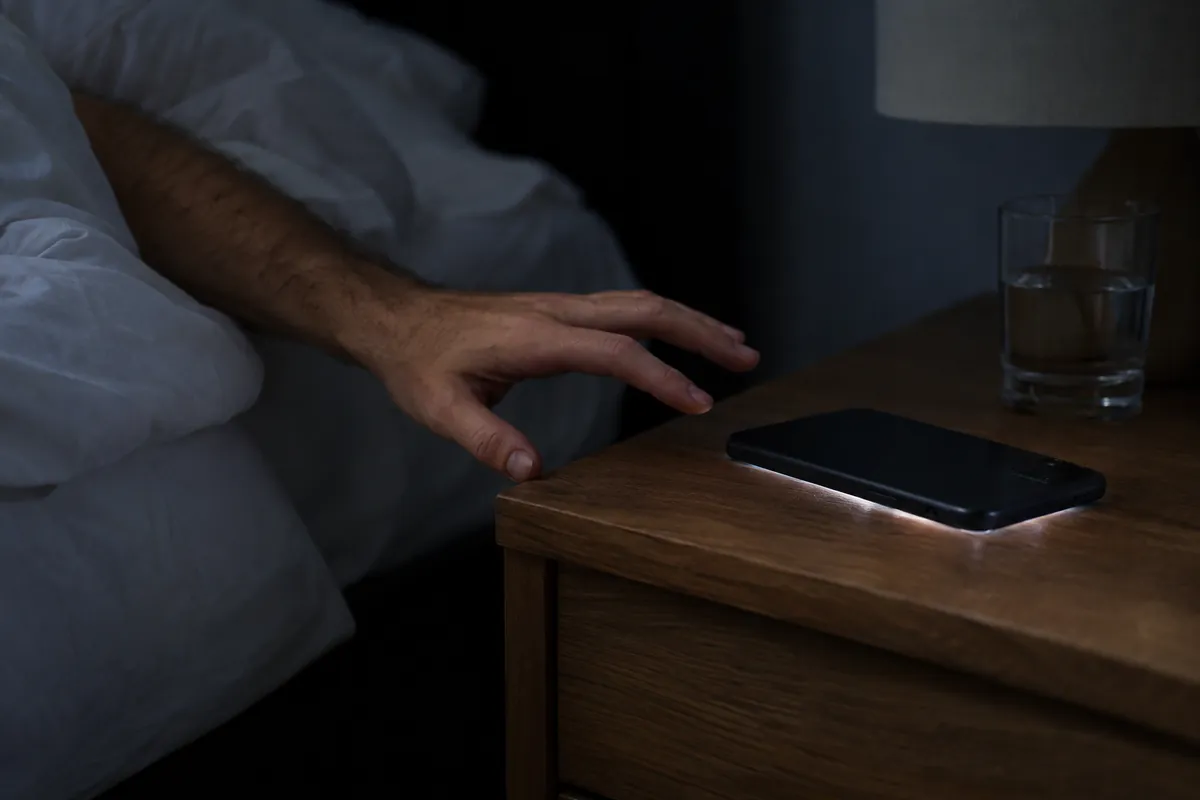
Every buzz is a small question your brain wants answered now: who was it, what did they say, did anyone reply. Answer enough of them and you're checking even when nothing has buzzed.
How notifications arrive matters. In a two-week field experiment with 237 people, those whose notifications came in three batches a day felt less stressed, more in control of their phones and better able to concentrate than people whose notifications arrived as usual. People who got no notifications at all didn't gain that: they reported more anxiety and more fear of missing out than the usual group [7].
Fear of missing out
Feeds show you, in real time, what you're not part of: the dinner, the trip, the joke in the group chat. Fear of missing out had the strongest link to social media addiction of everything measured in that student meta-analysis, stronger than anxiety or depression [3]. The fear drives the checking, and the checking feeds the fear.
Comparison and being judged
A feed is everyone else's best moments, and your own posts come with a public count of likes. People who feel anxious around others seem especially caught up: a 2024 meta-analysis of 53 studies with nearly 60,000 people found a strong link between social anxiety and problematic social media use [8]. It may be that online contact feels safer than face to face, and then becomes hard to step away from; the studies can't yet say which comes first. If comparison is the part that stings, our guide to social media and mental health looks at what it does to mood.
Bad news at night
The feed doesn't sort news by how much you can take at 11 p.m. During the pandemic, a study that tracked people's media use and symptoms every day for 30 days found that on days of more pandemic news on social media, symptoms of depression and post-traumatic stress were higher, especially in people who had been mistreated as children. The same link didn't show up for traditional news sources such as television [9]. That pull toward bad news is what doomscrolling means.
A feed never tells you that you've seen enough. Your nervous system has to decide that for itself.
Signs your feeds are winding you up
Studies describe groups; you're one person. These signs suggest your own social media use is adding to your anxiety:
- Your chest tightens or your thoughts speed up while you scroll, and the feeling lingers after.
- You check before you're properly awake, and again as the last thing at night.
- A post with few likes, or a message left on read, stays on your mind for hours.
- You feel uneasy when you can't check, and relieved only for a moment when you do.
- You keep scrolling bad news you can do nothing about.
Two or three of these are a reason to change how you use the apps, not a diagnosis. If the unease comes from being apart from your phone itself, read about nomophobia.
What helps
- Batch the checks. On iPhone, Scheduled Summary in Settings gathers notifications from the apps you choose and delivers them at set times. Turn off the rest for social apps, and keep calls and messages from the people you love. In the notification experiment, three deliveries a day worked better than constant alerts, while going without any raised anxiety [7].
- Give the feeds a budget. About 30 minutes a day was enough to bring loneliness and depression down in the student trial [6]. A daily limit in Unrotten keeps the budget for you: once it's used up, Apple's Screen Time shield locks the apps you chose until the day resets, with no "ignore limit" button to talk yourself past.
- Tidy the feed. Mute or unfollow the accounts that leave you comparing or on edge, and get your news from one or two outlets you read directly instead of from the feed. Feeds learn partly from what you watch, so scrolling past the posts that wind you up, instead of lingering on them, can change what they show you.
- Post, then put it down. If waiting for the likes is the anxious part, close the app once you've posted and come back hours later, or hide like counts where the app lets you.
- Protect the last hour. Charge your phone outside the bedroom, or let Unrotten's Calmer evenings goal keep a window each evening without your rot apps.
- Try a week off. The trial's one-week break was enough to reduce anxiety [5]. Our social media detox guide walks you through one.
- Notice how you feel after. For a week, ask one question as you close each app: calmer, the same or more wound up? Tracking your use helped both groups in the student trial [6]. Unrotten's Coach can help here too: it checks in on plans you share and nudges you when scrolling runs fast.

When a scroll has already wound you up
You'll still catch yourself mid-spiral sometimes, thumb moving, chest tight. Don't argue with the feed. Finish the post you're on, put the phone face down and give your body something else to do for two minutes: stand up, get a glass of water, look out of a window, breathe out slowly. Then decide, on purpose, whether you're going back in. Often, once the pull has passed, you won't.
When it's more than your feeds
Cutting back on social media can make you calmer, but it isn't a treatment for an anxiety disorder. If anxiety is strong, lasts for weeks, or shows up whatever you're doing, a doctor or therapist can help, whatever part your phone plays in it.
Make the feed wait for you
Much of social media anxiety comes down to pace: the feed sets it, and you follow. Batch the alerts, put a ceiling on the scrolling and give your evenings back to quiet, and the pace becomes yours again.
Questions people ask
Can social media cause anxiety?
It can feed it. Studies link heavier and more compulsive use with more anxiety, though the link often runs both ways, because anxious people also turn to their phones more. In a randomized trial, a one-week break from social media reduced anxiety compared with carrying on as usual.
Why does social media make me anxious?
The usual culprits are constant checking and notifications, fear of missing out, comparing yourself with other people's highlights, worry about how your own posts land, and bad news late at night. Each keeps your attention on alert and gives it little rest.
How do I stop social media anxiety?
Check at set times instead of whenever a notification arrives, cap the time you spend in the feeds, keep the last hour before bed free of them, and notice how you feel after each session. In one experiment, getting notifications in three batches a day left people less stressed than getting them as they came.
Is social media anxiety a disorder?
No. It isn't a diagnosis, just a common name for feeling anxious around social media. If anxiety is strong or constant whatever you're doing, talk to a doctor or therapist.
References
- Vannucci A, Flannery KM, Ohannessian CM. "Social media use and anxiety in emerging adults." Journal of Affective Disorders. 2017;207:163-166. doi:10.1016/j.jad.2016.08.040 ↩
- Primack BA, Shensa A, Escobar-Viera CG, Barrett EL, Sidani JE, Colditz JB, James AE. "Use of multiple social media platforms and symptoms of depression and anxiety: A nationally-representative study among U.S. young adults." Computers in Human Behavior. 2017;69:1-9. doi:10.1016/j.chb.2016.11.013 ↩
- Jing Z, Yang W, Lei Z, Junmei W, Hui L, Tianmin Z. "Correlations between social media addiction and anxiety, depression, FoMO, loneliness and self-esteem among students: A systematic review and meta-analysis." PLOS ONE. 2025;20(9):e0329466. doi:10.1371/journal.pone.0329466 · Read our plain-English summary ↩
- Lopes LS, Valentini JP, Monteiro TH, Costacurta MCF, Soares LON, Telfar-Barnard L, Nunes PV. "Problematic Social Media Use and Its Relationship with Depression or Anxiety: A Systematic Review." Cyberpsychology, Behavior, and Social Networking. 2022;25(11):691-702. doi:10.1089/cyber.2021.0300 ↩
- Lambert J, Barnstable G, Minter E, Cooper J, McEwan D. "Taking a One-Week Break from Social Media Improves Well-Being, Depression, and Anxiety: A Randomized Controlled Trial." Cyberpsychology, Behavior, and Social Networking. 2022;25(5):287-293. doi:10.1089/cyber.2021.0324 · Read our plain-English summary ↩
- Hunt MG, Marx R, Lipson C, Young J. "No More FOMO: Limiting Social Media Decreases Loneliness and Depression." Journal of Social and Clinical Psychology. 2018;37(10):751-768. doi:10.1521/jscp.2018.37.10.751 · Read our plain-English summary ↩
- Fitz N, Kushlev K, Jagannathan R, Lewis T, Paliwal D, Ariely D. "Batching smartphone notifications can improve well-being." Computers in Human Behavior. 2019;101:84-94. doi:10.1016/j.chb.2019.07.016 · Read our plain-English summary ↩
- Wu W, Huang L, Yang F. "Social anxiety and problematic social media use: A systematic review and meta-analysis." Addictive Behaviors. 2024;153:107995. doi:10.1016/j.addbeh.2024.107995 ↩
- Price M, Legrand AC, Brier ZMF, van Stolk-Cooke K, Peck K, Dodds PS, et al. "Doomscrolling during COVID-19: The negative association between daily social and traditional media consumption and mental health symptoms during the COVID-19 pandemic." Psychological Trauma: Theory, Research, Practice, and Policy. 2022;14(8):1338-1346. doi:10.1037/tra0001202 ↩
Written by
Maren AshbyCOO, Unrotten
Maren Ashby is the COO of Unrotten, the iPhone app that helps people take their attention back from the feed. She writes about the research on phones, sleep and focus, and about the small, practical changes that make a phone easier to put down.