

Blog/Guide
Social Media Addiction: Why Feeds Hook You and How to Break Free
Not an official diagnosis, but a pattern researchers can measure: the signs, why social apps are so hard to put down, and what the trials say helps.

In this article
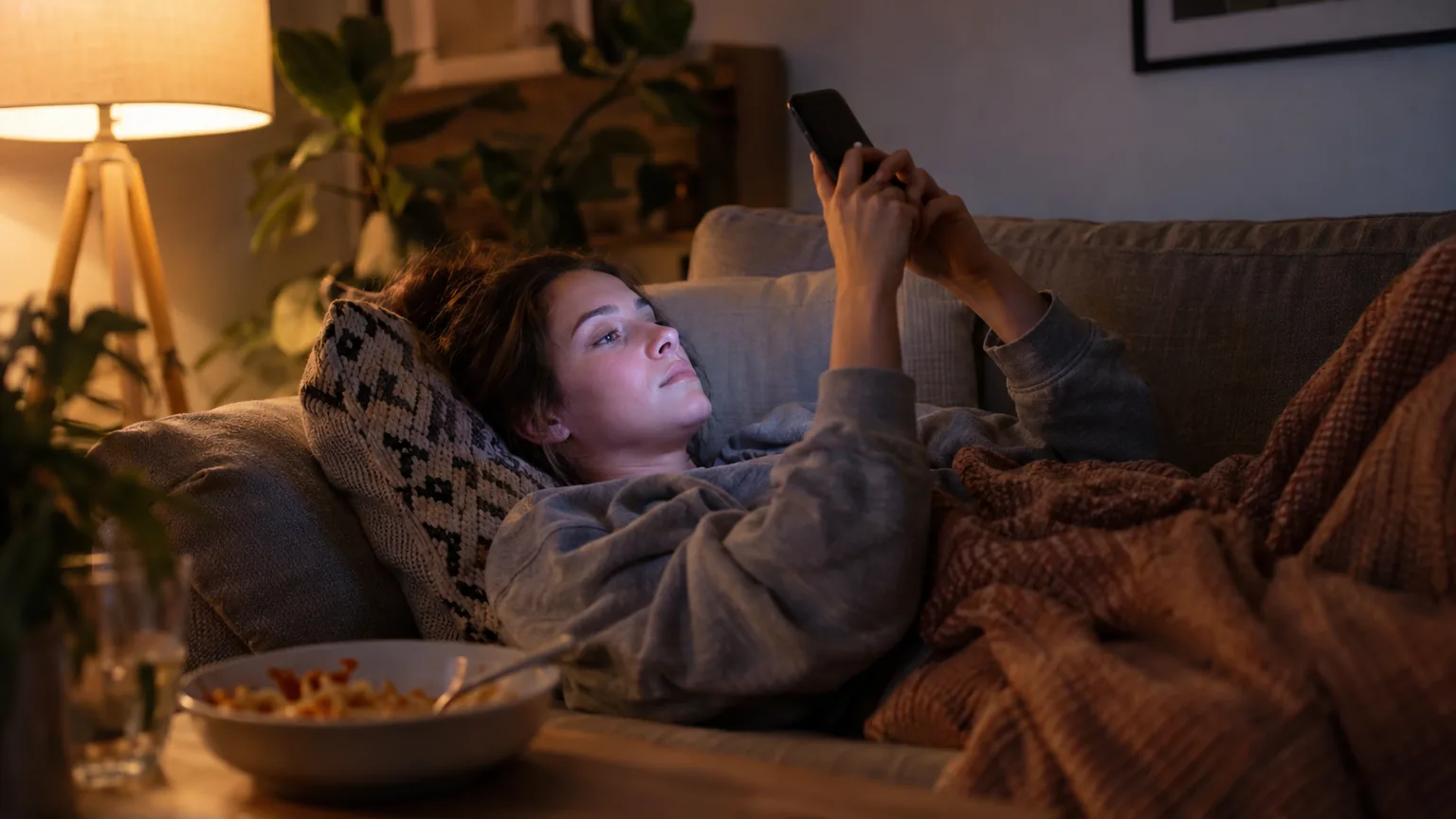
You open Instagram to post one photo. Forty minutes later you're watching a stranger renovate a bathroom, the photo still unposted and dinner going cold beside you. If that happens most nights, you've probably wondered whether you're addicted to social media.
Here's the honest answer: social media addiction isn't an official diagnosis, but researchers can measure it, and a minority of users score high. The feeds are built to be hard to leave. And the best evidence for getting free points to limits and short breaks, not to quitting forever.
Is social media addiction real?
Not as a formal diagnosis. Social media addiction isn't recognized as a disorder in either of the big diagnostic manuals, the DSM-5 and the ICD-11, and researchers still debate what to call it [1]. Many prefer a plainer label: problematic social media use.
What they can do is measure it. The best-known tool, the Bergen scale, asks six questions about the past year, one for each classic component of addiction [2]. When its authors gave it to 23,533 adults who answered a survey in Norwegian newspapers, they noted that its suggested cutoffs would have flagged 13.5% of them as problematic users [2].
How many people struggle depends on where you draw the line. A meta-analysis of 63 samples, with 34,798 people in 32 nations, found that 5% met the strictest definitions, 13% passed a cutoff for severe problems and 25% a looser cutoff for moderate ones [3]. Rates in collectivist countries were about twice those in individualist ones [3].
Signs of social media addiction
The Bergen scale's six questions make a useful self-check [2]. Think back over the past year. How often have you:
- Thought about social media when you weren't using it, or planned when you'd get back to it?
- Felt an urge to use it more and more?
- Used it to forget about personal problems?
- Tried to cut down without success?
- Become restless or troubled when you couldn't use it?
- Used it so much that it hurt your job or your studies?
Each one is answered from "very rarely" to "very often". Saying "often" to several doesn't diagnose anything, but it does tell you the habit is costing you something. The restlessness on that list is what people mean by social media withdrawal symptoms: the itch to check, and the unease when you can't. Our guide to phone addiction covers the same six signs for the phone as a whole.
Why social media is so hard to put down
Likes work like rewards
Social media is often compared to a Skinner box, the lab cage where an animal learns to press a lever for food. One team tested the comparison on more than a million posts from 4,168 people on Instagram and online forums. People's posting followed the same learning rules: when their posts were earning more likes, they posted again sooner, and on Instagram the gap between posts shrank by about 18% [4]. In an online experiment, changing how many likes people's posts received changed how often they posted [4].
The feed never ends
A magazine ends. An episode ends. A feed doesn't. The next post is already loading before you've decided to keep going, videos start on their own, and notifications call you back once you've left. Nothing in the design suggests a place to stop.
The feed doesn't run out, so the stop has to come from somewhere else.
Scrolling past other people's lives
How you use social media matters as much as how long. In two studies, one in a lab and one following people through their days, scrolling Facebook passively (reading without posting or messaging) lowered people's mood over time, and envy explained the drop [5]. Active use didn't have the same effect.
The fear of missing out runs through all of it. A 2025 meta-analysis of 32 studies with 26,166 students found that social media addiction went with more anxiety and depression, more loneliness and lower self-esteem, and its strongest link was with the fear of missing out [6].

What it does to you
Those links are correlations, so they can't say which comes first. Low mood can send people to their feeds, and heavy, compulsive use can deepen low mood; both probably happen.
Experiments help untangle it. A 2025 meta-analysis of 10 randomized trials with 1,491 people found that using social media less reduced symptoms of depression, a small but real effect, and that cutting back worked at least as well as quitting altogether [7].
How to break a social media addiction
1. Look at your real numbers
Open Settings, then Screen Time, and look at a full week: your daily average and the two or three social apps at the top. Write the numbers down. Start from the record, not the feeling.
2. Cut to a limit, not zero
In a randomized trial, 143 students at the University of Pennsylvania limited Facebook, Instagram and Snapchat to 10 minutes per platform per day for three weeks. Compared with students who used social media as usual, they became less lonely and less depressed [8]. Both groups grew less anxious and less afraid of missing out, which suggests that simply tracking your use helps too. The authors' takeaway: about 30 minutes a day may meaningfully improve well-being [8].
3. Try a one-week break
In another trial with 154 adults, those asked to stay off Facebook, Instagram, Twitter and TikTok for a week reported better well-being and fewer symptoms of depression and anxiety than those who carried on as usual [9]. A week is short enough to finish and long enough to show you which apps you actually missed.
4. Remove the cues
Turn off notifications from every social app, move the apps off your Home Screen or delete them, and sign out so that opening one takes a deliberate step. Those are the tips the break group in that trial received [9].
5. Fill the gap on purpose
When researchers paid Facebook users to deactivate their accounts for four weeks, the average person got back 60 minutes a day and spent more of it offline, including time with friends and family. Their well-being rose slightly, 80% said the break had been good for them, and weeks later they were still using the Facebook app less than the control group [10]. Decide in advance what the time is for: a dopamine menu gives you a short list of better things to reach for when the urge hits.
6. Make the limit hold
A limit gets tested late in the day, when you're tired, which is exactly when one you can dismiss with a tap gets dismissed. Unrotten gives the apps you choose limits that hold. Less scrolling sets a daily limit, after which Apple's Screen Time shield locks them until the day resets, with no "ignore limit" button. Shorter scroll sessions puts a break on a scroll that runs too long, and Fewer app returns sets a daily target for how many times you open them. Unrotten's Coach, a chat that knows your goals and your day, checks in on the plans you share and nudges you when your scrolling runs fast.

When it's more than a habit
If your social media use comes with low mood, anxiety or sleep problems that don't lift, a doctor or therapist can help, and asking is a strong move, not a weak one. If you ever have thoughts of harming yourself, call or text 988, the Suicide & Crisis Lifeline in the US, at any hour.
Keep the people, shrink the feed
You don't have to delete every account to get your evenings back. Keep the parts of social media that connect you to people you care about, and put a limit on the endless part. Start tonight with one change: turn off notifications for every social app. For the scroll itself, read how to stop doomscrolling.
Questions people ask
Is social media addiction a real diagnosis?
No. It isn't recognized as a disorder in the DSM-5 or the ICD-11, and many researchers prefer the term problematic social media use. They can still measure it, most often with the six-question Bergen scale, and the pattern of compulsive use with real costs is real.
How common is social media addiction?
It depends on where the line is drawn. A meta-analysis of 34,798 people in 32 nations found that 5% met the strictest definitions, 13% a cutoff for severe problems and 25% a looser cutoff for moderate ones.
What are the symptoms of social media addiction?
The Bergen scale asks how often, over the past year, you thought about social media when you weren't using it, felt the urge to use it more, used it to forget personal problems, tried to cut down without success, felt restless when you couldn't use it, and used it so much it hurt your work or studies.
How do you break a social media addiction?
Look at your real numbers in Screen Time, cut to a limit rather than zero (one trial used 10 minutes per platform a day), try a one-week break, turn off notifications and move the apps off your Home Screen, plan what fills the time, and use limits that hold when you're tired.
Is it better to quit social media or cut back?
Cutting back looks at least as good. A 2025 meta-analysis of 10 randomized trials found that using social media less eased symptoms of depression, and that reducing use worked at least as well as quitting altogether.
References
- Moretta T, Wegmann E. "Toward the classification of social media use disorder: Clinical characterization and proposed diagnostic criteria." Addictive Behaviors Reports. 2025;21:100603. doi:10.1016/j.abrep.2025.100603 ↩
- Andreassen CS, Billieux J, Griffiths MD, Kuss DJ, Demetrovics Z, Mazzoni E, et al. "The relationship between addictive use of social media and video games and symptoms of psychiatric disorders: A large-scale cross-sectional study." Psychology of Addictive Behaviors. 2016;30(2):252-262. doi:10.1037/adb0000160 ↩
- Cheng C, Lau YC, Chan L, Luk JW. "Prevalence of social media addiction across 32 nations: Meta-analysis with subgroup analysis of classification schemes and cultural values." Addictive Behaviors. 2021;117:106845. doi:10.1016/j.addbeh.2021.106845 ↩
- Lindström B, Bellander M, Schultner DT, Chang A, Tobler PN, Amodio DM. "A computational reward learning account of social media engagement." Nature Communications. 2021;12(1):1311. doi:10.1038/s41467-020-19607-x ↩
- Verduyn P, Lee DS, Park J, Shablack H, Orvell A, Bayer J, et al. "Passive Facebook usage undermines affective well-being: Experimental and longitudinal evidence." Journal of Experimental Psychology: General. 2015;144(2):480-488. doi:10.1037/xge0000057 ↩
- Jing Z, Yang W, Lei Z, Junmei W, Hui L, Tianmin Z. "Correlations between social media addiction and anxiety, depression, FoMO, loneliness and self-esteem among students: A systematic review and meta-analysis." PLOS ONE. 2025;20(9):e0329466. doi:10.1371/journal.pone.0329466 ↩
- May W, Malouff JM, Meynadier J. "Reducing Social Media Use Decreases Depression Symptoms: A Meta-Analysis of Randomised Controlled Trials." European Journal of Investigation in Health, Psychology and Education. 2025;15(11):222. doi:10.3390/ejihpe15110222 ↩
- Hunt MG, Marx R, Lipson C, Young J. "No More FOMO: Limiting Social Media Decreases Loneliness and Depression." Journal of Social and Clinical Psychology. 2018;37(10):751-768. doi:10.1521/jscp.2018.37.10.751 ↩
- Lambert J, Barnstable G, Minter E, Cooper J, McEwan D. "Taking a One-Week Break from Social Media Improves Well-Being, Depression, and Anxiety: A Randomized Controlled Trial." Cyberpsychology, Behavior, and Social Networking. 2022;25(5):287-293. doi:10.1089/cyber.2021.0324 ↩
- Allcott H, Braghieri L, Eichmeyer S, Gentzkow M. "The Welfare Effects of Social Media." American Economic Review. 2020;110(3):629-676. doi:10.1257/aer.20190658 ↩
Written by
Maren AshbyCOO, Unrotten
Maren Ashby is the COO of Unrotten, the iPhone app that helps people take their attention back from the feed. She writes about the research on phones, sleep and focus, and about the small, practical changes that make a phone easier to put down.