Blog/Phone addiction/Explainer
Phubbing: What It Means and What It Does to Relationships
Snubbing someone for your phone has had a name since 2012. Here's what the research says it costs, and how to stop doing it.


In this article
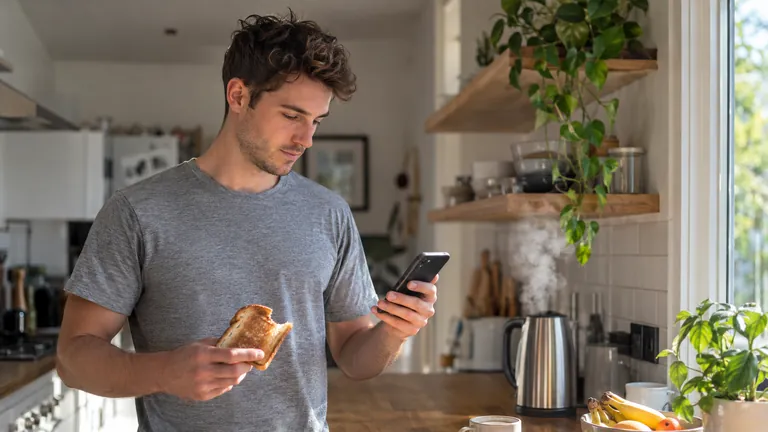
You're halfway through a story when the person across the table glances at their phone. Then they start typing. You finish the story anyway, a little quieter, and you both pretend nothing happened. That small snub has a name, phubbing, and most of us have been on both sides of it.
It feels too minor to matter. The research says otherwise: it changes how a conversation feels, how close two people feel afterward and, in couples, how often they argue. The good news is that it's one of the easier phone habits to fix, because most of the fix is where you put the phone.
What phubbing means
Phubbing is a blend of "phone" and "snubbing": ignoring the person you're with to pay attention to your phone. The word was coined in 2012, in a campaign by Australia's Macquarie Dictionary, to name a habit that had become common enough to need one [1].
It covers plenty of ordinary moments:
- checking a notification while a friend is talking
- scrolling at the dinner table, "just for a second"
- answering a text in the middle of a conversation, without a word
- holding the phone through a walk, a movie or a drink, glancing at it every few minutes
When it's your partner doing it, researchers call it partner phubbing; when it's your manager, boss phubbing. So if you're wondering what phubbing means in a relationship, it's the same snub, from the person whose attention you most expect.
Why people phub
Nobody plans to ignore a friend. Phubbing happens because the phone is built to pull, and the pull is strongest on people who already find it hard to put down.
In a survey of 251 adults, psychologists at the University of Kent found that internet addiction, fear of missing out and low self-control all predicted smartphone addiction, which in turn predicted how often people phubbed [1]. They found a loop as well: people who phubbed more were also phubbed more, and both experiences went with seeing phubbing as normal. Every snub makes the next one feel a little more acceptable, on both sides of the table.
Fear of missing out keeps coming up. A 2024 meta-analysis pooled 27 studies with 20,415 people in 15 countries and found a moderate link between phubbing and FOMO [10]. These are surveys, so they can't say which comes first, but the pattern fits ordinary life: the sense that something is happening elsewhere is what makes a buzz in your pocket feel urgent. Our guide to fear of missing out explains why the feed makes that feeling worse.
What phubbing does to a conversation
The clearest evidence comes from experiments, where researchers change only the phone and keep everything else the same.
In one, 128 British university students watched a three-minute animation of two people talking and imagined being one of them. Their partner in the animation phubbed them not at all, part of the time or extensively. The more the partner phubbed, the worse the students rated the conversation and the relationship, and the differences were large. What carried it was a drop in the sense of belonging, along with a worse mood [2]. An animation isn't a dinner with a friend, and most of the students were women, but the size of the effect is hard to wave away.

Two more experiments looked at how phubbers come across. People who used their phone during a conversation were seen as less polite and less attentive, and checking it on their own initiative made a worse impression than reacting to a notification. The conversation itself was rated lower when one person was messaging, too [3]. That detail is useful: the snub is partly about intent. "Sorry, it's my sister, one second" lands differently from a silent glance down.
What about a phone that's only sitting there? A well-known 2013 study found that pairs of strangers who talked with a phone in view, instead of a notebook, felt less close afterward, mostly when the conversation was meaningful [4]. But two later attempts to repeat it didn't find the effect [5, 6]; the second had 356 people, more than twice the original two experiments combined. So the evidence that a silent phone spoils a talk is weak. Picking it up is what does the damage.
Studies of real life point the same way. In a field study of 100 pairs of people, a research assistant noted whether either person put a phone on the table or held it during a 10-minute conversation, and conversations without a phone in sight were rated better, with more empathy [7]. Nobody was told what to do with their phone there, so it shows a link rather than a cause. In a Vancouver café, though, 304 friends and relatives shared meals with their phones either on the table or put away by design. Those with phones on the table enjoyed the meal a little less and felt more distracted, and they had their phones out for about 11% of the meal, against 1% for those whose phones sat in a container [8]. The effect was small, and it came from fairly light use.
The snub isn't the phone on the table. It's the glance down that tells someone they just came second.
Partner phubbing: what it does to couples
Couples have the most chances for it, because they share the most unstructured time: dinners, evenings on the sofa, the half hour in bed before sleep.
In a survey of 143 married or cohabiting women, most said that technology, from phones and computers to TV, often interrupted their time with their partner, in conversations, at meals and in their leisure time together. The more interruptions they reported, the more they fought about technology and the less satisfied they were with the relationship, and they also reported more depressive symptoms and lower satisfaction with life [9]. It was a one-time survey of women only, so it shows a pattern, not a cause. But the chain it describes will sound familiar to plenty of couples: the phone, then the argument about the phone, then the distance.

If arguments about phones have become part of a wider strain between you, a couples therapist can help you talk about it without it turning into the same fight.
How to stop phubbing
Most phubbing isn't a decision. It's a reflex, so the fixes that work change the setup instead of relying on remembering.
- Put it out of reach, not just face down. In a bag, a coat pocket or another room. In the café study, phones put away in a container came out about 1% of the meal [8].
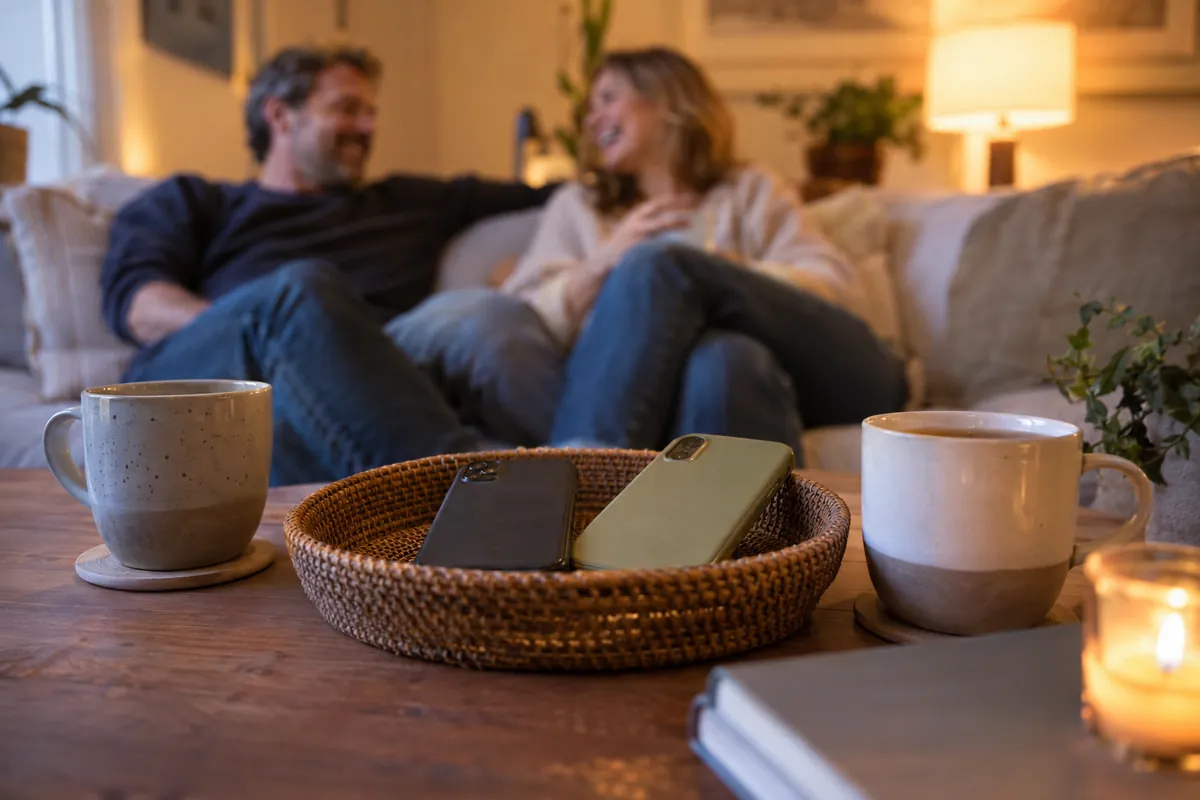
- Pick phone-free moments. Meals, the first fifteen minutes after you get home, and bed are good places to start. A basket by the door or the sofa gives phones somewhere to be.
- Turn off the notifications that aren't people. Keep calls and messages from the people who matter, and silence the apps that only want you back. Fewer buzzes, fewer glances.
- Say it out loud. If you have to check, say why and for how long: "It's the babysitter, give me one minute." Then put it away again. A reason you announce lands very differently from a silent look down [3].
- Notice when you reach. A lull in the conversation, a story you've heard before, a pause while someone thinks: those are the moments the hand moves. Ask a question instead.
Often what pulls you away in company isn't a message, though. It's the feed that's one tap away. Unrotten takes that tap away during the hours you choose: Calmer evenings protects a window each evening without the apps that eat your time, so the sofa and the dinner table stay with the people at them. If the trouble is that one look turns into twenty minutes, a daily limit in Unrotten locks those apps once the day's time is used, and its shield has no "ignore limit" button.
For a bigger reset, our 30-day plan to stop phone addiction walks through it week by week.
When you're the one being phubbed
Being phubbed stings precisely because it seems too small to mention. Mention it anyway, but pick the moment.
- Not mid-snub. Bring it up later, when nobody's holding a phone, and talk about how it feels ("I feel like I'm talking to myself") rather than what they always do.
- Agree on rules together. Phones away at dinner, no phones in bed, a basket by the door: rules you set together are easier to keep than rules one of you enforces.
- Don't phub back. It's tempting, but the Kent survey found that being phubbed went with seeing phubbing as normal [1]. Answering in kind only makes it the house style.
- Go first. Put yours away where they can see it. It's an invitation, not a lecture.
Look up first
Phubbing isn't a character flaw. It's what happens when a device designed to grab attention sits within reach of people who would rather be paying attention to each other. Move the phone a few feet away and most of it goes with it. For the bigger picture of why the phone is so hard to put down, start with our guide to phone addiction.
Questions people ask
What does phubbing mean?
Phubbing, a blend of phone and snubbing, means ignoring the person you're with to pay attention to your phone: checking notifications while they talk, scrolling at dinner or texting in the middle of a conversation. The word was coined in 2012, in a campaign by Australia's Macquarie Dictionary.
What is phubbing in a relationship?
Partner phubbing is when your partner pays attention to their phone instead of you, at meals, on the sofa or in bed. In a survey of 143 married or cohabiting women, more interruptions from technology went with more conflict about it and lower satisfaction with the relationship.
Is it rude to have your phone on the table?
Using it is what does the damage. A 2013 study found that a phone merely in view made conversations between strangers feel less close, but later replications, one of them with 356 people, didn't find that. Picking the phone up is another matter: in experiments, people who checked their phones in the middle of a conversation were judged less polite and less attentive.
How do I stop phubbing?
Change the setup rather than relying on willpower: keep the phone out of reach when you're with people, pick phone-free moments such as meals and bedtime, silence notifications that don't come from people, and if you must check, say why and for how long, then put the phone away.
References
- Chotpitayasunondh V, Douglas KM. "How 'phubbing' becomes the norm: The antecedents and consequences of snubbing via smartphone." Computers in Human Behavior. 2016;63:9-18. doi:10.1016/j.chb.2016.05.018 ↩
- Chotpitayasunondh V, Douglas KM. "The effects of 'phubbing' on social interaction." Journal of Applied Social Psychology. 2018;48(6):304-316. doi:10.1111/jasp.12506 ↩
- Vanden Abeele MMP, Antheunis ML, Schouten AP. "The effect of mobile messaging during a conversation on impression formation and interaction quality." Computers in Human Behavior. 2016;62:562-569. doi:10.1016/j.chb.2016.04.005 ↩
- Przybylski AK, Weinstein N. "Can you connect with me now? How the presence of mobile communication technology influences face-to-face conversation quality." Journal of Social and Personal Relationships. 2013;30(3):237-246. doi:10.1177/0265407512453827 ↩
- Crowley JP, Allred RJ, Follon J, Volkmer C. "Replication of the Mere Presence Hypothesis: The Effects of Cell Phones on Face-to-Face Conversations." Communication Studies. 2018;69(3):283-293. doi:10.1080/10510974.2018.1467941 ↩
- Linares C, Sellier AL. "How bad is the mere presence of a phone? A replication of Przybylski and Weinstein (2013) and an extension to creativity." PLOS ONE. 2021;16(6):e0251451. doi:10.1371/journal.pone.0251451 ↩
- Misra S, Cheng L, Genevie J, Yuan M. "The iPhone Effect: The Quality of In-Person Social Interactions in the Presence of Mobile Devices." Environment and Behavior. 2016;48(2):275-298. doi:10.1177/0013916514539755 ↩
- Dwyer RJ, Kushlev K, Dunn EW. "Smartphone use undermines enjoyment of face-to-face social interactions." Journal of Experimental Social Psychology. 2018;78:233-239. doi:10.1016/j.jesp.2017.10.007 · Read our plain-English summary ↩
- McDaniel BT, Coyne SM. "'Technoference': The interference of technology in couple relationships and implications for women's personal and relational well-being." Psychology of Popular Media Culture. 2016;5(1):85-98. doi:10.1037/ppm0000065 ↩
- Ansari S, Azeem A, Khan I, Iqbal N. "Association of Phubbing Behavior and Fear of Missing Out: A Systematic Review and Meta-Analysis." Cyberpsychology, Behavior, and Social Networking. 2024;27(7):467-481. doi:10.1089/cyber.2023.0761 ↩
Written by
Maren AshbyCOO, Unrotten
Maren Ashby is the COO of Unrotten, the iPhone app that helps people take their attention back from the feed. She writes about the research on phones, sleep and focus, and about the small, practical changes that make a phone easier to put down.