Blog/App blockers & screen time apps/Comparison
Clearspace App Review: How It Compares With Jomo, Unpluq and Flipd
How Clearspace's pause and push-ups work, what Premium costs, and when Jomo's rules, Unpluq's key or a study timer fits you better.

In this article
- The four apps side by side
- Clearspace at a glance
- How Clearspace works
- What Clearspace costs
- Does a pause before an app work?
- Where Clearspace falls short
- Jomo: best for building your own rules
- Unpluq: best for a key you have to go and get
- Flipd: still listed, not updated since February 2025
- Where Unrotten fits
- How to choose
- So, is Clearspace worth paying for?
Clearspace puts a short pause between your thumb and the apps you open on autopilot: your opens left for the day, a slow breath, then your choice. When your minutes run out, push-ups buy more. Jomo, Unpluq and Flipd tackle the same habit with a rulebook, a key and a study timer, and each suits a different way of slipping.
Disclosure: Unrotten, one of the alternatives below, is made by the team behind this blog. We checked Clearspace, Jomo, Unpluq and Flipd on November 7, 2026, against their US App Store listings and official websites, and the others against their listings. We didn't lab-test anything: every price, rating and feature here comes from those pages.
The four apps side by side
| App | Price (US) | How it blocks or slows you | Free version | App Store rating (US) |
|---|---|---|---|---|
| Clearspace | Free; Premium $6.99/mo or $44.99/yr (options up to $59.99) | A pause, then a breath or push-ups to earn minutes; limits; schedules | Yes (free features not listed) | 4.7 (about 9,000 ratings) |
| Jomo | Free plan; Plus $29.99/yr, $5.99/mo or $99.99 once | Rules you build: sessions, schedules, limits, unlock challenges; Strict Mode | Yes (1 session, 1 action or limit) | 4.8 (2,562 ratings) |
| Unpluq | Free plan; Premium $59.99/yr or $6.99/mo; Tag $26.50 (needs Premium) | Scheduled blocks you open with an NFC Tag or a small chore | Yes (2 apps, 1 schedule) | 4.8 (931 ratings) |
| Flipd | Free; Premium $44.99/yr or $5.99/mo | A study timer with study rooms; no blocking on iPhone; last updated February 2025 | Yes (basic features) | 4.5 (6,964 ratings) |
| Unrotten | $49.99/yr or $9.99/mo, each after a 7-day free trial | Screen Time shields tied to goals, and an AI Coach | No (7-day free trial) | New (October 2026) |
Checked November 7, 2026, on the US App Store and each maker's website.
Clearspace at a glance
- What it is: a screen time app by Clearspace Technologies, Inc., on the App Store since July 2021, with an Android app and a Chrome extension.
- Price: free to download; Premium is $6.99 a month or $44.99 a year.
- Needs: iOS 16 or later, on iPhone (it isn't listed for iPad).
- Rating: 4.7 stars from about 9,000 US ratings.
- Best for: the reflex open, when you're in the feed before you've decided to go.
- Watch out for: on a tired night, you can earn your way past the pause.
How Clearspace works
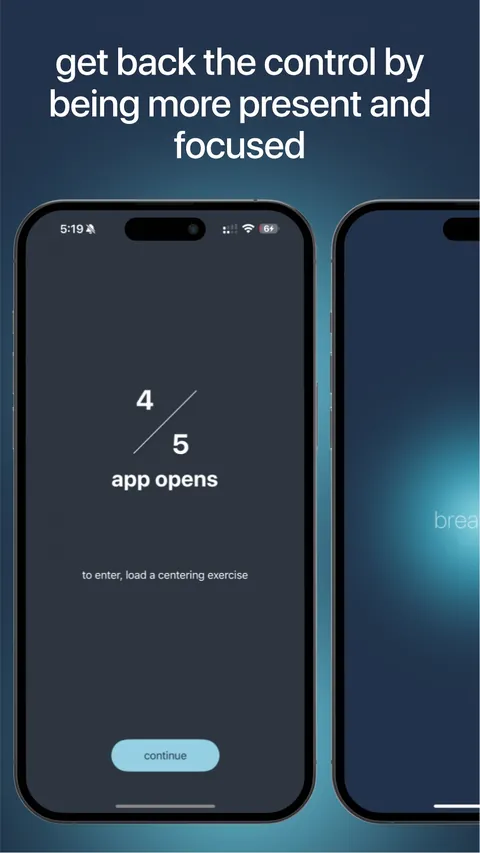
You pick the apps that pull you in, and each gets a number of opens for the day. Open one and Clearspace steps in first: its website says it "shows a short pause with your remaining uses for the day." You close the app, or you earn time to go in.
The usual price of entry is a breath: you "proceed after a deep breath or opt out," says its App Store description. Its screenshots then ask how long you'll stay, from 1 to 10 minutes, and when the time runs out, the app is limited again. More time costs another guided breath or, with Push-Up to Scroll, a set of push-ups.
Friend challenges let you "see who spends less time on their phone," accountability partners "help you stick to your goals," and focus schedules set when apps can be used.
What Clearspace costs
Clearspace is free to download, and Premium is sold in the app. On November 7, 2026, the US App Store listed it at $6.99 a month and $44.99 a year, with other Premium options at $49.99 and $59.99 and a Family plan at $79.99. The website lists neither its prices nor what's free, so check in the app before you pay.
Does a pause before an app work?
We found no published study of Clearspace itself. The closest evidence comes from one sec, an app built on the same idea.
Most checks start with you. In a study that filmed 37 people's days with wearable cameras, 89% of their phone interactions were started by the users, not by a notification [1]. A pause targets that reach.
In one sec's studies, the pause cut openings. Over six weeks, 280 users closed the app again after the pause on 36% of their attempts. By the sixth week they tried to open those apps 37% less than in the first, and their actual openings fell by 57% [2]. In a preregistered experiment with 500 people, the option to dismiss did the most, the wait helped too, and the reflective message alone made no difference [2].
The most useful part of a pause may be the way out it puts in front of you.
A second study followed 1,039 users for 13.4 weeks on average: the frictions cut how often they tried to open their target apps and made the remaining openings more intentional [3].
The caveats: the six-week study had no control group, its users had chosen the app, and one sec's creator co-wrote both papers [2, 3]. We found no study of Clearspace's extras, its limits and push-ups.
Where Clearspace falls short
- It's a speed bump, not a wall. Earning minutes is the design, so a determined night can turn into push-ups for more feed.
- The prices take digging: several on the App Store, none on the website.
- Its privacy label lists tracking. The label, which developers fill in themselves, says contact info and usage data may be used to track you across other companies' apps and websites.
Jomo: best for building your own rules
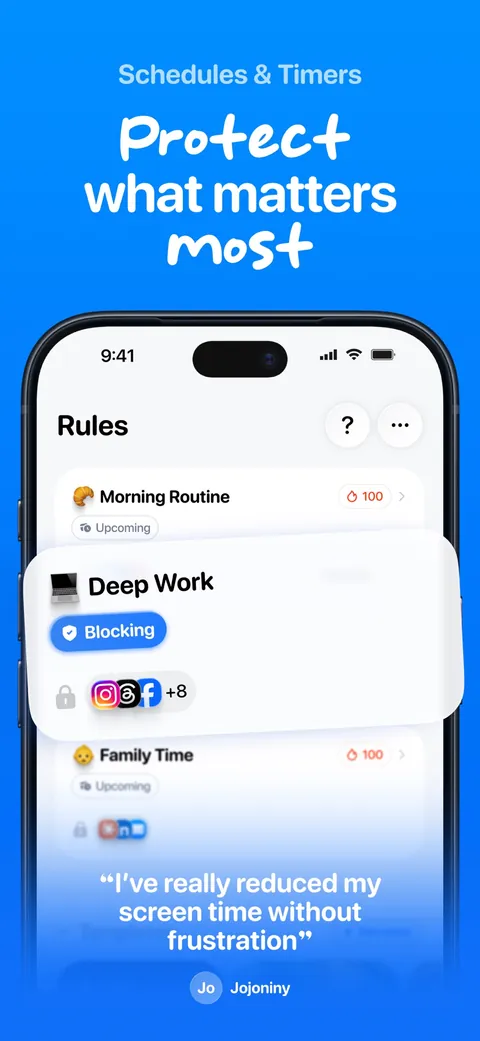
The Jomo app is a rulebook you write: "Block distracting apps your way: at set times, after a limit, or until you take action," says its website. That can be a one-hour Deep Work session, a cap by minutes or opens, or a routine that pays out screen time, like 15 minutes for proof of a daily run in its screenshots.
To get back in, Jomo can make you "prove you really want it": wait, give a reason, retype a painful text, enter a password or scan a QR code. Strict Mode "makes your rules unbreakable: you can't delete or bypass them," for a set time, during a block or always. It works through Apple's Screen Time API, blocks websites in any browser, and runs on iPhone, iPad and Mac.
Rules like these are commitment devices: a choice made now that makes giving in harder later. In a randomized experiment, letting people set limits on their future screen time substantially reduced their use, and the economists behind it estimate that self-control problems cause 31% of social media use [4].
Best for: people who like to set things up their way, on more than one device.
Watch out for: the free plan covers one session, one action or limit and one screen time budget. Strict Mode needs Jomo Plus: $29.99 a year after a 3-day free trial, $5.99 a month or $99.99 once ($14.99 a year for students, says its website). It has 4.8 stars from 2,562 US ratings.
Unpluq: best for a key you have to go and get
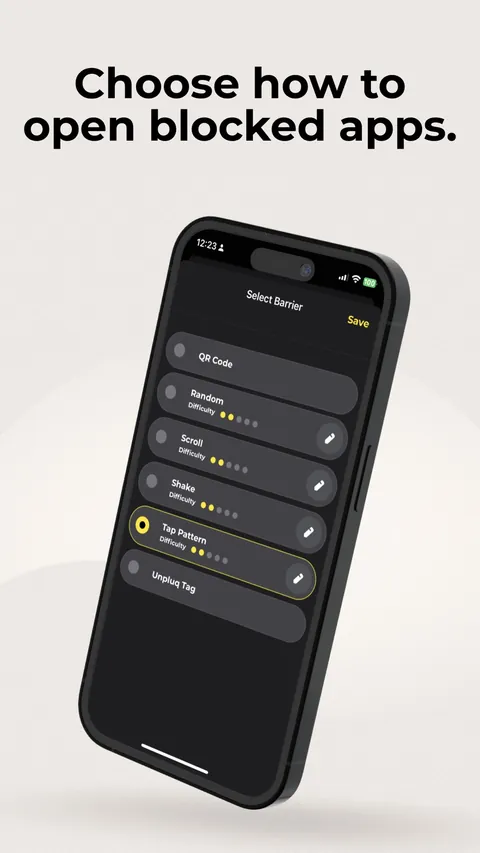
Unpluq blocks the apps you choose on a schedule, and opening one means passing a "distraction barrier": shake the phone, tap a pattern or scroll through blank space, at a difficulty you set, or scan a QR code. The signature one is the Unpluq Tag, a yellow NFC key for your keyring that you hold to your iPhone.
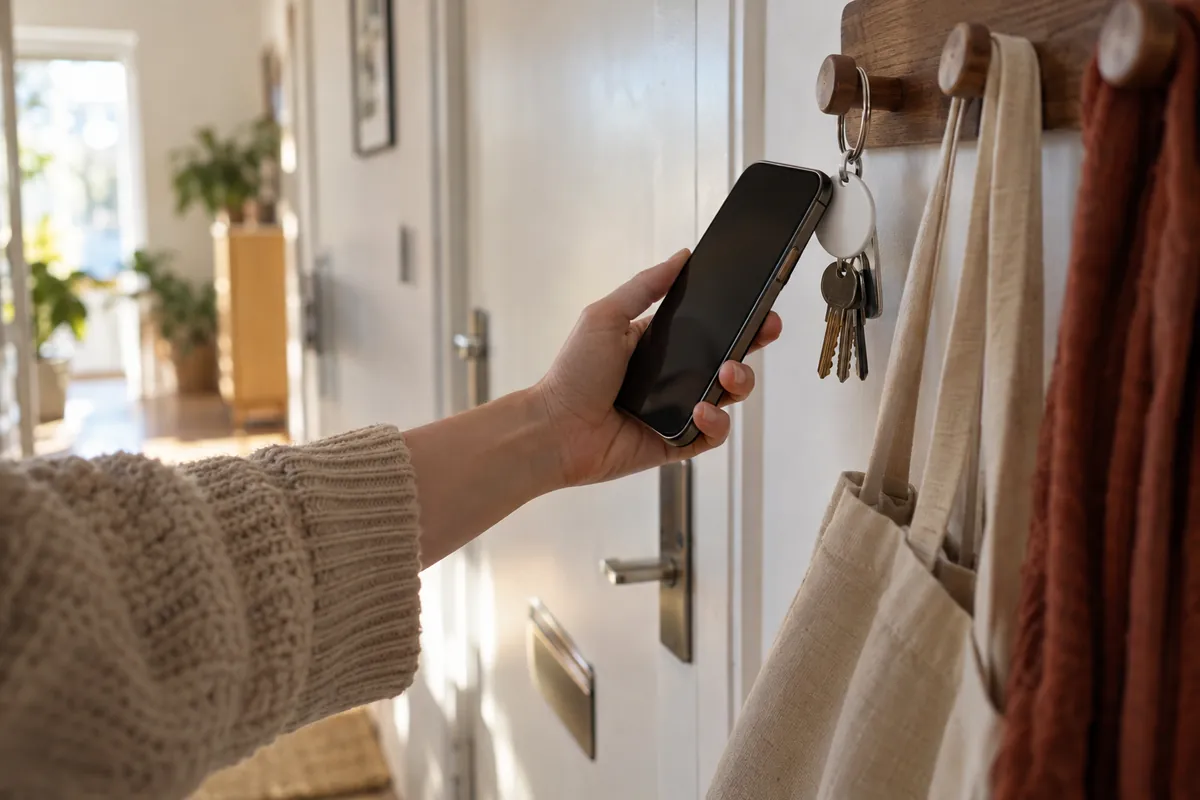
Its FAQ is frank about where the Tag works best: "in a place that requires you to get up to retrieve it." If you lose it, the app can switch you to another barrier.
What it costs: the free plan blocks two apps on one schedule, with the shake and tap barriers. Premium, which the Tag needs, is $59.99 a year or $6.99 a month in the App Store. On Unpluq's US site in November 2026, the Tag costs $26.50 alone, or comes with Premium: $29 for three months (the same as without it), $46 for six or $80 for twelve, with a 30-day money-back guarantee.
Best for: people who want a physical ritual between them and the feed.
Watch out for: a key on the keyring in your pocket is one tap away. Its privacy label says identifiers may be used to track you. It runs on iPhone (iOS 16 or later) and Android, with 4.8 stars from 931 US ratings. Stricter physical options are in our guide to phone lock boxes.
Flipd: still listed, not updated since February 2025
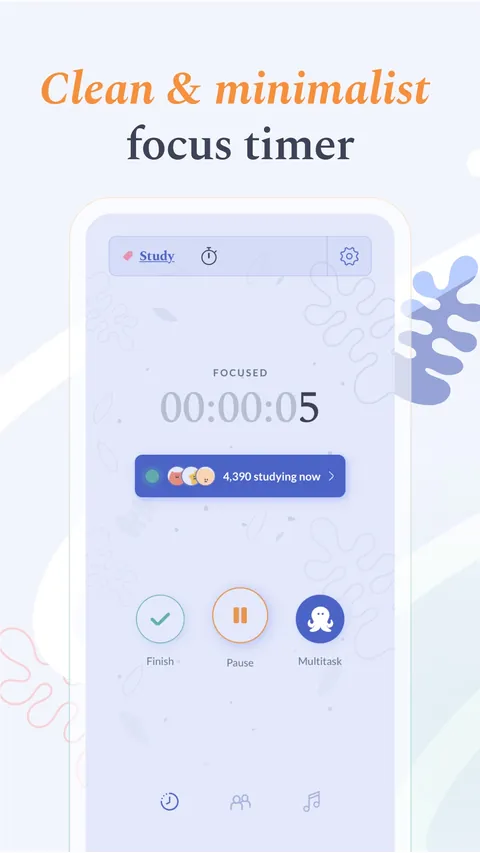
Flipd is a focus timer for studying, with tagged tasks, break tracking, live study rooms, stats and badges. Basic features are free; Premium is $44.99 a year or $5.99 a month, per its App Store description. It has 4.5 stars from 6,964 US ratings.
Two catches. Its last update, version 5.0.1, came on February 25, 2025, more than 20 months before we checked. And on iPhone it doesn't block apps: hiding apps "was previously a feature included in the Flipd iOS app," its website says, until Apple's developer policies required a separate app. That's Focus Lock, from the same team, which blocks chosen apps until a session ends. Updated on October 31, 2026, it has 4.3 stars from 295 US ratings and costs $9.99 a month or $49.99 a year after up to five free sessions.
A timer also leaves the phone on the desk, and whether that hurts focus is unsettled. A widely cited 2017 study found that the mere presence of people's own phone reduced their available cognitive capacity [5]. A preregistered replication in 2022 found no difference between a phone on the desk, in a pocket or bag, or outside the room [6], while a small 2023 experiment with 42 young adults found lower attention scores with a switched-off phone on the desk than outside the room [7]. Another room costs nothing.

Best for: students who like a visible timer and company, and don't need a block.
Watch out for: the missing updates. For a timer and a lock in one, a phone-free Focus session in Unrotten locks the apps you've chosen until it ends, with a countdown on your Lock Screen and in the Dynamic Island.
Where Unrotten fits
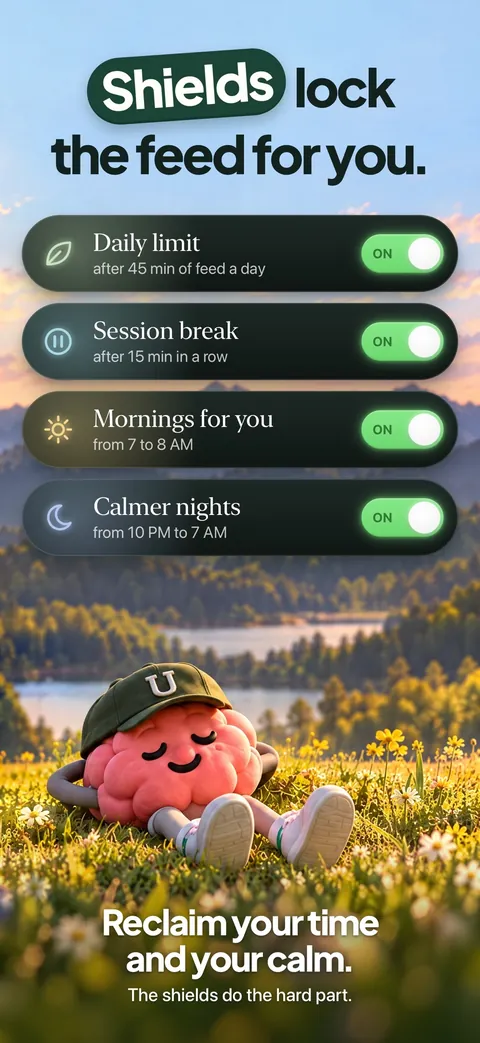
Unrotten ties its locks to goals and adds a coach. You choose your rot apps, the ones that eat your time, and turn on goals: Less scrolling sets a daily limit, Shorter scroll sessions a break after a session length you choose, and Fewer app returns a daily target for opens, the reflex Clearspace counts. Mornings for yourself and Calmer evenings protect a window each day. Apple's Screen Time shield then locks those apps, with no "ignore limit" button, until the limit resets or the window ends.
An AI Coach, drawn like iOS Messages, sends a morning message, checks in on the plans you share and nudges you when scrolling runs fast.
Compared with the four: Unrotten has no free tier. It's $49.99 a year or $9.99 a month, each after a 7-day free trial. It's an iPhone app (iOS 17 or later) with no Android version, and it's new, on the App Store since October 14, 2026. Turning a goal off, or removing Unrotten's Screen Time access, lifts that goal's shield: it's a commitment device, not a vault.
How to choose
Pick the tool for the moment you slip: at the door, in the rules, in your pocket or on the clock.
- You open apps before you've decided to: a pause, from Clearspace or one sec, which has published research behind it (our one sec review).
- You want your own rules, on an iPad or Mac too: Jomo.
- You want a physical ritual: Unpluq, with the Tag kept where you'd have to get up for it.
- You study in blocks: Flipd's timer, knowing its last update was in February 2025, or Focus Lock to block apps.
- You blow through your own limits, or want the habit to change: goals that lock and a coach, with Unrotten.
- Clearspace or Opal? Opal can be stricter: its listing says Deep Focus "won't let you cancel or bypass at all." It's $99.99 a year and needs iOS 18 (our Opal review).
Whatever you pick, free nudges stack with it. In a small randomized trial with 70 people, those who picked from ten strategies, such as silencing non-essential notifications and going grayscale, cut screen time and problematic use and slept better than a control group that only tracked its time [8].
So, is Clearspace worth paying for?
If your problem is the reflex, start free: two weeks of watching your open count will show whether the pause changes anything. Premium at $44.99 a year makes sense once you know you'll keep it on.
If you catch yourself doing push-ups at midnight to buy ten more minutes, the pause has become part of the ritual. Go firmer. Limits help while they hold: in a randomized trial with 111 students, those who capped their phone use at two hours a day for three weeks slept better and reported more well-being, less stress and fewer depressive symptoms than the control group, small to medium effects, and their screen time climbed back once the cap ended [9]. Choose a rule you'll keep, like a daily limit in Unrotten whose shield holds until the day resets.
If the scrolling comes with low mood, anxiety or sleep trouble that won't lift, a doctor or therapist can help.
Questions people ask
Is Clearspace free?
Clearspace is free to download, and Premium is sold in the app. On November 7, 2026, the US App Store listed Premium at $6.99 a month or $44.99 a year, with other Premium options up to $59.99. Clearspace's website doesn't publish its prices or what the free version includes, so check in the app before you pay.
How does Clearspace work?
You choose the apps that pull you in. When you open one, Clearspace shows a short pause with the opens you have left for the day, and you can close the app or earn minutes with a breathing exercise or push-ups. It also has time limits, schedules, friend challenges and accountability partners.
Clearspace vs Opal: what's the difference?
Clearspace slows you down with a pause and lets you earn time back with a breath or push-ups. Opal blocks apps on schedules and limits, and its App Store listing says Deep Focus won't let you cancel or bypass at all. In November 2026, Opal's yearly plan cost $99.99 and it needed iOS 18; Clearspace runs on iOS 16 or later.
How does the Unpluq Tag work?
The Unpluq Tag is a small NFC key for your keyring. During your blocking schedule, the apps you chose stay blocked until you hold the Tag to your iPhone or pass another barrier you've picked, such as shaking the phone. It only works with Unpluq Premium. On Unpluq's US site in November 2026, the Tag cost $26.50 alone or $29 with three months of Premium.
Is Flipd still available?
Yes, Flipd is still on the US App Store, but when we checked on November 7, 2026, its last update was version 5.0.1 from February 25, 2025. On iPhone it's a study timer that doesn't block apps: its website sends iPhone users who want to hide apps to Focus Lock, a separate app from the same team.
References
- Heitmayer M, Lahlou S. "Why are smartphones disruptive? An empirical study of smartphone use in real-life contexts." Computers in Human Behavior. 2021;116:106637. doi:10.1016/j.chb.2020.106637 ↩
- Grüning DJ, Riedel F, Lorenz-Spreen P. "Directing smartphone use through the self-nudge app one sec." Proceedings of the National Academy of Sciences. 2023;120(8):e2213114120. doi:10.1073/pnas.2213114120 ↩
- Haliburton L, Grüning DJ, Riedel F, Schmidt A, Terzimehić N. "A Longitudinal In-the-Wild Investigation of Design Frictions to Prevent Smartphone Overuse." Proceedings of the CHI Conference on Human Factors in Computing Systems. 2024:1-16. doi:10.1145/3613904.3642370 ↩
- Allcott H, Gentzkow M, Song L. "Digital Addiction." American Economic Review. 2022;112(7):2424-2463. doi:10.1257/aer.20210867 ↩
- Ward AF, Duke K, Gneezy A, Bos MW. "Brain Drain: The Mere Presence of One's Own Smartphone Reduces Available Cognitive Capacity." Journal of the Association for Consumer Research. 2017;2(2):140-154. doi:10.1086/691462 · Read our plain-English summary ↩
- Ruiz Pardo AC, Minda JP. "Reexamining the 'brain drain' effect: A replication of Ward et al. (2017)." Acta Psychologica. 2022;230:103717. doi:10.1016/j.actpsy.2022.103717 ↩
- Skowronek J, Seifert A, Lindberg S. "The mere presence of a smartphone reduces basal attentional performance." Scientific Reports. 2023;13(1):9363. doi:10.1038/s41598-023-36256-4 · Read our plain-English summary ↩
- Olson JA, Sandra DA, Chmoulevitch D, Raz A, Veissière SPL. "A Nudge-Based Intervention to Reduce Problematic Smartphone Use: Randomised Controlled Trial." International Journal of Mental Health and Addiction. 2023;21(6):3842-3864. doi:10.1007/s11469-022-00826-w · Read our plain-English summary ↩
- Pieh C, Humer E, Hoenigl A, Schwab J, Mayerhofer D, Dale R, Haider K. "Smartphone screen time reduction improves mental health: a randomized controlled trial." BMC Medicine. 2025;23(1):107. doi:10.1186/s12916-025-03944-z · Read our plain-English summary ↩
Written by
Maren AshbyCOO, Unrotten
Maren Ashby is the COO of Unrotten, the iPhone app that helps people take their attention back from the feed. She writes about the research on phones, sleep and focus, and about the small, practical changes that make a phone easier to put down.