

Blog/Comparison
Forest App Review: Does Growing a Tree Keep You Off Your Phone?
How Forest's focus timer, Deep Focus and Time Guard work, what's free, what Forest Plus adds, and what the research says about the tree.


In this article
Forest turns not using your phone into something you can see. Start a session and a small tree begins to grow; leave for another app and it withers. Twelve years after it launched, it's still one of the best-loved focus apps on the iPhone, rated 4.8 stars by nearly 50,000 people in the US. The real question is which part of your day a tree can protect.
Disclosure: Unrotten, one of the alternatives below, is made by the team behind this blog. We checked Forest on October 29, 2026, against its US App Store listing and its official website, and every other app against its own listing and site the same day. We didn't lab-test anything: every price, rating and feature here comes from those pages.
Forest at a glance
- What it is: a focus timer with app blocking, by Seekrtech, an independent studio in Taiwan, on the App Store since May 2014. It's also on Android and comes as a Chrome and Firefox extension.
- Price: free; Forest Plus is an optional subscription, listed on the US App Store at $5.99 a month or $32.49 to $35.99 a year.
- Needs: iOS 16 or later.
- Rating: 4.8 stars from about 49,600 US App Store ratings.
- Best for: protected blocks of focus for work, study or time with people.
- Watch out for: it guards the sessions you start and the windows you schedule, not the rest of your day.
How Forest works
Plant a tree, then leave the phone alone
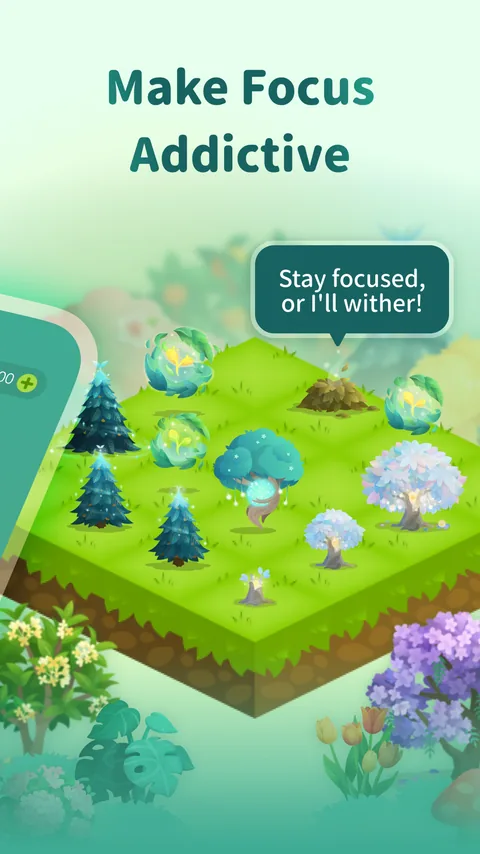
You choose a length and a tree species, and the tree grows in real time while you stay out of your other apps. Finish, and it joins your forest for good. Give up, and a dead tree joins it instead, which Forest calls "an honest record of the journey, not a verdict." The timer counts down, Pomodoro style, or up like a stopwatch, and over the weeks your forest becomes a picture of your focused time. Forest Plus adds detailed analytics and custom tags.
Deep Focus: the block inside a session
With Deep Focus on, Forest blocks every app that isn't on your allow list for the length of the session. Try to switch and, in Forest's words, it "pulls you back": the only way out is to tap Give Up and let the tree die, and Deep Focus can't be switched off mid-session. Free users can't pause a session at all; Plus allows pauses of up to five minutes without losing the tree, and lets you turn pauses off if you'd rather stay strict. Building your own allow list is a Plus feature too.
Forest doesn't make leaving impossible. It makes leaving cost something you can see.
Time Guard: phone-free windows on a schedule
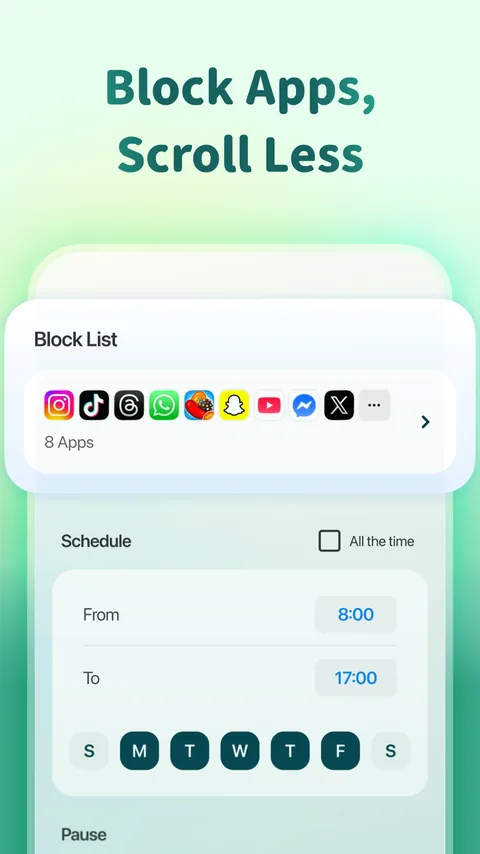
Sessions protect the time you remember to protect. Time Guard covers the rest: you choose apps and windows, such as no social media from 9 to 5 or no feeds before bed, and Forest blocks them on schedule, with no tree involved. The free plan guards one app or site; Plus guards several.
Plant Together, Mindful Space and real trees
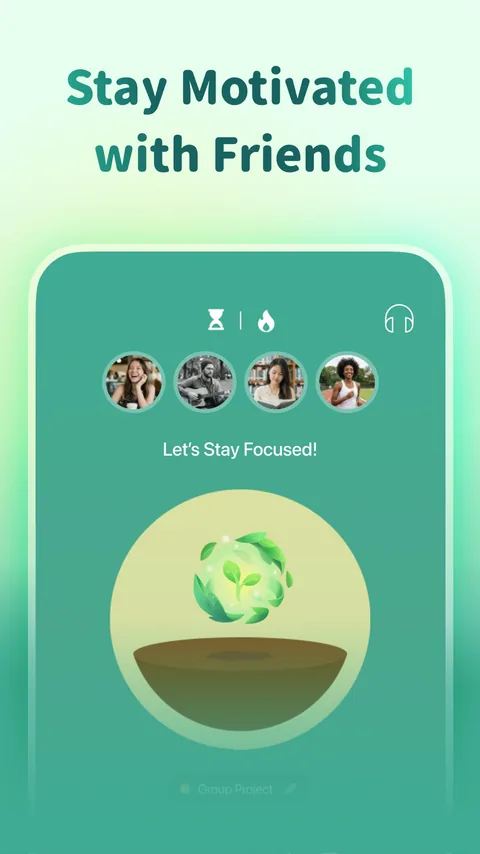
Plant Together syncs a session with friends, on iPhone or Android: everyone grows the same tree, and if anyone gives up, it dies for all of them. Mindful Space offers breathing exercises and soundscapes for your breaks. And Forest funds real trees through the nonprofit Trees for the Future, paying from its own revenue; its website counted 2,102,946 planted on October 29, 2026. Spending your coins on a real tree in the app is a Plus feature, up to five per account.
Is Forest free? What it costs
Yes. Forest's website says you can download and use it "for free with no payment required and no time limit." On October 29, 2026:
- Free: the focus timer, Deep Focus app blocking, Time Guard for one app or site, Mindful Space with one soundscape, Plant Together, focus tracking and the classic trees. Forest says the free tier shows occasional ads, never during an active session.
- Forest Plus: a custom allow list, Time Guard for several apps or sites, pauses, detailed analytics and custom tags, all soundscapes, exclusive and seasonal trees, three times the coins, real trees and no ads. Forest says the price varies by region and platform; the US App Store listed Monthly (Early Bird) at $5.99 and Annual (Early Bird) at $32.49 and $35.99, and you can start a free trial in the app.
- The game's currency: crystals and "sunshine elixir," sold separately from $0.99 to $21.99.
Forest Pro, a one-time purchase from earlier years, is no longer sold to new users; people who bought it keep it.
Does a growing tree actually work?
We found no published trial of Forest itself. The ideas inside it have been tested, though mostly on other habits.
Games move behavior, a little. A meta-analysis of 16 randomized trials with 2,407 participants found that gamified programs raised physical activity with a small to medium effect, more than both waiting lists and comparable programs without the game. About 14 weeks after the programs ended, the effect was smaller but still there [1].
Losing something weighs more than winning it. In a trial with 281 employees aiming for 7,000 steps a day, people who were given $42 at the start of each month and lost $1.40 for every missed day met their goal on 45% of days, against 30% in a control group. The same $1.40 paid out as a daily reward did no better than control, and once the money stopped, the incentive groups fell back to the control group's level [2]. Forest's withering tree is a loss frame without the money; whether a virtual tree carries the same weight hasn't been tested.
A fixed rhythm beats winging it. In a study of 87 university students over one day of real self-study, those who took breaks whenever they felt like it studied and rested longer, and felt more tired and distracted, less concentrated and less motivated, than students on a fixed schedule: 24 minutes on and 6 off, the Pomodoro rhythm, or 12 on and 3 off. All three groups got the same amount done [3]. It's one small study, but it suits Forest's countdown.

The phone on the desk still costs something. In a German experiment, 42 young adults took an attention test either with their phone switched off and face down on the desk, or switched off outside the room. The group with the phone beside them scored lower, a sizable effect in one small experiment [4]. A famous earlier study of this kind failed to replicate, so treat it as a hint rather than a law, but the fix is free: a Forest session keeps growing wherever your phone is, so plant the tree, then put the phone in another room.
A buzz breaks focus even if you ignore it. In a lab experiment, notifications alone disrupted performance on a demanding task even when people didn't touch their phones, about as much as actually using one [5]. Pair your sessions with an iPhone Focus mode, so the buzz doesn't reach you either.
Company is better without the phones. When more than 300 people shared a restaurant meal with friends or family, those told to keep their phones on the table felt more distracted and enjoyed the meal less than those told to put them away [6]. A Plant Together session is an easy way to agree on that at the table, since everyone's tree dies if anyone picks up their phone.
Where Forest may not suit you
- If your scrolling happens between sessions. Forest protects the sessions you start and the windows you schedule. Free Time Guard covers one app or site, so an unplanned 1 a.m. scroll on another app is outside its reach.
- If you need a lock, not a nudge. Give Up is always one tap away. That's the design: the tree makes quitting visible, not impossible.
- If ads or tracking bother you. The free tier shows occasional ads, and Forest's App Store privacy label lists contact info and usage data among the data that may be used to track you across other companies' apps and websites.
- If in-app purchases tempt you. The game's crystals and elixirs are sold separately from Plus.
Forest vs the alternatives
| App | Price (US) | How it blocks | Free version | App Store rating (US) |
|---|---|---|---|---|
| Forest | Free; Forest Plus listed at $5.99/mo or $32.49 to $35.99/yr | A focus timer that grows a tree; app blocking in sessions (Deep Focus) and on a schedule (Time Guard) | Yes | 4.8 (49,600 ratings) |
| Unrotten | $69.99/yr after a 7-day free trial, or $14.99/mo | Screen Time shields tied to goals, phone-free sessions and an AI Coach | No (7-day free trial) | New (October 2026) |
| Opal | Free plan; Pro $99.99/yr, $19.99/mo or $399 once | Screen Time rules on schedules, time limits and open limits; focus timers; hardcore sessions can't be ended early (Pro) | Yes (1 rule) | 4.7 (90,500 ratings) |
| ScreenZen | Free; optional tips | A wait before apps open, daily goals, strict blocks, locked settings | Yes, all features | 4.9 (52,700 ratings) |
| Brick | $59 once for the device; free app | Tap your phone on the Brick to start and end a block | No (needs the device) | 4.9 (58,900 ratings) |
Checked October 29, 2026, on the US App Store and the makers' own websites.
Unrotten: best if you want the whole day covered, not just the session
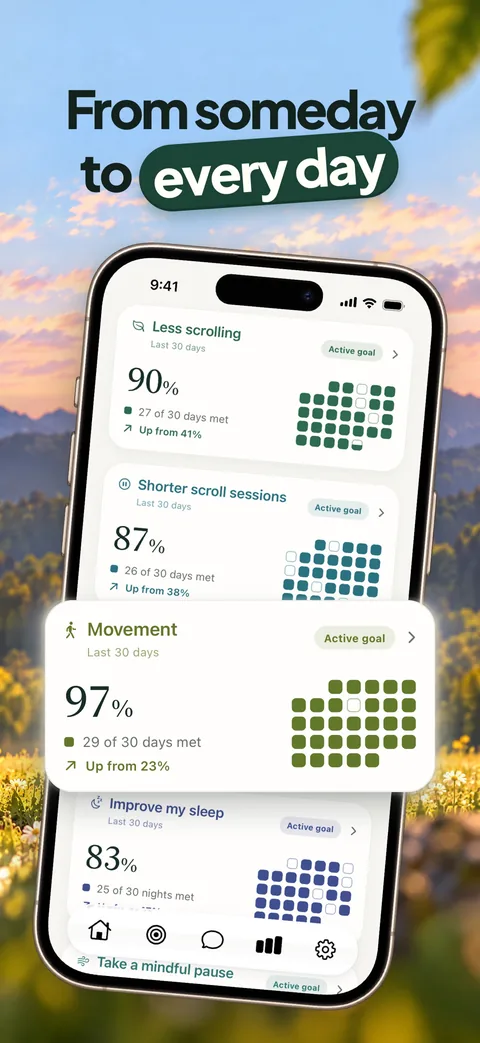
Unrotten has its own version of Forest's session. From Home's + button, a Work, Focus or Reading session locks the apps you've chosen until it ends, with a countdown on your Lock Screen and in the Dynamic Island, and a soft alarm or a gentle vibration when it's over.
The difference is what happens outside the session. Goals keep running all day: a daily limit for the apps that eat your time, a break once a scroll session runs long, a protected window in the morning or the evening. Every met day builds a streak, with milestones at 7, 14, 30, 60, 90, 180 and 365 days, and the MindBattery, a score from 0 to 100, shows what the scrolling cost and what time away gave back.
Compared with Forest: Unrotten has no free tier: it's $69.99 a year after a 7-day free trial, or $14.99 a month. It's an iPhone app (iOS 17 or later) with no Android version or browser extension, it's new, on the App Store since October 14, 2026, and it grows no trees, real or virtual. Turning a goal off lifts that goal's shield.
Opal: best for strict schedules
Opal has focus timers too, plus rules on schedules, time limits and open limits, and its hardcore difficulty, part of Opal Pro, won't let you end a session early. Read our full Opal review.
ScreenZen: best free blocker
ScreenZen is free, makes you wait before a chosen app opens and can lock its own settings so your rules hold. Read our ScreenZen review.
Brick: best for physical distance
Brick blocks your apps when you tap your phone on a $59 device, and only another tap brings them back, so leaving it in another room turns willpower into a walk. Read our Brick review.
Should you plant a Forest?
Forest is free to start, kind in tone, and genuinely motivating for the hours you set aside. Use it for the two or three blocks of your day that matter most, set Time Guard on your worst app for the evening, and once the tree is planted, put the phone in another room.
If the trouble lives in the unplanned hours, the scroll you never meant to start, Forest won't follow you there. That's what a daily limit and an evening window in Unrotten are for.
Questions people ask
Is the Forest app free?
Yes. On October 29, 2026, Forest's website said you can download and use it for free with no time limit, including the focus timer, Deep Focus app blocking, Time Guard for one app or site, Plant Together and Mindful Space with one soundscape. The free tier shows occasional ads, which Forest says never appear during a focus session. Forest Plus is optional.
How much does Forest Plus cost?
Forest says Plus pricing varies by region and platform. On October 29, 2026, the US App Store listed Monthly (Early Bird) at $5.99 and Annual (Early Bird) at $32.49 and $35.99. You can start a free Plus trial from inside the app.
Does Forest block apps on iPhone?
Yes. With Deep Focus on, Forest blocks every app that isn't on your allow list during a focus session, and the only way out is to tap Give Up, which kills your tree. Time Guard blocks apps on a schedule outside sessions. A custom allow list, and Time Guard for more than one app or site, need Forest Plus.
Does Forest plant real trees?
Yes. Forest partners with the nonprofit Trees for the Future and pays for the planting from its revenue; its website counted more than 2.1 million real trees on October 29, 2026. In the app, planting real trees with the coins you earn is a Forest Plus feature, up to five per account.
Is the Forest app worth it?
For protected blocks of work, study or time with people, Forest is a gentle, well-loved commitment, and it costs nothing to start. If most of your scrolling happens outside the sessions you remember to start, you'll also want daily limits or protected windows that run on their own.
References
- Mazeas A, Duclos M, Pereira B, Chalabaev A. "Evaluating the Effectiveness of Gamification on Physical Activity: Systematic Review and Meta-analysis of Randomized Controlled Trials." Journal of Medical Internet Research. 2022;24(1):e26779. doi:10.2196/26779 ↩
- Patel MS, Asch DA, Rosin R, Small DS, Bellamy SL, Heuer J, et al. "Framing Financial Incentives to Increase Physical Activity Among Overweight and Obese Adults: A Randomized, Controlled Trial." Annals of Internal Medicine. 2016;164(6):385-394. doi:10.7326/M15-1635 ↩
- Biwer F, Wiradhany W, oude Egbrink MGA, de Bruin ABH. "Understanding effort regulation: Comparing 'Pomodoro' breaks and self-regulated breaks." British Journal of Educational Psychology. 2023;93(Suppl 2):353-367. doi:10.1111/bjep.12593 ↩
- Skowronek J, Seifert A, Lindberg S. "The mere presence of a smartphone reduces basal attentional performance." Scientific Reports. 2023;13(1):9363. doi:10.1038/s41598-023-36256-4 ↩
- Stothart C, Mitchum A, Yehnert C. "The attentional cost of receiving a cell phone notification." Journal of Experimental Psychology: Human Perception and Performance. 2015;41(4):893-897. doi:10.1037/xhp0000100 ↩
- Dwyer RJ, Kushlev K, Dunn EW. "Smartphone use undermines enjoyment of face-to-face social interactions." Journal of Experimental Social Psychology. 2018;78:233-239. doi:10.1016/j.jesp.2017.10.007 ↩
Written by
Maren AshbyCOO, Unrotten
Maren Ashby is the COO of Unrotten, the iPhone app that helps people take their attention back from the feed. She writes about the research on phones, sleep and focus, and about the small, practical changes that make a phone easier to put down.