

Blog/Comparison
BePresent App Review: Can a Game Cut Your Screen Time?
How BePresent's streaks, money stakes, leaderboards and rewards work, what it costs, and what the research says about each of them.


In this article
BePresent turns cutting your screen time into a game. You set a daily goal and keep a streak alive, block apps in sessions with friends, climb a weekly leaderboard and earn points toward real rewards, and if you want the stakes higher, you can put money on it. Whether a game can do what willpower couldn't depends mostly on you: how much a streak matters to you, and who's on your leaderboard.
Disclosure: Unrotten, one of the alternatives below, is made by the team behind this blog. We checked BePresent on October 28, 2026, against its US App Store listing and its official website, and the alternatives against their App Store listings the same day, with Opal's and Brick's prices from their own websites. We didn't lab-test anything: every price, rating and feature here comes from those pages.
BePresent at a glance
- What it is: a screen time app for iPhone and Android by Screen Detox Inc., on the App Store since 2022.
- Price: free to download; paid plans from $3.99 a month to $59.99 a year, plus a $99.99 family plan.
- Needs: iOS 16 or later.
- Rating: 4.8 stars from about 70,000 US App Store ratings.
- Best for: people who stay on track when there's a score, a streak or a friend to beat.
- Watch out for: the App Store lists ten plans; check the price you're shown before a trial ends.
How BePresent works
On iPhone, BePresent works through Apple's Screen Time API, like most blockers, and builds five kinds of motivation on top of it.
A daily goal and a streak
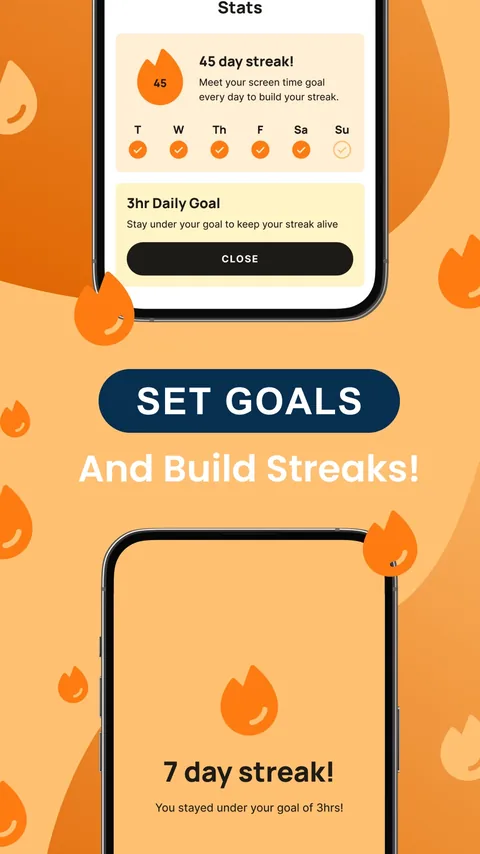
You choose a daily screen time limit, and every day you stay under it extends your streak. Hourly reminders can tell you how long you've been scrolling, and daily and weekly reports, plus a review of the day before, show where the time went.
Blocking sessions, with friends or in BEAST MODE
Present Sessions block your chosen apps for a stretch: a study block, a night out. Group Sessions let friends block together and cheer each other on inside the app, and schedules can start sessions on their own. BEAST MODE is the strict version. As one of its App Store screenshots puts it, "You won't be able to end your blocking session early in Beast Mode."
Leaderboards and tiers
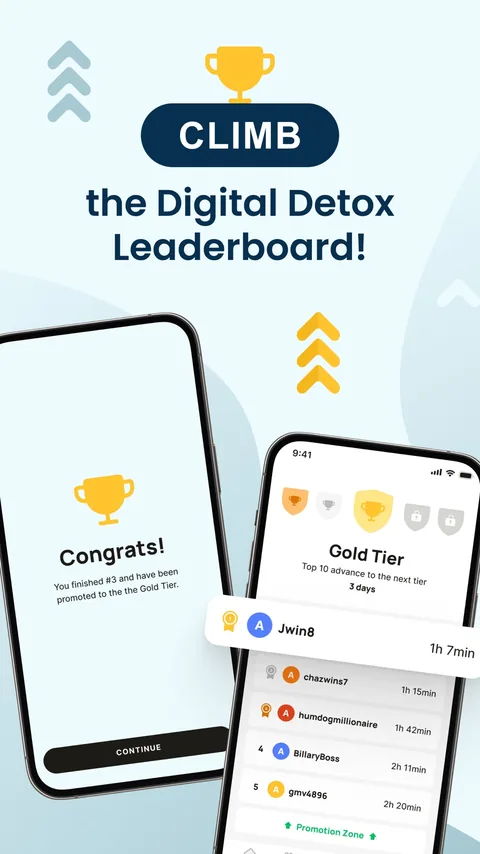
Weekly leaderboards rank you against other people by screen time, and doing well moves you up through tiers. You can also challenge friends directly.
Points, rewards and money on the line
Staying off your phone earns points you can redeem for real-life rewards. The listing names a Headspace subscription, free workout classes with ClassPass and discounted therapy sessions with BetterHelp, and notes that the rewards are sponsored by BePresent and its partners.
Then there's the stake. You can back your daily goal with money, and in the listing's words, "overshoot, and that stake's gone."
What BePresent costs
BePresent is free to download. On October 28, 2026, its US App Store listing showed ten in-app purchases:
- Yearly plans at $24.99, $29.99 and $59.99.
- Monthly plans at $3.99 and $14.99.
- BePresent Pro Family at $99.99, and the app supports Apple's Family Sharing.
- Free trials from 3 days to 30 days, depending on the plan.
The listing doesn't say which plan a given person is offered, and the listing and home page we checked don't spell out what stays free without a plan. Read the price on the screen before you start a trial, and set a reminder for the day before it ends.
Does gamifying screen time work?
We found no published trial of BePresent itself, but each of its main ideas has been tested elsewhere.
Competition beat support and teamwork. In a 24-week trial, 602 American adults with overweight or obesity tracked their steps in a game with points and levels. Every version beat a control group, and the one where people competed did best: about 920 more steps a day, against roughly 690 when people supported each other and 640 when they collaborated. Three months after the game ended, only the competition group was still significantly more active than the controls [1]. That was walking, not scrolling, but it's a clean test of BePresent's central bet.
Money on the line is powerful, if you'll take it. A large trial of incentives to quit smoking offered some people rewards and others a deal that started with a $150 deposit of their own. Only 13.7% accepted the deposit deal, against 90% for rewards, so the rewards helped more people overall. But among people willing to accept either deal, the deposit worked better: six months on, their quit rate was about 13 percentage points higher [2].
A money stake is strong medicine that most people won't take.
Rewards can leave a habit behind. In a randomized economics experiment, people given a temporary incentive to cut their social media use kept using it less after the incentive ended, which the authors read as evidence that social media use is habit forming [3]. If points and prizes get you through the first weeks, the lower use may outlast them.
A daily cap works without quitting. When 143 University of Pennsylvania students kept Facebook, Instagram and Snapchat to 10 minutes each a day for three weeks, their loneliness and depression fell compared with students who carried on as usual. Anxiety and fear of missing out fell in both groups, which the authors partly credit to simply tracking their use [4].

Measured beats guessed. A meta-analysis pooling 106 results found that people's own estimates of their media use match the logs of their actual use only moderately, and rarely accurately [5]. A goal checked against Screen Time's numbers starts from the truth, not from a hopeful guess. Our page on average screen time shows how your number compares.
Where BePresent may not suit you
- If you don't want to compete. Leaderboards, tiers, groups and challenges are the heart of the app. If a ranking stresses you out, or no friend will play, you'd be paying for the parts you'd skip.
- If you'd rather not put money down. The stake is optional, and the smoking trial suggests most people skip that kind of deal, yet it's one of the strongest levers on offer.
- If you want one clear price. Ten plans from $3.99 to $99.99 make it hard to know what you'll pay until the paywall appears.
BePresent vs the alternatives
| App | Price (US) | How it blocks | Free version | App Store rating (US) |
|---|---|---|---|---|
| BePresent | Plans from $3.99/mo to $59.99/yr; family $99.99 | Screen Time sessions, a daily goal and streak, leaderboards; optional money stake | Free download; free tier not stated | 4.8 (70K ratings) |
| Unrotten | $69.99/yr after a 7-day free trial, or $14.99/mo | Screen Time shields tied to goals, with an AI Coach | No (7-day free trial) | New (October 2026) |
| Opal | Free plan; Pro $99.99/yr, $19.99/mo or $399 once | Screen Time blocks, limits and schedules; a leaderboard; Deep Focus can't be cancelled | Yes (1 rule) | 4.7 (90K ratings) |
| ScreenZen | Free; optional tips | A wait before apps open, app goals, strict blocks, streaks | Yes (tips only) | 4.9 (53K ratings) |
| Brick | $59 once for the device; free app | Tap your phone on the Brick to start and end a block | No (needs the device) | 4.9 (59K ratings) |
Checked October 28, 2026, on the US App Store and the makers' own websites.
Unrotten: best if you'd rather have a coach than a leaderboard
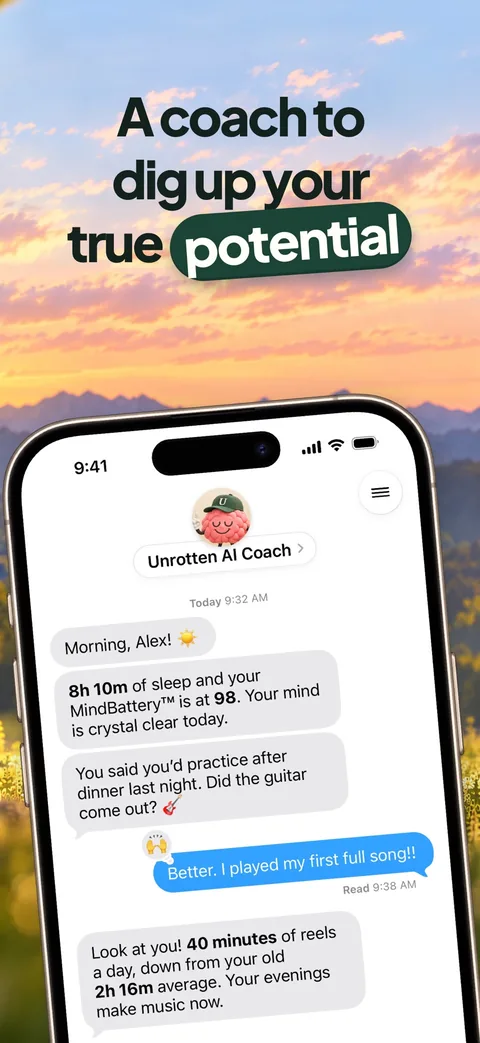
Unrotten swaps the scoreboard for a coach. Its AI Coach, drawn like iOS Messages, knows your goals and your day (never the names of your apps), sends a morning message, checks in on the plans you share and nudges you when the scrolling runs fast. You pick the Wise Coach, the Stoic Coach or the Drill Sergeant, who can be set to Standard, Hard or Savage.
Streaks are there too: every goal you meet adds to one, with milestones at 7, 14, 30, 60, 90, 180 and 365 days. And the limits hold. Less scrolling gives your rot apps a daily limit, after which Apple's Screen Time shield locks them until the day resets, with no "ignore limit" button.
Watch out for: there's no free tier, only a 7-day free trial on the yearly plan, and no leaderboards or money stakes. It's new, on the App Store since October 14, 2026. And it's a commitment device, not a vault: turning a goal off, or removing its Screen Time access, lifts that goal's shield.
Opal: best for a leaderboard plus strict blocking
Opal has a leaderboard to challenge friends and milestones you can share, on top of strict blocking: its listing says Deep Focus "won't let you cancel or bypass at all." The free plan includes one rule; Pro costs $99.99 a year, $19.99 a month or $399 once. It needs iOS 18 and also runs on Android and Mac. Our guide to Opal alternatives compares it in depth.
ScreenZen: best free option
ScreenZen is free, supported by optional tips. It makes you wait before a distracting app opens, and the wait can grow each time you open it. It adds app goals that can block when you reach them, strict blocks by time or number of opens, locks on its own settings and, yes, streaks. It runs on iOS 16.4 or later.
Brick: best if the problem is willpower in the moment
Brick moves the off switch out of your phone: tap your phone on a $59 device to block your apps, and tap it again to get them back. Leave it in another room and the game becomes a walk. Read our full Brick review.
Is BePresent worth it?
BePresent is worth a trial if a streak, a ranking or a friend to beat genuinely moves you, and the research on competition says that's true of many people. To give it a fair test, set your goal a little below your real average from Screen Time, start one group session with a friend, and leave the money stake until you've kept a streak for a week.
If what you want is less a game than a reason to stop, and limits that hold on a tired evening, Unrotten's Coach and shields are built for that instead.
Questions people ask
What is the BePresent app?
BePresent is an iPhone and Android app that turns cutting screen time into a game: a daily screen time goal with a streak, blocking sessions alone or with friends, weekly leaderboards, points you can redeem for rewards from partners such as Headspace and ClassPass, and an optional money stake on your goal. On iPhone it works through Apple's Screen Time API.
How much does BePresent cost?
It's free to download, with paid plans. On October 28, 2026, its US App Store listing showed yearly plans at $24.99, $29.99 and $59.99, monthly plans at $3.99 and $14.99, and a Pro Family plan at $99.99, several with free trials of 3 to 30 days. Check the price the app shows you before a trial ends.
What is BEAST MODE in BePresent?
BePresent's strictest blocking session. Its App Store screenshots sum it up as no ignoring limits: once it starts, you can't end the blocking session early.
Is BePresent worth it?
If a streak, a ranking or a friend to beat keeps you going, BePresent is built around exactly that, and research on competition backs the idea. If competing leaves you cold, or you want a coach and a firm daily limit, another app may suit you better.
What are the best BePresent alternatives?
For a coach and limits tied to your goals, Unrotten. For a leaderboard plus strict blocking with a free plan, Opal. For a free app with a wait before apps open, ScreenZen. For a physical lock, Brick.
References
- Patel MS, Small DS, Harrison JD, et al. "Effectiveness of Behaviorally Designed Gamification Interventions With Social Incentives for Increasing Physical Activity Among Overweight and Obese Adults Across the United States: The STEP UP Randomized Clinical Trial." JAMA Internal Medicine. 2019;179(12):1624-1632. doi:10.1001/jamainternmed.2019.3505 ↩
- Halpern SD, French B, Small DS, et al. "Randomized Trial of Four Financial-Incentive Programs for Smoking Cessation." New England Journal of Medicine. 2015;372(22):2108-2117. doi:10.1056/NEJMoa1414293 ↩
- Allcott H, Gentzkow M, Song L. "Digital Addiction." American Economic Review. 2022;112(7):2424-2463. doi:10.1257/aer.20210867 ↩
- Hunt MG, Marx R, Lipson C, Young J. "No More FOMO: Limiting Social Media Decreases Loneliness and Depression." Journal of Social and Clinical Psychology. 2018;37(10):751-768. doi:10.1521/jscp.2018.37.10.751 ↩
- Parry DA, Davidson BI, Sewall CJR, Fisher JT, Mieczkowski H, Quintana DS. "A systematic review and meta-analysis of discrepancies between logged and self-reported digital media use." Nature Human Behaviour. 2021;5(11):1535-1547. doi:10.1038/s41562-021-01117-5 ↩
Written by
Maren AshbyCOO, Unrotten
Maren Ashby is the COO of Unrotten, the iPhone app that helps people take their attention back from the feed. She writes about the research on phones, sleep and focus, and about the small, practical changes that make a phone easier to put down.