Blog/App blockers & screen time apps/Comparison
Unrot App Review: Does Earning Your Screen Time Work?
How Unrot's coins, habits and buddy work, what it costs, what research says about earning your scroll, and how it differs from Unrotten.

In this article
Unrot's deal fits on a sticky note: do something real first, then scroll. A walk, an hour of study or the dishes earn coins, and coins unlock TikTok, Instagram or whatever else you chose to lock. Its name is close to ours, but it's a different app from a different company, so here is how it works, what it costs and what the research says about earning your feed.
Disclosure: Unrotten, which we compare with Unrot below, is made by the team behind this blog. We checked Unrot, Pushscroll, Unglue and Clearspace on November 8, 2026, against their US App Store listings and their websites. We didn't lab-test anything: every price, rating and feature here comes from those pages.
Unrot and four alternatives side by side
| App | Price (US) | How it works | Free version | App Store rating (US) |
|---|---|---|---|---|
| Unrot | Subscription required; Full Access listed from $8.99 to $69.99 | Habits, timed or photographed, earn coins; coins buy minutes in your locked apps | No | 4.7 (57,047 ratings) |
| Pushscroll | Subscription required; $14.99/mo, yearly plans listed from $24.99 to $59.99 | Exercise counted with pose detection earns minutes: one push-up, one minute | No | 4.7 (18,017 ratings) |
| Unglue | Subscription required; Unglue Plus listed from $4.99 to $69.99 | Healthy habits, from studying to touching grass, earn screen time | No | 4.7 (2,678 ratings) |
| Clearspace | Free; Premium $6.99/mo or $44.99/yr | A pause with your opens left; push-ups or a breath earn more minutes | Yes (free features not listed) | 4.7 (8,966 ratings) |
| Unrotten | $49.99/yr or $9.99/mo, each after a 7-day free trial | Screen Time shields tied to goals, an AI Coach and the MindBattery™ | No (7-day free trial) | New (October 2026) |
Checked November 8, 2026, on the US App Store and each maker's website.
Unrot at a glance
- What it is: an iPhone app by Unrot OÜ that makes you earn your screen time, on the App Store since June 2025.
- Price: free to download, but its features need a subscription; the App Store lists Full Access from $8.99 to $69.99 (more below).
- Needs: iOS 18 or later, on iPhone.
- Rating: 4.7 stars from 57,047 US ratings.
- Best for: people who keep putting off the walk, the dishes or the studying, and reach for the feed instead.
- Watch out for: prices you only see in the app, and an honor system: its listing doesn't say how a timer or a photo is checked.
How Unrot works
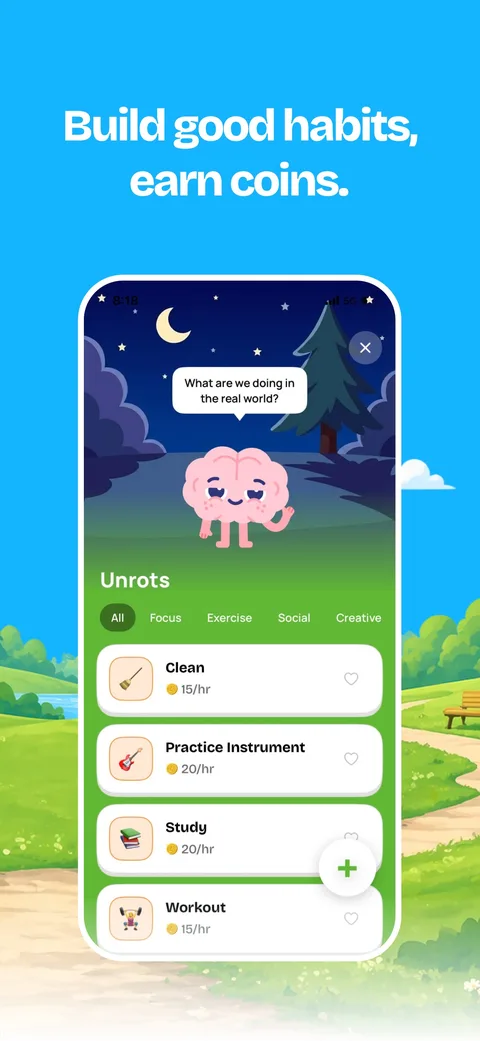
You choose the apps to lock and the habits that pay. Unrot's website gives a short walk, reading, homework and meditating as examples, and says you can "choose from our database of 25+ tasks or create your own." Its App Store description sums up the rest in four steps:
- Pick a habit.
- Start a timer, or snap a photo when you're done.
- Earn coins.
- Use coins to open your apps.
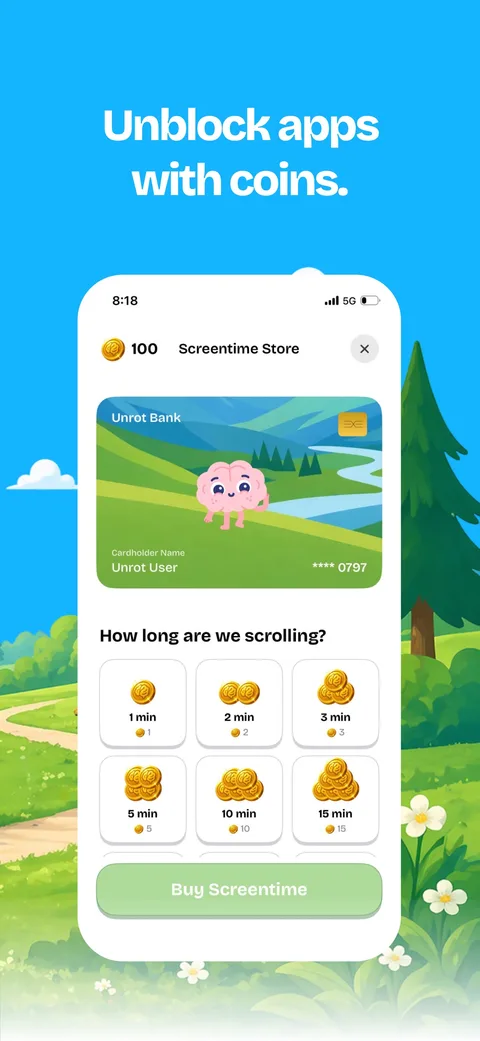
"No coins? The apps stay locked," the description says. The screenshots on its listing show the exchange rate. Clean and Workout pay 15 coins an hour, Study and Practice Instrument 20, and in the Screentime Store a coin buys a minute: 1 minute for 1 coin, 15 minutes for 15. At those rates, an hour of cleaning buys a quarter of an hour of feed.
The rest is encouragement. A buddy, "a cute little guy that lives in the app," grows when you do things and "loses energy when you scroll too much," and there are streaks and focus sessions. Unrot pitches itself as a trade rather than a block: "Other apps say 'stop.' But stopping isn't the whole point."
What Unrot costs
Unrot is free to download, and "an active Unrot subscription is required to access the features," says its App Store description. On November 8, 2026, the US App Store listed ten in-app purchases, nearly all called Full Access, at prices from $8.99 to $69.99, without saying which is weekly, monthly or yearly. Unrot's website publishes no prices. The paywall shows the real price, so read it before you choose a plan, along with whether a free trial comes with it.
Does earning your screen time work?
We found no published study of Unrot itself. The ideas behind it have been studied, though, one piece at a time.
Pairing a want with a should can work, for a while. In a field experiment, people who could listen to tempting audiobooks only while at the gym went to the gym 51% more often at first than a control group, and people who were merely encouraged to save the books for the gym went 29% more often [1]. The effect faded over the weeks, especially after the Thanksgiving break, yet 61% of participants later chose to pay for gym-only access to the books [1]. Unrot changes the order, with the feed after the habit rather than during it, but the bet is the same: let the thing you want pull you through the thing you should do.
Moving more and scrolling less help each other. In a German experiment, 503 adults spent two weeks cutting their phone use by an hour a day, adding 30 minutes of physical activity a day, or both, alongside a control group [2]. All three changes made people more active and eased symptoms of problem phone use, depression and anxiety. The effects held up better over time in the groups that cut their phone use than in the group that only added exercise [2].

Rewards can crowd out what you already enjoy. A review of 128 experiments found that rewards handed out for doing an activity tended to reduce how much people chose to do it on their own afterwards, a small to moderate effect [3].
Earning works best for chores you'd skip anyway. For what you already love, a guitar or a novel, keep the coins out of it.
The dent can outlast the rule. In a randomized experiment, people paid for a few weeks to cut their social media use kept using it less after the payments ended, which the economists read as evidence that social media use is habit forming [4]. If a trade makes you scroll less for a while, some of that may stick. A broken streak isn't fatal either: in a classic study of people building a new daily habit, missing a single day didn't derail it [5].
Where Unrot falls short
- Prices you can't see until you're in. Ten unlabeled purchases on the App Store and none on the website make Unrot hard to compare.
- An honor system. The listing doesn't say how a timer or a photo is checked, so the trade holds as long as you play fair.
- It prices the scroll. "You don't have to pretend you'll never scroll again," says its description, and a full balance buys a long session: the 100 coins in its screenshots would pay for an hour and forty minutes of feed.
- Its privacy label lists tracking. The label, which developers fill in themselves, says identifiers may be used to track you across other companies' apps and websites.
- It needs iOS 18, so older iPhones are out.
Unrot vs Unrotten: two different apps
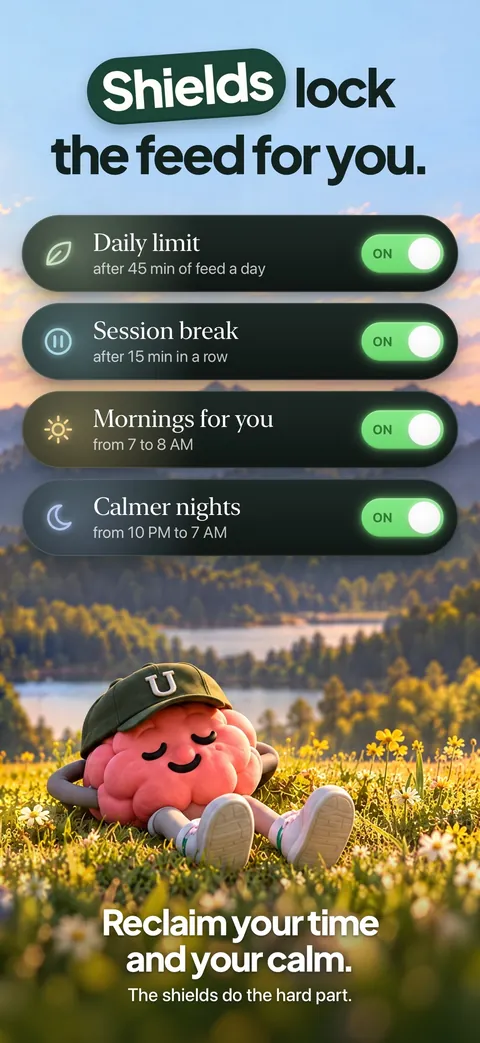
The names are close, but the two apps come from different companies and work in opposite directions. Unrot makes you buy minutes in the apps you locked. Unrotten gives those apps a budget: you choose your rot apps, the ones that eat your time, and goals decide when Apple's Screen Time shield locks them. Less scrolling sets a daily limit, Shorter scroll sessions makes the apps take a break once a session runs past the length you choose, and Mornings for yourself and Calmer evenings protect a window each day. The shield has no "ignore limit" button and holds until the limit resets or the window ends.
What Unrot does with its buddy, Unrotten does with the MindBattery™: a score from 0 to 100 that drains while you use your rot apps and recharges with sleep, movement, mindful minutes and time away from them, on your Lock Screen, in the Dynamic Island and in widgets. Where Unrot pays out coins, Unrotten talks back. An AI Coach, drawn like iOS Messages, sends a morning message, checks in on the plans you share and nudges you when your scrolling runs fast.
Compared with Unrot: Unrotten runs on iOS 17 or later and costs $49.99 a year or $9.99 a month, each after a 7-day free trial, with no free tier. It's new, on the App Store since October 14, 2026. Turning a goal off, or removing Unrotten's Screen Time access, lifts that goal's shield: it's a commitment device, not a vault.
Other apps that make you earn your scroll
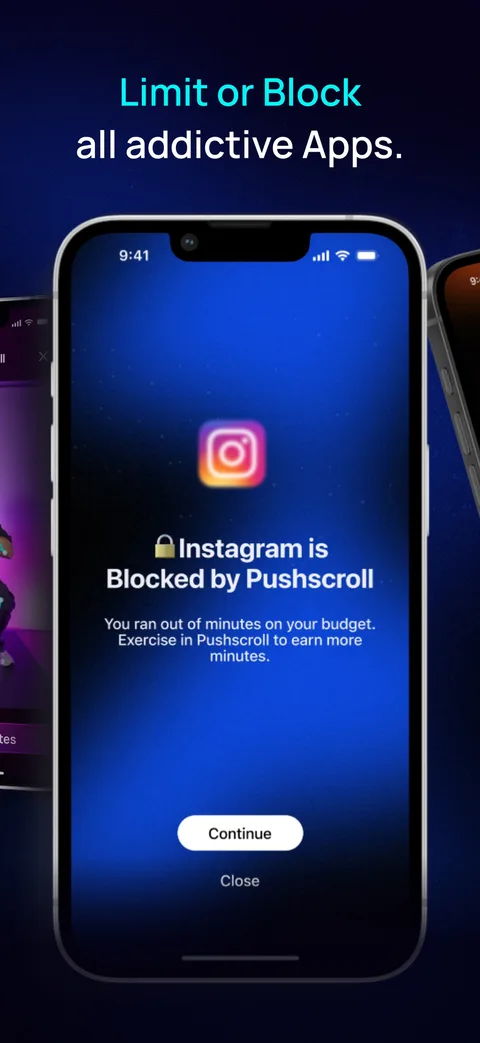
Pushscroll turns the trade into a workout. "One pushup = one minute of app time," says its listing, and it counts push-ups, squats, lunges and more with pose detection ("Can't cheat," it promises). A subscription is required: $14.99 a month, or yearly plans listed from $24.99 to $59.99. It runs on iOS 16 or later, has 4.7 stars from 18,017 US ratings, and its privacy label lists purchases and identifiers among the data that may be used to track you.
Unglue keeps the habits small. Its screenshots pay out for studying, eating a healthy meal, smiling and touching grass, and its website makes the case plainly: "A basic block is easy to tap past when TikTok is one thumb away." Unglue Plus is required for full access, listed from $4.99 to $69.99 without periods; it needs iOS 17 and has 4.7 stars from 2,678 US ratings. Its privacy label lists purchases, identifiers and usage data among the data that may be used to track you.
Clearspace mixes a pause with earning: opening a limited app shows how many opens you have left, and when your time runs out, push-ups or a breathing exercise earn more minutes. Our Clearspace review has the details, and our guide to the best screen time apps for iPhone compares the wider field.
How to choose
- You put off real-life tasks and scroll instead: Unrot, or Unglue for smaller habits.
- You want your exercise counted, not claimed: Pushscroll counts the reps itself.
- You open apps before you've decided to: a pause, like Clearspace's.
- You lose an hour once you're in: a session break or a daily limit, which acts on the scroll itself.
- You'd rather build the new habit without an app: tie it to one you already have, as in habit stacking.
So, is Unrot worth it?
If you know exactly what you've been putting off, Unrot's deal is simple: the walk, the dishes or the hour of study first, then the feed, at a price you can see in coins. Check the subscription on the paywall before you commit, and watch your balance. When coins pile up faster than you spend them, the toll has stopped working.
If your trouble is the scroll itself, the hour that vanishes once you're in, earning more minutes won't shrink it. A cap does. In a randomized trial with 111 students, those who capped their phone use at two hours a day for three weeks slept better and reported more well-being, less stress and fewer depressive symptoms than the control group, small to medium effects, and their screen time climbed back once the cap ended [6]. Choose a rule you'll keep, like a daily limit in Unrotten whose shield holds until the day resets.
If the scrolling comes with low mood, anxiety or sleep trouble that won't lift, a doctor or therapist can help.
Questions people ask
Is the Unrot app free?
Unrot is free to download, but its App Store description says an active subscription is required to use its features. On November 8, 2026, the US App Store listed ten in-app purchases, nearly all called Full Access, from $8.99 to $69.99, without saying which period each one covers. Unrot's website showed no prices, so check the paywall before you start.
How does Unrot work?
You pick a habit, such as a walk, a study session or cleaning, start a timer or snap a photo when you're done, and earn coins. Coins unlock the apps you chose to lock: in the screenshots on its App Store listing, one minute of app time costs one coin. Without coins, the apps stay locked.
Are Unrot and Unrotten the same app?
No. Unrot is made by Unrot OÜ and makes you earn screen time with real-life habits. Unrotten is made by the team behind this blog and locks the apps you choose according to goals, such as a daily limit or a break after a long session, with an AI Coach and a score called the MindBattery™. Both are iPhone apps that need a paid plan.
What iPhone do you need for Unrot?
Unrot needs iOS 18 or later, and its App Store listing names only the iPhone, as of November 2026. Unrotten needs iOS 17 or later.
Is Unrot worth it?
If the chores, the workout or the studying are what you skip, and the feed is what you reach for, a trade can get the habit done first. If what you want is for the scrolling itself to shrink, a daily limit or a session break targets it more directly.
References
- Milkman KL, Minson JA, Volpp KG. "Holding the Hunger Games Hostage at the Gym: An Evaluation of Temptation Bundling." Management Science. 2014;60(2):283-299. doi:10.1287/mnsc.2013.1784 ↩
- Precht LM, Mertens F, Brickau DS, Kramm RJ, Margraf J, Stirnberg J, Brailovskaia J. "Engaging in physical activity instead of (over)using the smartphone: An experimental investigation of lifestyle interventions to prevent problematic smartphone use and to promote mental health." Journal of Public Health. 2024;32(4):589-607. doi:10.1007/s10389-023-01832-5 · Read our plain-English summary ↩
- Deci EL, Koestner R, Ryan RM. "A meta-analytic review of experiments examining the effects of extrinsic rewards on intrinsic motivation." Psychological Bulletin. 1999;125(6):627-668. doi:10.1037/0033-2909.125.6.627 ↩
- Allcott H, Gentzkow M, Song L. "Digital Addiction." American Economic Review. 2022;112(7):2424-2463. doi:10.1257/aer.20210867 ↩
- Lally P, van Jaarsveld CHM, Potts HWW, Wardle J. "How are habits formed: Modelling habit formation in the real world." European Journal of Social Psychology. 2010;40(6):998-1009. doi:10.1002/ejsp.674 ↩
- Pieh C, Humer E, Hoenigl A, Schwab J, Mayerhofer D, Dale R, Haider K. "Smartphone screen time reduction improves mental health: a randomized controlled trial." BMC Medicine. 2025;23(1):107. doi:10.1186/s12916-025-03944-z · Read our plain-English summary ↩
Written by
Maren AshbyCOO, Unrotten
Maren Ashby is the COO of Unrotten, the iPhone app that helps people take their attention back from the feed. She writes about the research on phones, sleep and focus, and about the small, practical changes that make a phone easier to put down.