
Blog/Explainer
Nomophobia: The Fear of Being Without Your Phone
What the word means, how researchers measure it, why a dead battery can feel like an emergency, and how to loosen the grip without losing touch.


In this article
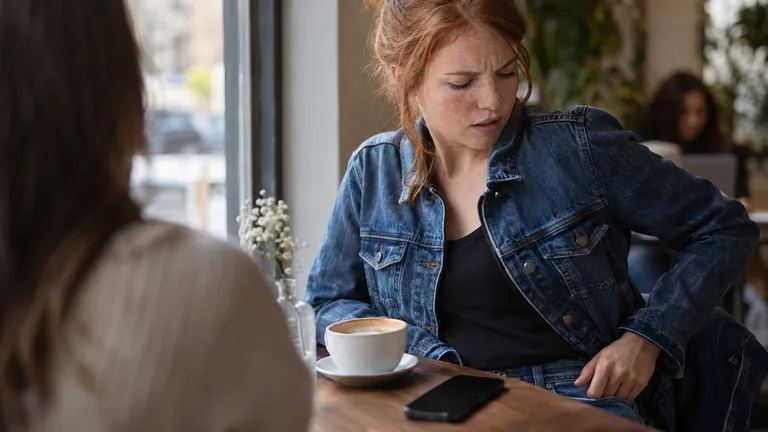
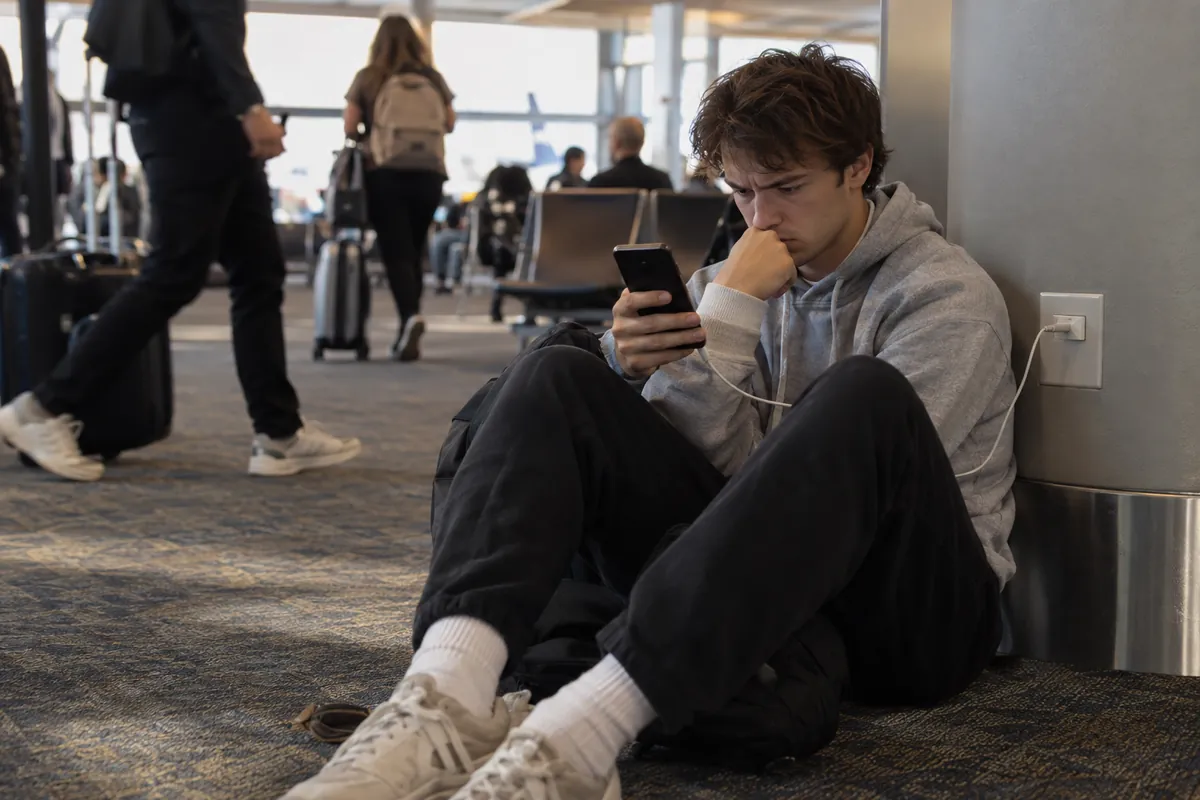
You're halfway down the stairs when you pat your pocket and your stomach drops: no phone. Or the battery hits 4% on the way home, and suddenly it's all you can think about. That jolt has a name, nomophobia, and researchers have been measuring it for more than a decade.
It's common, it isn't a diagnosis, and you can loosen its grip without giving up the phone you need. Here's what it is, why your body reacts the way it does, and what helps.
What nomophobia means
Nomophobia is short for "no mobile phone phobia": the fear of being without your phone, or of not being able to use it. The word comes from a 2008 survey the UK Post Office commissioned from the research firm YouGov, which found that about 53% of British mobile phone users felt anxious when they lost their phone, ran out of battery or credit, or had no network coverage [1].
It isn't a diagnosis. In 2014, two researchers proposed adding nomophobia to the DSM-5, the manual used to diagnose mental disorders. It wasn't included, and the authors themselves cautioned against labeling normal behavior as illness [2]. In 2023, a large review was still recommending it for future editions [3]. For now, the word describes a common, measurable worry, not a condition.
Signs of nomophobia
Researchers measure nomophobia with a questionnaire, the NMP-Q, built at Iowa State University from interviews with students and then tested on 301 undergraduates [4]. Its 20 statements, each rated from 1 to 7, fall into four groups, and they double as a list of signs:
- Not being able to communicate: you worry that family and friends can't reach you, or that you'll miss a call or a text.
- Losing connectedness: you feel cut off from your online life when you can't check social media or your notifications.
- Not being able to access information: it annoys you not to be able to look something up or check the news.
- Giving up convenience: a dying battery scares you, you keep checking for a signal, and you worry about getting stranded.
Scores run from 20 to 140. Studies then sort people into mild, moderate and severe groups, but they draw the lines in different places, so treat any label loosely [5]. The more useful question is simpler: is the fear costing you something, like sleep, attention or the freedom to leave the phone behind when you want to?
How common is nomophobia?
Very. A 2023 meta-analysis pooled 52 studies of 47,399 young people and young adults in 20 countries: about 20% showed mild symptoms, 50% moderate and 20% severe [3]. A little nomophobia is the norm, not the exception.
Take the exact numbers loosely. A review of 108 studies found that the share of people classed as nomophobic ranged from 6% to 73%, mostly because the studies measured it differently. Women and younger people tended to score higher [5].
What being apart from your phone does to you
Your body reacts. In a lab experiment, 40 iPhone users did word-search puzzles twice: once with their phone, and once separated from it while it rang where they couldn't answer it. Apart from it, their heart rate and blood pressure rose, they felt more anxious and unpleasant, and they did worse on the puzzle [6].
Most people feel the loss, but not everyone. In a survey of 272 young adults recalling a time they were separated from their phone against their will, most remembered feeling lonely, anxious or bored. Some felt relieved to be out of touch. People who used their phone more as an extension of themselves felt worse, and less relief [7].
Not knowing makes it worse. In a study of 270 smartphone users, nomophobia was linked to stress through a sense of social threat. That link disappeared only when people knew how long they would be without their phone and had control over the situation [8].
A separation you choose, with a known end, is a different thing from a dead battery.
That finding is the most practical one in this research, and it shapes most of the fixes below.
Why the fear makes sense, up to a point
Your phone isn't just a phone. It's your map, wallet, camera, calendar, boarding pass and the way the people you love reach you. Some worry about losing it is simply practical. The problem starts when the worry outlasts the reason: when ten minutes without it at dinner feels as urgent as a missed flight.
Nomophobia and phone addiction
They travel together, but they aren't the same. Phone addiction is the pull to keep using; nomophobia is the fear of being without. A 2023 meta-analysis of 16 studies found that nomophobia went with smartphone addiction and anxiety to a moderate degree, and with insomnia symptoms more strongly [9]. Those are correlations, so they can't say which comes first. Late-night news can feed the same loop, as our guide to doomscrolling explains.
If the pull to use is your bigger problem, start with our guide to phone addiction, or give the apps that take your time a daily limit in Unrotten, which locks them once the time is used up while the rest of your phone stays yours.
How to ease nomophobia
You don't need to give up your phone. The goal is a phone you use on purpose, and a few minutes without it that feel like nothing.
1. Practice short, planned separations
Start small and on purpose: the phone in another room for 20 minutes while you cook, then a ten-minute walk around the block without it. Decide in advance how long it will be, and notice what happened while you were apart. Usually, nothing that couldn't wait. When you're ready for a longer stretch, a timed box makes the decision for you (we compared the best phone lock boxes).

2. Keep the phone, lock the feeds
Often the fear is about the useful parts of the phone, while the urge to keep checking comes from its feeds. You can separate the two. A phone-free session in Unrotten (Work, Focus or Reading, started from the + on Home) locks only the apps you've chosen until it ends, with a countdown on your Lock Screen and in the Dynamic Island, and a soft alarm or a gentle vibration at the end. Calls, maps and the rest of your phone keep working, and you know exactly when the session ends, the kind of certainty and control the study above found mattered.
3. Solve the practical worries first
Much of the fear is practical, so plan for it: carry a small battery pack, download offline maps for the places you go, keep two or three important numbers written down, and tell the people who might need you when you'll be offline. A worry with a plan behind it is easier to set down.
4. Batch notifications instead of switching them off
Going cold turkey on alerts can backfire. In a randomized field experiment with 237 smartphone users, people whose notifications arrived in three batches a day felt more attentive, more productive, in a better mood and more in control of their phones than people who got them as usual. People whose notifications were switched off entirely got few of those benefits, and felt more anxious and more afraid of missing out [10]. On an iPhone, go to Settings, then Notifications, then Scheduled Summary, and pick the times and the apps to include.
5. Give your phone a bedtime
Charge it outside the bedroom and use a cheap alarm clock. If the thought of the phone across the house keeps you awake at first, start with the far side of the room. The first few nights feel strange; after that, it's simply where the phone sleeps.
When to get help
If the fear of being without your phone comes with panic, keeps you from going places, or sits on top of anxiety that doesn't lift, a doctor or therapist can help. That's not a failure of willpower; it's the right tool for a bigger problem.
Make your phone a tool again
Your phone should be something you pick up, not an alarm that goes off when it's out of reach.
Start tonight with ten minutes in another room and a known end. Then make it twenty.
Questions people ask
What is nomophobia?
Nomophobia, short for 'no mobile phone phobia', is the fear of being without your phone or unable to use it: a dead battery, no signal, or the phone left at home. The term comes from a 2008 survey for the UK Post Office, and it isn't an official diagnosis.
Is nomophobia a real disorder?
It isn't listed in the manuals used to diagnose mental disorders. Researchers proposed adding it in 2014 and were still recommending it in 2023, but for now it's best understood as a common, measurable worry rather than a diagnosis.
What are the symptoms of nomophobia?
The questionnaire researchers use asks about four kinds of worry: not being able to communicate, losing your connection to people and feeds, not being able to look things up, and losing convenience, such as a dead battery or no signal. In studies, most phone owners show at least mild symptoms.
How do I get over nomophobia?
Practice short, planned separations with a known end, solve the practical worries first (a battery pack, offline maps, a few numbers written down), batch notifications rather than switching them all off, and charge your phone outside the bedroom. If the fear comes with panic or anxiety that doesn't lift, a doctor or therapist can help.
References
- Bhattacharya S, Bashar MA, Srivastava A, Singh A. "NOMOPHOBIA: NO MObile PHone PhoBIA." Journal of Family Medicine and Primary Care. 2019;8(4):1297-1300. doi:10.4103/jfmpc.jfmpc_71_19 ↩
- Bragazzi NL, Del Puente G. "A proposal for including nomophobia in the new DSM-V." Psychology Research and Behavior Management. 2014;7:155-160. doi:10.2147/PRBM.S41386 ↩
- Jahrami H, Trabelsi K, Boukhris O, Hussain JH, Alenezi AF, Humood A, et al. "The Prevalence of Mild, Moderate, and Severe Nomophobia Symptoms: A Systematic Review, Meta-Analysis, and Meta-Regression." Behavioral Sciences. 2023;13(1):35. doi:10.3390/bs13010035 ↩
- Yildirim C, Correia AP. "Exploring the dimensions of nomophobia: Development and validation of a self-reported questionnaire." Computers in Human Behavior. 2015;49:130-137. doi:10.1016/j.chb.2015.02.059 ↩
- León-Mejía AC, Gutiérrez-Ortega M, Serrano-Pintado I, González-Cabrera J. "A systematic review on nomophobia prevalence: Surfacing results and standard guidelines for future research." PLOS ONE. 2021;16(5):e0250509. doi:10.1371/journal.pone.0250509 ↩
- Clayton RB, Leshner G, Almond A. "The Extended iSelf: The Impact of iPhone Separation on Cognition, Emotion, and Physiology." Journal of Computer-Mediated Communication. 2015;20(2):119-135. doi:10.1111/jcc4.12109 ↩
- Hoffner CA, Lee S, Park SJ. "'I miss my mobile phone!': Self-expansion via mobile phone and responses to phone loss." New Media & Society. 2016;18(11):2452-2468. doi:10.1177/1461444815592665 ↩
- Tams S, Legoux R, Léger PM. "Smartphone withdrawal creates stress: A moderated mediation model of nomophobia, social threat, and phone withdrawal context." Computers in Human Behavior. 2018;81:1-9. doi:10.1016/j.chb.2017.11.026 ↩
- Daraj LR, AlGhareeb M, Almutawa YM, Trabelsi K, Jahrami H. "Systematic Review and Meta-Analysis of the Correlation Coefficients between Nomophobia and Anxiety, Smartphone Addiction, and Insomnia Symptoms." Healthcare. 2023;11(14):2066. doi:10.3390/healthcare11142066 ↩
- Fitz NS, Kushlev K, Jagannathan R, Lewis T, Paliwal D, Ariely D. "Batching smartphone notifications can improve well-being." Computers in Human Behavior. 2019;101:84-94. doi:10.1016/j.chb.2019.07.016 ↩
Written by
Maren AshbyCOO, Unrotten
Maren Ashby is the COO of Unrotten, the iPhone app that helps people take their attention back from the feed. She writes about the research on phones, sleep and focus, and about the small, practical changes that make a phone easier to put down.