
Blog/Guide
Doomscrolling: Why Your Brain Can't Stop, and What It Does to You
Why bad news keeps your thumb moving long after it stops helping, what the habit does to your mood and sleep, and how to stay informed without the spiral.

In this article
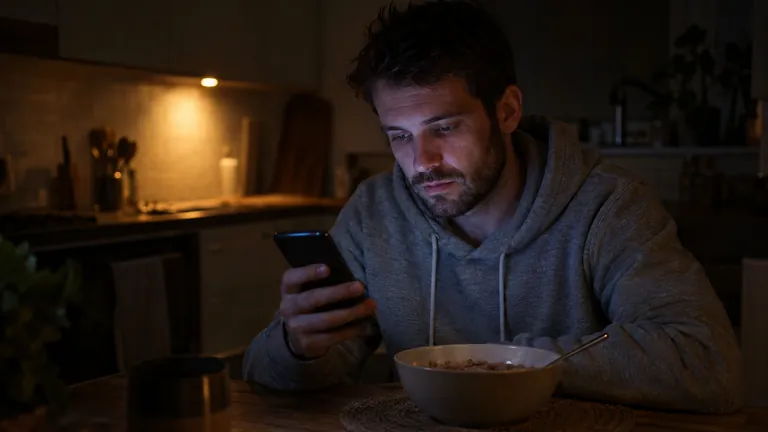
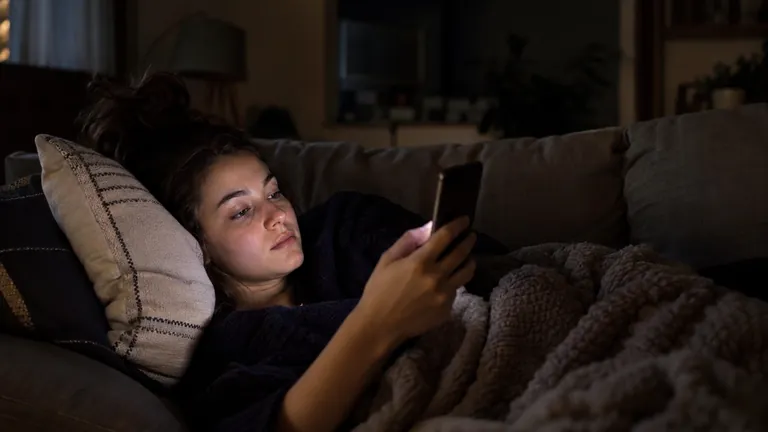
It's 12:40 a.m. You've read the same story five ways, watched the clip twice and scrolled well past the point where anything new could happen tonight. Every swipe makes you feel a little worse, and you keep swiping.
That's doomscrolling, and it isn't a character flaw. Your brain is doing what it evolved to do with bad news; the feed just never lets it finish. Here's what's going on, what it costs you, and how to stay informed without the spiral.
What doomscrolling means
Doomscrolling (also written doom scrolling) is spending far too much time scrolling through news or posts that leave you sad, anxious or angry. That's close to how Merriam-Webster defines it, and the dictionary dates its first known use to 2020 [1]. The word is simply "doom" plus "scroll." It took off that spring, when a pandemic gave everyone a reason to keep refreshing. When Merriam-Webster first wrote about it in April 2020, it quoted a report that the word had been spotted on Twitter as early as October 2018; it entered the dictionary in September 2023 [2].
Doomscrolling isn't the same as an evening of cat videos. Mindless scrolling numbs; doomscrolling alarms. What sets it apart is the pull of threat: a war, a storm, an election, the economy, a frightening diagnosis in the news. You keep reading because part of you believes the next post will tell you how bad it is, or what to do about it.
Researchers now measure it. In 2022, a team built a 15-item doomscrolling scale and tested it with survey panels across OECD countries [3]. Doomscrolling turned out to be less common than they expected, but the people who scored high also tended to be more vigilant online, more afraid of missing out, more anxious and lower in self-control. Men, younger adults and the politically engaged did it more [3].
Why your brain can't stop
Bad news is built to win your attention
Psychologists call it negativity bias: a threat weighs more than a pleasure of the same size, and you can see it in the body. In a study across 17 countries, 1,156 people watched real BBC World News stories while sensors on their fingers tracked their reactions [4]. Negative stories set off more physical arousal than positive ones, measured in the skin's electrical response and in heart rhythm. The authors suggest this helps explain why news around the world leans negative: it's what audiences react to [4].
Put an attention system that favors threats in front of a feed tuned for engagement, and you get more of whatever alarms you.
Uncertainty makes checking feel like doing something
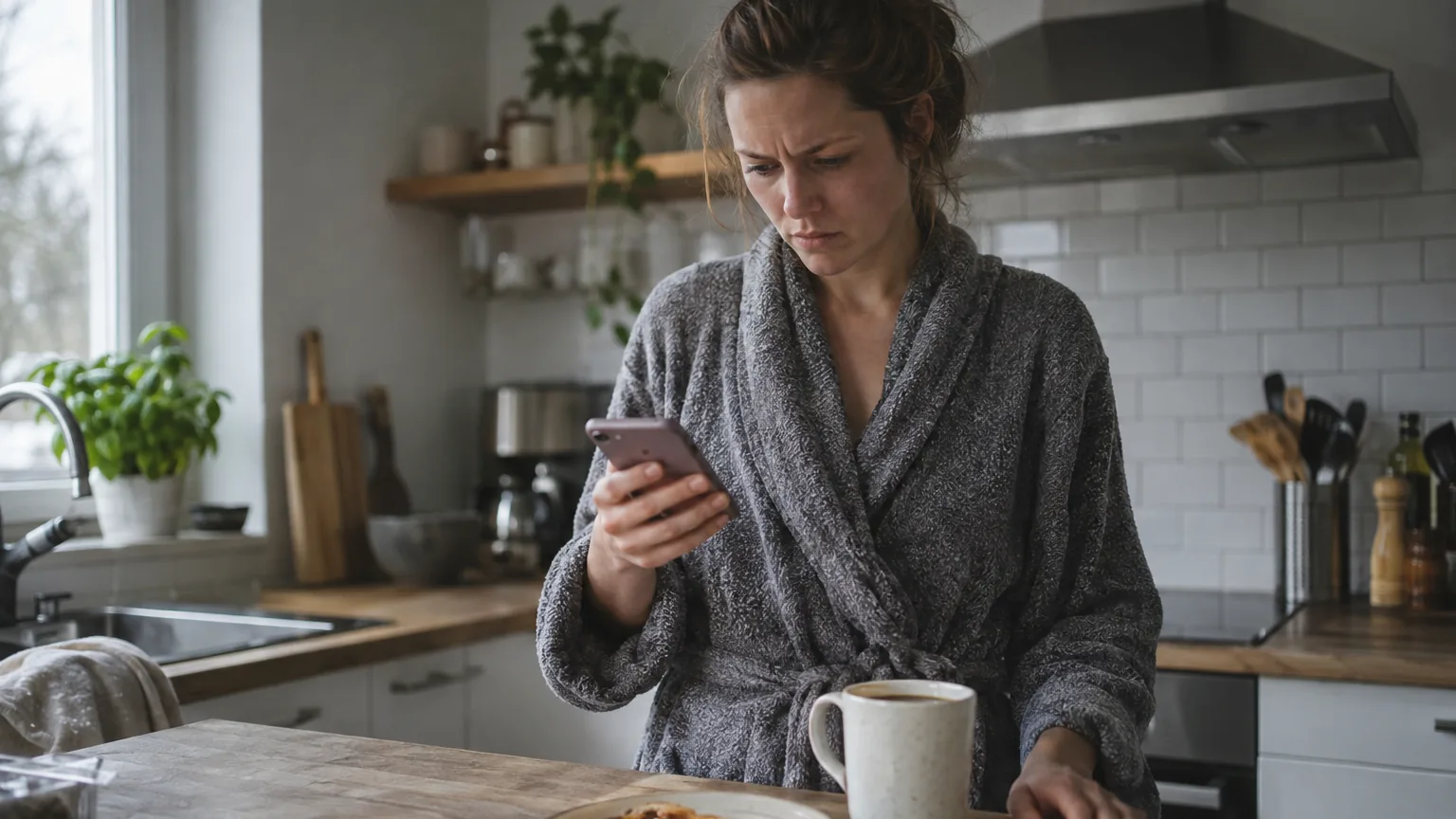
When something threatening is unfolding, checking feels like preparing. If you know the latest, you can't be caught off guard. But most updates add nothing you can act on, and the relief of being up to date lasts only until the next refresh. The feed is always ready with one.
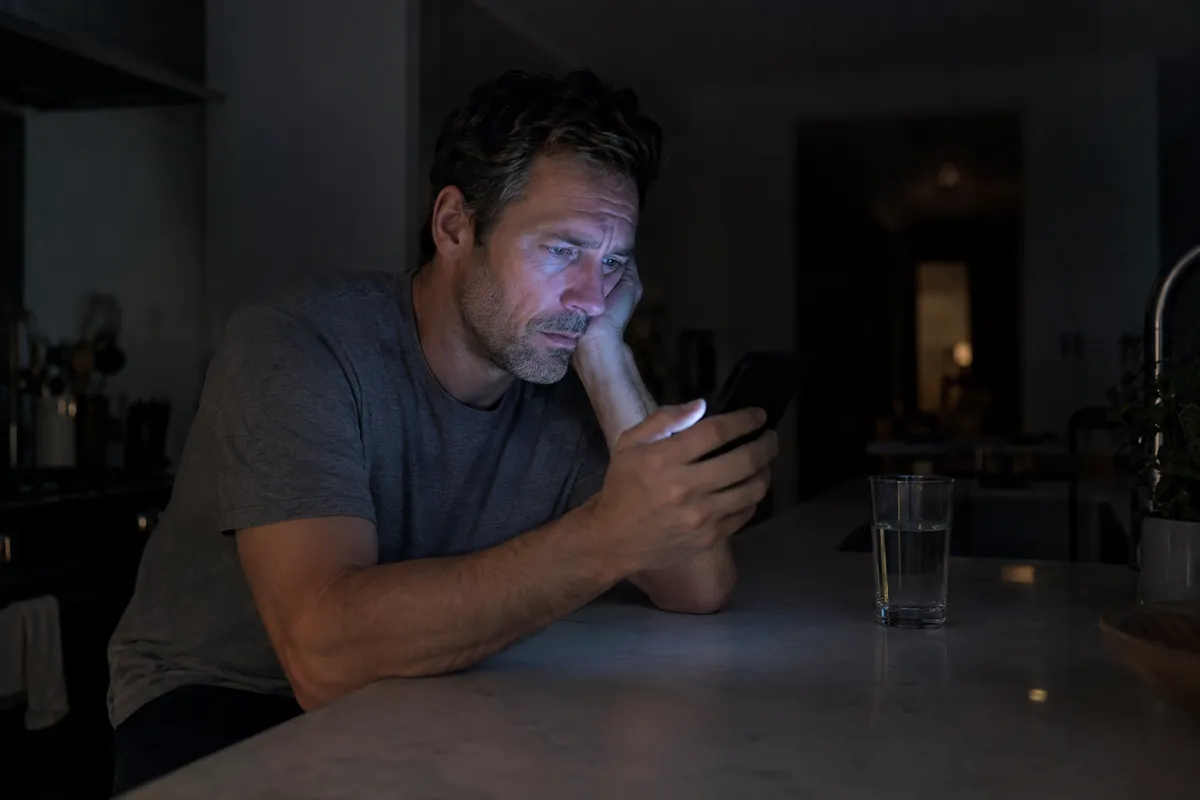
You can't scroll your way to certainty, and the feed will never tell you you're done.
The feed never runs out
A newspaper ends. A bulletin ends. A feed refills as fast as you can swipe, so the decision to stop is left entirely to you, usually late at night, when you have the least willpower left to make it.
Scrolling feels like rest, but isn't
Scrolling feels like a break. The research suggests otherwise. In a classic study, 82 young adults in Michigan got five texts a day for two weeks asking how they felt and how much they had used Facebook since the last text. The more they had used it, the worse they felt at the next text, while feeling low didn't predict using it more [5]. In a later lab experiment from the same group, people asked to use Facebook passively, browsing rather than interacting, felt worse over time, and a follow-up in daily life pointed to envy as part of the reason [6].
Doomscrolling is passive scrolling with an alarm added. Unrotten's MindBattery is built to make that cost visible while you're still scrolling: a score from 0 to 100 on your Lock Screen that drains while you use the apps you choose and recharges with sleep, movement and time away from them.
What doomscrolling does to you
It lowers your mood within minutes. In two experiments, people who spent just 2 to 4 minutes on COVID-19 news, in a Twitter feed or a YouTube video, felt less positive right away than people who saw nothing, and in the second study less optimistic too [7]. People who saw stories of kindness from the same pandemic didn't take that hit [7].
Hours of coverage can weigh more than the event itself. Two to four weeks after the 2013 Boston Marathon bombings, researchers surveyed 4,675 Americans. Six or more hours a day of bombing coverage in the week after the attack was linked to more acute stress than direct exposure to the bombings [8]. The authors warn that engaging with trauma coverage for hours every day may prolong acute stress [8].
A news habit can become a problem of its own. In a national survey of US adults, researchers measured problematic news consumption: getting absorbed in and preoccupied with the news, struggling to rein it in, and letting it interfere with daily life. People with more of those signs reported more mental and physical ill-being, even after accounting for how much news they consumed overall [9].
It follows you to bed. In a survey of 663 adults in Turkey, people who doomscrolled more slept worse, and part of that link ran through nomophobia, the fear of being without your phone [10].
Most of this research shows links, not proof, and the experiments tested minutes, not months. But the studies point the same way: the habit costs more than the time it takes.
Signs you're doomscrolling, not just keeping up
- You've stopped learning anything new: it's the same story, from a different angle.
- You feel worse with each swipe and keep going anyway.
- The news is the first thing you check in the morning and the last thing at night.
- You go back "just in case" something changed in the last ten minutes.
- You meant to read one headline, and it's been forty minutes.
- Your jaw is tight and your shoulders are up, and you notice only when you finally put the phone down.
How to stop doomscrolling without tuning out
Staying informed matters, and quitting the news isn't the goal. The goal is to take it the way you'd take a meal: at set times, from something that ends.
Choose news that ends. A morning newsletter, a daily news podcast or a paper edition has a last page, and you stop when it does. Read it once or twice a day at times you pick, not whenever the worry spikes.

Turn off breaking-news alerts. Each one is an invitation back into the feed, and almost none of them needs you right now. If one source's alerts are worth keeping, keep only that one.
Give the feed the stopping point it lacks. A session that ends on its own, a daily limit, no feeds after a set hour. Unrotten does this with Shorter scroll sessions (past the session length you set, the apps take a break before they open again) and Calmer evenings (a protected window each evening without them), so the decision to stop isn't left to you at midnight.
Do one thing, then close the app. When a story moves you, act on it once: donate, check on someone, make the plan. Then stop reading. One more update rarely adds anything you can act on.
Swap the feed for something that also ends. If you want something to read, the kindness-scrolling result above suggests the content matters, not just the time [7]. Better still, reach for something that isn't a screen: a short dopamine menu of things you'd rather do makes the swap easy when the urge hits.
Move the phone out of the bedroom. Night is when doomscrolling runs longest. A charger in the kitchen turns "one more scroll" into getting out of bed, and our guide to revenge bedtime procrastination explains why that last hour is so hard to give up.
For the full set of research-backed fixes, from grayscale to batching notifications, read how to stop doomscrolling. And if you'd like a nudge in the moment, Unrotten's Coach messages you when your scrolling runs fast.
Stay informed, not flooded
Being informed is something you can finish. Doomscrolling is the part that never ends.
Pick a source that ends, a time to read it and a limit for the feeds, and you'll still know what you need to know, with your evening left over. Start tonight with the easiest change: turn off one breaking-news alert.
If the news has left you anxious or low for weeks and it doesn't lift, a doctor or therapist can help.
Questions people ask
What does doomscrolling mean?
Doomscrolling means spending too much time scrolling through news or posts that leave you feeling sad, anxious or angry. The word blends 'doom' and 'scroll', and it took off in 2020, when the pandemic gave people a reason to keep refreshing.
Why do I doomscroll?
Your brain gives bad news more weight than good news, uncertainty makes checking feel like preparing, and a feed never runs out, so the decision to stop is left to you, usually late at night, when it's hardest to make.
Is doomscrolling bad for you?
Studies link it to a worse mood, more stress and poorer sleep. In two experiments, just 2 to 4 minutes of pandemic news lowered people's mood right away. After the Boston Marathon bombings, six or more hours a day of coverage was linked to more acute stress than direct exposure to the bombings.
How do I stop doomscrolling without ignoring the news?
Read news that ends, such as a newsletter or a daily podcast, at times you choose. Turn off breaking-news alerts, give your feed apps a time limit or an evening cutoff, and charge your phone outside the bedroom.
References
- Merriam-Webster. "Doomscroll." Merriam-Webster.com Dictionary. Accessed October 23, 2026. merriam-webster.com ↩
- Merriam-Webster. "On 'Doomsurfing' and 'Doomscrolling.'" Words We're Watching. April 22, 2020, updated September 2023. merriam-webster.com ↩
- Sharma B, Lee SS, Johnson BK. "The dark at the end of the tunnel: Doomscrolling on social media newsfeeds." Technology, Mind, and Behavior. 2022;3(1):144-156. doi:10.1037/tmb0000059 ↩
- Soroka S, Fournier P, Nir L. "Cross-national evidence of a negativity bias in psychophysiological reactions to news." Proceedings of the National Academy of Sciences. 2019;116(38):18888-18892. doi:10.1073/pnas.1908369116 ↩
- Kross E, Verduyn P, Demiralp E, Park J, Lee DS, Lin N, et al. "Facebook use predicts declines in subjective well-being in young adults." PLOS ONE. 2013;8(8):e69841. doi:10.1371/journal.pone.0069841 ↩
- Verduyn P, Lee DS, Park J, Shablack H, Orvell A, Bayer J, et al. "Passive Facebook usage undermines affective well-being: Experimental and longitudinal evidence." Journal of Experimental Psychology: General. 2015;144(2):480-488. doi:10.1037/xge0000057 ↩
- Buchanan K, Aknin LB, Lotun S, Sandstrom GM. "Brief exposure to social media during the COVID-19 pandemic: Doom-scrolling has negative emotional consequences, but kindness-scrolling does not." PLOS ONE. 2021;16(10):e0257728. doi:10.1371/journal.pone.0257728 ↩
- Holman EA, Garfin DR, Silver RC. "Media's role in broadcasting acute stress following the Boston Marathon bombings." Proceedings of the National Academy of Sciences. 2014;111(1):93-98. doi:10.1073/pnas.1316265110 ↩
- McLaughlin B, Gotlieb MR, Mills DJ. "Caught in a Dangerous World: Problematic News Consumption and Its Relationship to Mental and Physical Ill-Being." Health Communication. 2023;38(12):2687-2697. doi:10.1080/10410236.2022.2106086 ↩
- Camadan F, Uzunoğlu Ö. "The role of FoMO and nomophobia in explaining the relationship between doomscrolling and poor sleep quality." BMC Psychology. 2025;14(1):115. doi:10.1186/s40359-025-03865-9 ↩
Written by
Maren AshbyCOO, Unrotten
Maren Ashby is the COO of Unrotten, the iPhone app that helps people take their attention back from the feed. She writes about the research on phones, sleep and focus, and about the small, practical changes that make a phone easier to put down.