Blog/Habits & self-control/Explainer
Touch Grass: What Going Outside Really Does for Your Brain
The internet's favorite put-down is decent advice. What time outside does for attention, stress and a looping mind, how much counts, and what cancels it.


In this article
"Touch grass" is what the internet tells someone who has been online too long: log off, go outside, rejoin the world. It's usually meant as a put-down. It also happens to be one of the better-supported pieces of advice about screens, as long as you leave the feed behind when you go. Here's what time outside does for your brain, how much of it counts, and the mistake that cancels it.
What touch grass means
The phrase is slang, often typed in the middle of an argument online, and it means roughly "you've lost perspective; go spend some time in the real world." Nobody needs to touch actual grass for it to work, though bare feet in a park are a fine way to start. The useful question behind the joke is a serious one: after hours of feeds, does going outside actually do anything? Researchers have been testing that for decades, and the answer is yes, with some conditions.
What time outside does for your attention
The leading explanation is called attention restoration theory. Focusing on demanding things, like a spreadsheet or a busy street, uses a limited kind of attention, the effortful kind you direct on purpose. Nature, the theory says, holds your attention gently: leaves moving, water, clouds. That gives the effortful kind a chance to recover. A city, by contrast, grabs your attention hard and demands it at the same time, so it restores less [1].
The classic test came from the University of Michigan. In an experiment with 38 students, each took two walks of 50 to 55 minutes a week apart, one through an arboretum and one through downtown Ann Arbor. After the walk in nature, their scores on a demanding attention test improved; after the downtown walk, they didn't improve reliably. In a second experiment, even looking at photos of nature helped more than looking at photos of city streets [1].
Since then, dozens of studies have tried to pin down what improves. A 2018 review of 42 studies found that working memory and cognitive flexibility, and less reliably the ability to control attention, improved after exposure to natural environments. The effects were low to moderate. Real places seemed to work better than virtual ones, though that may be partly because real visits tended to last longer [2].
A feed is close to the opposite of a park. It's built to grab attention hard and keep it, one post at a time, which is part of why an hour of scrolling can leave you more scattered than rested. Our guide to the short attention span covers what that does to focus.
What it does for stress and a looping mind
Time outside also shows up in the body. In a study of 36 city dwellers over eight weeks, people took a "nature experience" of 10 minutes or more at least three times a week, at times and places of their own choosing, and gave saliva samples before and after. Their levels of cortisol, a stress hormone, fell by 21.3% per hour outside beyond the hormone's usual daily decline. The biggest return per minute came between 20 and 30 minutes, with benefits still building after that, only more slowly [3].
Nature may also quiet the kind of thinking that goes in circles. In a Stanford study, healthy adults went on a 90-minute walk either through a natural setting or through an urban one. Those who walked in nature reported less rumination afterward, the repetitive, self-focused negative thinking that keeps replaying what went wrong, and brain scans showed less activity in a region linked to it. The urban walk changed neither [4].
If your thoughts keep looping for weeks, or low mood or anxiety won't lift, a walk is a good habit but not a substitute for help: talk to a doctor or a therapist.
How much counts
In a survey of 19,806 people in England, those who had spent at least 120 minutes in nature in the previous week were more likely to report good health and high well-being than people who had spent none. The benefits peaked between 200 and 300 minutes a week, and it didn't matter how the 120 minutes came: one long walk or several short ones [5]. It's a survey, so it shows a link, not proof that the minutes caused the health.
Put the studies together and a reasonable target appears: two hours a week, which is 20 to 30 minutes on most days. A city park counts. So does a tree-lined walk to work, if you're actually looking at the trees.
The catch: taking the feed with you
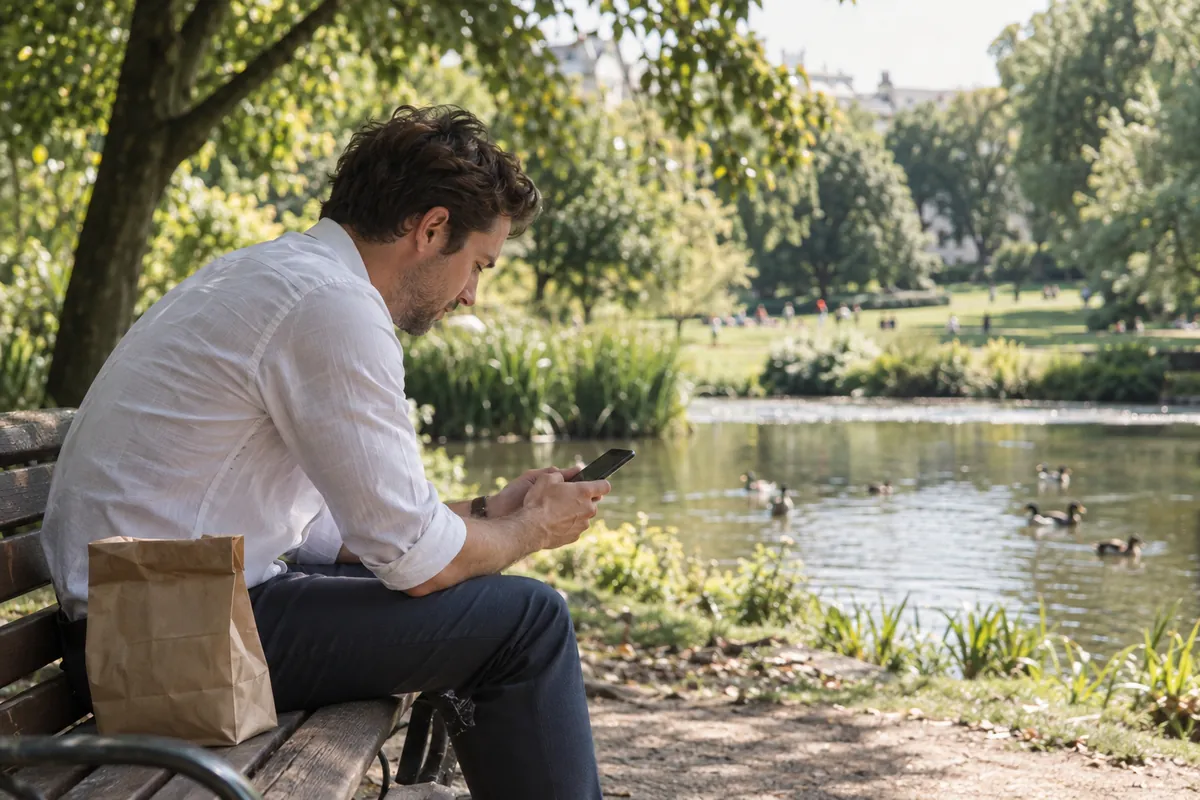
Here's the part the meme leaves out. In an experiment with 81 people, everyone first did demanding mental tasks, then rested in either a green setting or a barren one, with or without a laptop. Resting in green settings improved attention, but using a laptop during the break substantially counteracted the benefit, even after the researchers accounted for how long people looked at the screen [6].
The study used laptops, not phones, so it isn't a perfect stand-in for scrolling on a park bench. The lesson still carries over.
Touching grass works when your attention goes outside with you. Bring the feed along and you've only moved the scroll.
There's encouraging evidence from the other direction too. In a randomized trial, adults who blocked all mobile internet on their phones for two weeks, with calls and texts still working, improved in sustained attention, mental health and well-being. Part of the improvement seemed to come from how they spent the time instead: more time socializing in person, more exercise and more time in nature [7]. In that trial, taking the feed away sent people outside on their own. For more on that trial and others like it, read our guide to a digital detox.
How to actually touch grass
- Put it on the calendar. Aim for 20 to 30 minutes outside on most days. Five or six of those make the two hours a week linked with better health and well-being [3, 5]. A lunch break, the walk home or a morning coffee on a bench all count.
- Leave the phone in your pocket, or at home. Take photos if you want, then put it away. If the pull is too strong, Unrotten's Time away from apps goal blocks the apps you choose during the hours you set every day, so your lunchtime walk doesn't turn into a lunchtime scroll.
- Skip the headphones sometimes. Let the gentle stuff hold your attention: wind, birds, water, people walking dogs. That soft kind of attention is the point [1].
- Go green, even in a city. Parks, riverbanks, tree-lined streets and gardens all count. Even photos of nature helped in one experiment [1], but real places seem to work better than screens of them [2].
- Trade the first scroll of the day. Swap the first 10 minutes on your phone for 10 minutes outside. Morning daylight also helps set the body clock that decides when you feel sleepy at night, as our guide to blue light and sleep explains.
- Let it count. Unrotten's MindBattery™, a score from 0 to 100, recharges with movement and with time away from the apps you chose, so a walk outside, recorded in Apple Health, shows up in your score, and the Movement goal turns the habit into a streak.
Go outside, and leave the feed
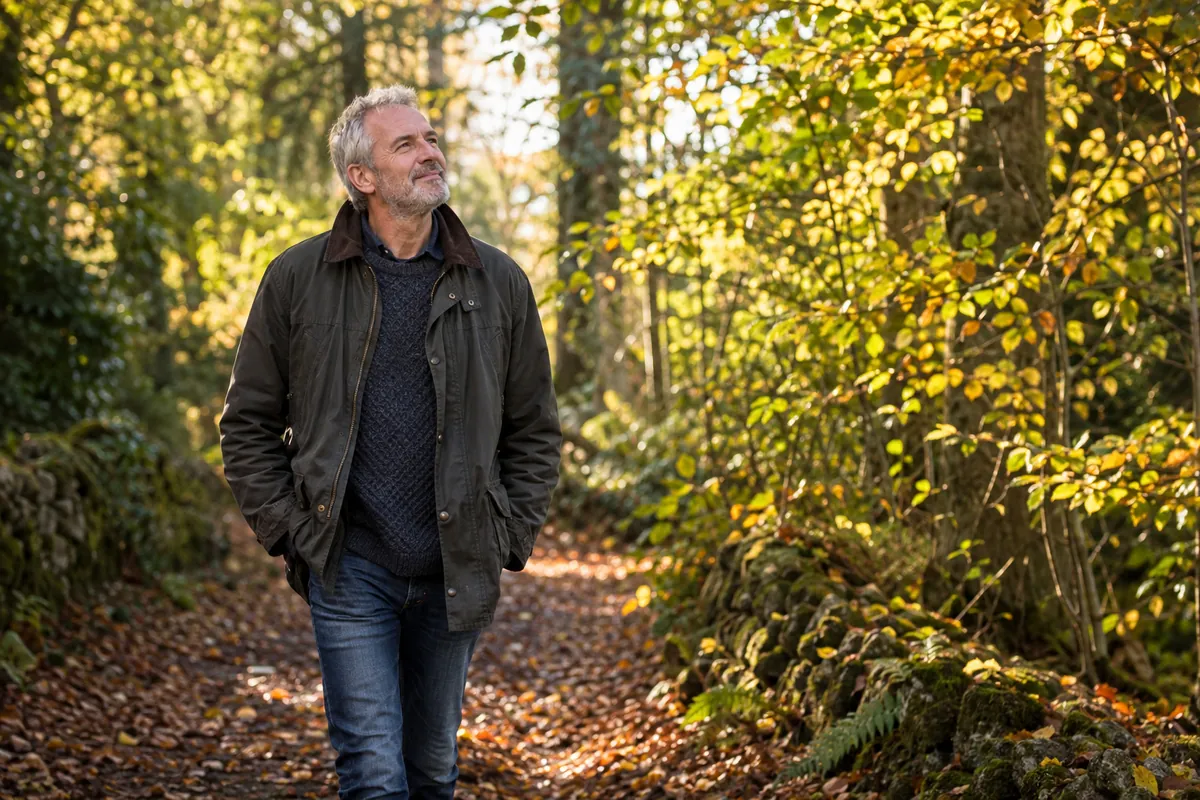
"Touch grass" works as an insult because everyone knows it's true: too long online and you lose the plot. The research adds the details. Go somewhere green, stay 20 minutes or more, and leave the feed in your pocket. The grass will do the rest.
Questions people ask
What does touch grass mean?
"Touch grass" is internet slang for log off and go outside. It's usually aimed at someone who seems to have spent too long online, as a reminder that the world beyond the screen is still there.
Does going outside really help your brain?
There's good evidence that it helps. In experiments, a walk in nature improved people's scores on attention tests more than a walk through city streets, and a review of 42 studies found modest improvements in working memory and mental flexibility after time in natural settings. Time in nature has also lowered a stress hormone, and a nature walk reduced repetitive negative thinking.
How much time outside do you need?
In a survey of nearly 20,000 people in England, those who spent at least 120 minutes a week in nature were more likely to report good health and high well-being, with the benefits leveling off at 200 to 300 minutes. It didn't matter whether the time came in one long visit or several short ones. In a study of stress hormones, 20 to 30 minutes per outing gave the most benefit per minute.
Does using your phone outside cancel the benefits?
It can. In an experiment with 81 people, resting in a green setting improved attention, but using a laptop during the break substantially cancelled that benefit. The study tested laptops, not phones, but it suggests the benefit depends on where your attention goes.
References
- Berman MG, Jonides J, Kaplan S. "The cognitive benefits of interacting with nature." Psychological Science. 2008;19(12):1207-1212. doi:10.1111/j.1467-9280.2008.02225.x ↩
- Stevenson MP, Schilhab T, Bentsen P. "Attention Restoration Theory II: a systematic review to clarify attention processes affected by exposure to natural environments." Journal of Toxicology and Environmental Health, Part B. 2018;21(4):227-268. doi:10.1080/10937404.2018.1505571 ↩
- Hunter MR, Gillespie BW, Chen SYP. "Urban Nature Experiences Reduce Stress in the Context of Daily Life Based on Salivary Biomarkers." Frontiers in Psychology. 2019;10:722. doi:10.3389/fpsyg.2019.00722 ↩
- Bratman GN, Hamilton JP, Hahn KS, Daily GC, Gross JJ. "Nature experience reduces rumination and subgenual prefrontal cortex activation." Proceedings of the National Academy of Sciences. 2015;112(28):8567-8572. doi:10.1073/pnas.1510459112 ↩
- White MP, Alcock I, Grellier J, Wheeler BW, Hartig T, Warber SL, et al. "Spending at least 120 minutes a week in nature is associated with good health and wellbeing." Scientific Reports. 2019;9(1):7730. doi:10.1038/s41598-019-44097-3 ↩
- Jiang B, Schmillen R, Sullivan WC. "How to Waste a Break: Using Portable Electronic Devices Substantially Counteracts Attention Enhancement Effects of Green Spaces." Environment and Behavior. 2019;51(9-10):1133-1160. doi:10.1177/0013916518788603 ↩
- Castelo N, Kushlev K, Ward AF, Esterman M, Reiner PB. "Blocking mobile internet on smartphones improves sustained attention, mental health, and subjective well-being." PNAS Nexus. 2025;4(2):pgaf017. doi:10.1093/pnasnexus/pgaf017 · Read our plain-English summary ↩
Written by
Maren AshbyCOO, Unrotten
Maren Ashby is the COO of Unrotten, the iPhone app that helps people take their attention back from the feed. She writes about the research on phones, sleep and focus, and about the small, practical changes that make a phone easier to put down.