Blog/Habits & self-control/Guide
How to Stop Procrastinating When Your Phone Is the Easy Way Out
Procrastination is less about time than about feelings, and your phone is the fastest mood fix you own. Why it happens, and what gets you started.

In this article
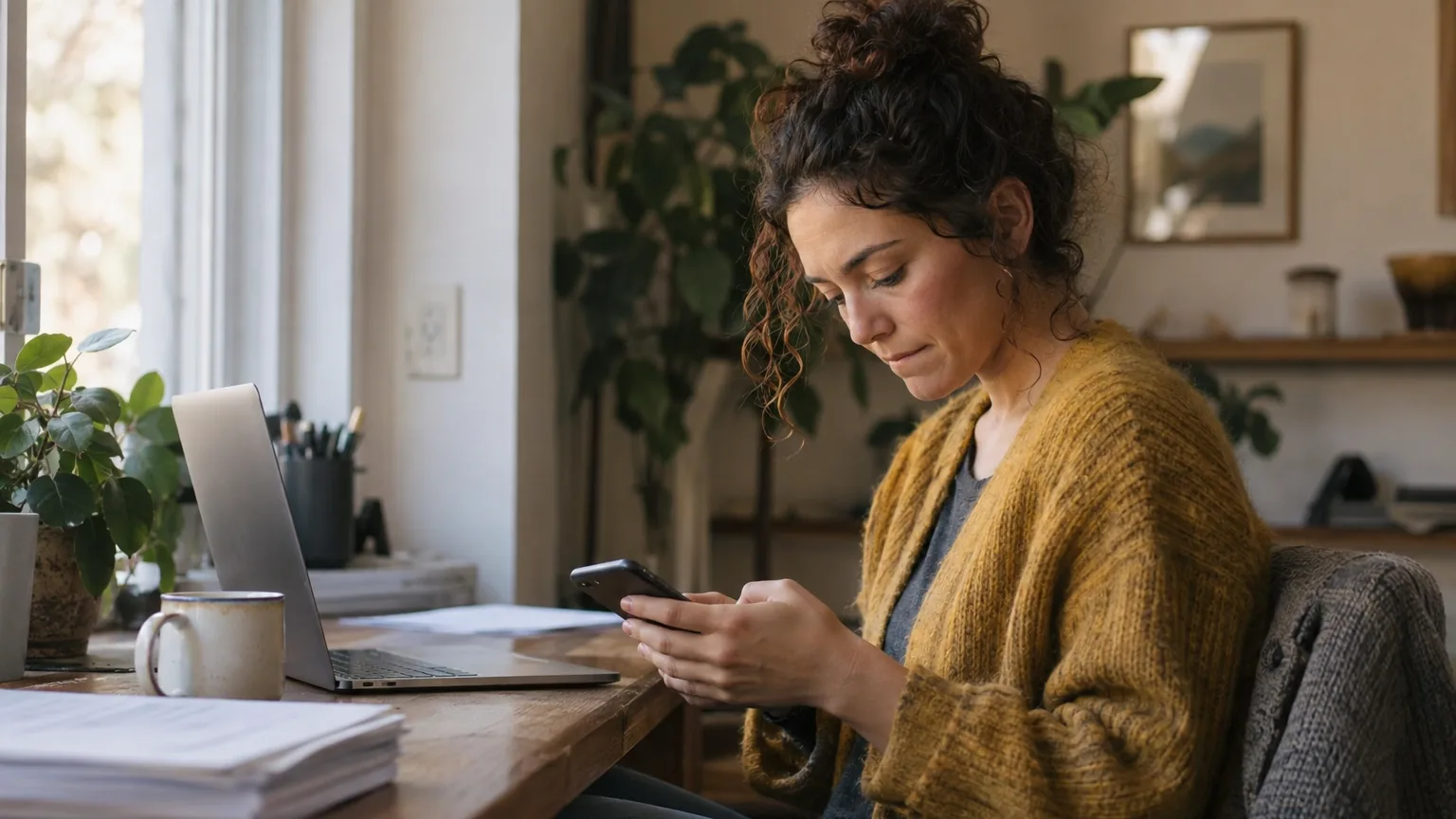
You sit down to do the thing you've been avoiding. You open the file, read the first line and feel a small wave of dread. Ten minutes later you're watching videos on your phone, and you can't remember deciding to pick it up.
That's procrastination doing what it does best: trading a bad feeling now for a worse one later. The way out isn't more discipline or a better calendar. It's making the start smaller and the escape harder to reach.
Why you procrastinate (it isn't laziness)
Procrastination is one of the most studied habits in psychology. In 2007 the psychologist Piers Steel pooled 691 correlations from studies of what goes with putting things off [1]. The strongest and most consistent predictors were how unpleasant the task feels, how far away its reward is, how much you doubt you can do it and how impulsive you are, along with low conscientiousness and its parts: self-control, distractibility, organization and the drive to achieve. Neuroticism, rebelliousness and sensation seeking showed only a weak connection [1].
Read that list again and notice what isn't on it: time management. The research points much more to feelings and self-control than to scheduling skills.
Two procrastination researchers, Fuschia Sirois and Timothy Pychyl, argue that procrastination "has a great deal to do with short-term mood repair and emotion regulation" [2]. A task that feels boring, confusing or threatening brings a bad feeling. Putting it off makes the feeling go away, right now. The bill for that relief goes to your future self, who still has the same task and less time to do it [2].
Procrastination isn't a time problem. It's a feelings problem, and your phone is the fastest mood fix you own.
The bill is real. In a classic pair of studies that followed students through a semester, procrastinators reported less stress and less illness than everyone else early in the term, then more stress and more illness late in it, and they were sicker overall. They also got lower grades on every assignment [3]. Relief first, costs later.
Why your phone makes it so easy
Every escape from an unpleasant task works best when it's close, quick and rewarding. A phone is all three. It's within arm's reach, it opens in a second, and it never runs out of something slightly more interesting than what you were doing. Nobody decides to procrastinate on a phone. The thumb gets there first.
The link shows up in the research. A 2024 meta-analysis pooled 75 studies with 48,031 students and found a moderate correlation (r = 0.38) between problematic phone use and procrastination [4]. It's a correlation, and only in students, so it can't say which comes first: the phone may make delay easier, and people who delay may reach for the phone more. Quite possibly it runs both ways.
There's also evidence that the pull is partly a self-control problem, not just a preference. In a large randomized experiment, economists found that giving people a way to set limits on their own future screen time substantially reduced their use, and they estimated that self-control problems cause about 31% of social media use [5]. In other words, people use these apps more than they themselves would choose to.

If the phone is your usual exit at work, our guide to how to focus better sets up a full hour around it, and revenge bedtime procrastination explains the late-night version of the same trade.
How to stop procrastinating
None of what follows needs a new personality. Each step makes the start smaller, the escape harder or the bad feeling weaker.
Make the first step almost too small
Dread attaches to the whole task: "do my taxes," "write the report." It doesn't attach well to "find last year's tax form" or "write one ugly sentence." Shrink the first step until starting it feels slightly silly. How unpleasant a task feels was one of the strongest predictors of procrastination in Steel's review [1], and the first step is the part you can make less unpleasant.
Popular tricks like the "two-minute rule" and the "five-second rule" haven't been tested in controlled studies, as far as we could find. They're handy ways to shrink the start, not proven methods.
Decide when and where, as an if-then plan
"I'll do it tomorrow" is a wish. "If it's 9 a.m. and I've poured my coffee, then I open the report and write the first paragraph" is a plan. Psychologists call these implementation intentions, and a 2025 meta-analysis of 642 tests found that they helped people act on their goals, with effects ranging from small to medium-large. They worked best in the if-then format, when people really cared about the goal and when they rehearsed the plan [6].
If you'd like someone to hold you to the plan, Unrotten's Coach is a chat that knows your goals: tell it what you'll do and when, and it checks in on the plan afterward.
Put the phone where reaching it costs a walk
The surest way to beat an escape route is to block it before you need it. In a randomized trial, people who picked from ten small changes to their phone, such as turning off nonessential notifications and switching the screen to grayscale, cut their screen time and problematic phone use compared with a group that only tracked its screen time [7]. Changing the setup did what willpower in the moment couldn't.
For the hour you need, put the phone in another room or a drawer. If it has to stay near you, a Focus session in Unrotten locks the apps you choose until the session ends, with a countdown on your Lock Screen, so "just checking" isn't an option until the block is over.

Forgive yourself for last time
It sounds backwards, but beating yourself up about yesterday's procrastination makes today's task feel worse, and a task that feels worse is easier to avoid. In a study of students in one introductory psychology course, described by one of its authors, those who forgave themselves for procrastinating before their first midterm procrastinated less before the second, and the link ran through feeling less bad [8]. It was one course and one pair of exams, so treat it as a hint rather than a rule. But it fits everything above: less dread, less avoiding.
Pair the task with something you enjoy
Behavioral scientists call it temptation bundling: you only get the thing you like while doing the thing you avoid. In a field experiment with 6,792 people in a four-week exercise program, giving them audiobooks and encouraging them to save the books for workouts raised the chance of a weekly workout by 10% to 14%, an effect that lasted up to 17 weeks after the program [9]. That study was about exercise, but the idea travels: the good coffee only while you do the paperwork, your favorite podcast only while you fold the laundry.
Plan your breaks before you need them
Working until you crack and then grabbing your phone for an unplanned break is how ten minutes becomes forty. In one small study of 87 university students, those who took planned breaks (for example, 6 minutes after every 24 minutes of study) felt less tired and distracted, and more focused and motivated, than students who decided for themselves when to stop, and they got about as much done [10]. Decide the break before you start, and decide what it will be: a walk to the window or a glass of water, not a feed.
Give your future self a ceiling
If the same apps swallow your afternoons, set the limit when you're calm, not in the moment when you're tempted. Limits chosen in advance are what cut people's use in the economists' experiment [5]. A daily limit in Unrotten locks the apps you choose once your minutes are used up, and a raised limit only counts from the next day, so there's no bargaining with yourself at 3 p.m.
For more on why fighting a habit head on so often fails, see our guide to how to break bad habits.
When it's more than procrastination
Everyone puts things off. But if procrastination is costing you a job, your health or your relationships, or it comes with low mood, constant worry or trouble concentrating that doesn't lift, talk to a doctor or a therapist. Structured help for procrastination exists, and what looks like laziness is sometimes something else entirely.
Start before you feel ready
You don't need to feel like doing it to begin. For many people the dread is at its worst right before they start. Pick the smallest first step of the thing you've been avoiding, put your phone somewhere you'd have to walk to and give yourself ten minutes. If you stop after ten, you still started, and starting was the hard part.
Questions people ask
Why do I procrastinate even when I want to do the task?
Because procrastination is mostly about how a task makes you feel, not how much you value it. Researchers describe it as short-term mood repair: a task that feels boring, confusing or threatening brings a bad feeling, putting it off makes the feeling go away for now, and the cost lands on your future self.
Is procrastination a time management problem?
Mostly not. A review of 691 correlations found that procrastination goes with finding a task unpleasant, a distant reward, doubting you can do it, impulsiveness and being easily distracted. That points to feelings and self-control far more than to scheduling skills.
Does phone use make procrastination worse?
Across 75 studies of about 48,000 students, heavier problematic phone use went with more procrastination, a moderate link. Those studies can't show which comes first, but a phone is the closest and quickest escape from an unpleasant task, so putting it out of reach is one of the simplest changes you can make.
What is the fastest way to stop procrastinating right now?
Shrink the first step until it feels almost silly, such as writing one sentence or opening one file, put your phone in another room and give yourself ten minutes. Starting is usually the hardest part, and a small start lowers the dread that drives the delay.
Does the Pomodoro technique help with procrastination?
Planned breaks can help you keep going. In one small study, students who took a 6-minute break after every 24 minutes of study felt less tired and distracted than students who chose their own breaks, and got about the same amount done. It hasn't been tested as a cure for procrastination itself.
References
- Steel P. "The nature of procrastination: a meta-analytic and theoretical review of quintessential self-regulatory failure." Psychological Bulletin. 2007;133(1):65-94. doi:10.1037/0033-2909.133.1.65 ↩
- Sirois F, Pychyl T. "Procrastination and the priority of short-term mood regulation: consequences for future self." Social and Personality Psychology Compass. 2013;7(2):115-127. doi:10.1111/spc3.12011 ↩
- Tice DM, Baumeister RF. "Longitudinal study of procrastination, performance, stress, and health: the costs and benefits of dawdling." Psychological Science. 1997;8(6):454-458. doi:10.1111/j.1467-9280.1997.tb00460.x ↩
- Zhou X, Yang F, Chen Y, Gao Y. "The correlation between mobile phone addiction and procrastination in students: a meta-analysis." Journal of Affective Disorders. 2024;346:317-328. doi:10.1016/j.jad.2023.11.020 ↩
- Allcott H, Gentzkow M, Song L. "Digital Addiction." American Economic Review. 2022;112(7):2424-2463. doi:10.1257/aer.20210867 ↩
- Sheeran P, Listrom O, Gollwitzer PM. "The when and how of planning: meta-analysis of the scope and components of implementation intentions in 642 tests." European Review of Social Psychology. 2025;36(1):162-194. doi:10.1080/10463283.2024.2334563 ↩
- Olson JA, Sandra DA, Chmoulevitch D, Raz A, Veissière SPL. "A Nudge-Based Intervention to Reduce Problematic Smartphone Use: Randomised Controlled Trial." International Journal of Mental Health and Addiction. 2023;21(6):3842-3864. doi:10.1007/s11469-022-00826-w · Read our plain-English summary ↩
- Pychyl TA. "Self-Forgiveness Reduces Procrastination." Psychology Today. March 14, 2009. psychologytoday.com ↩
- Kirgios EL, Mandel GH, Park Y, Milkman KL, Gromet DM, Kay JS, et al. "Teaching temptation bundling to boost exercise: a field experiment." Organizational Behavior and Human Decision Processes. 2020;161:20-35. doi:10.1016/j.obhdp.2020.09.003 ↩
- Biwer F, Wiradhany W, oude Egbrink MGA, de Bruin ABH. "Understanding effort regulation: comparing 'Pomodoro' breaks and self-regulated breaks." British Journal of Educational Psychology. 2023;93(S2):353-367. doi:10.1111/bjep.12593 ↩
Written by
Maren AshbyCOO, Unrotten
Maren Ashby is the COO of Unrotten, the iPhone app that helps people take their attention back from the feed. She writes about the research on phones, sleep and focus, and about the small, practical changes that make a phone easier to put down.