Blog/Habits & self-control/Explainer
Analog Bag: What It Is, What to Put in It, and Does It Work?
The TikTok trend of carrying a crochet project instead of reaching for your phone: where it came from, what to pack, and why it can help.

In this article
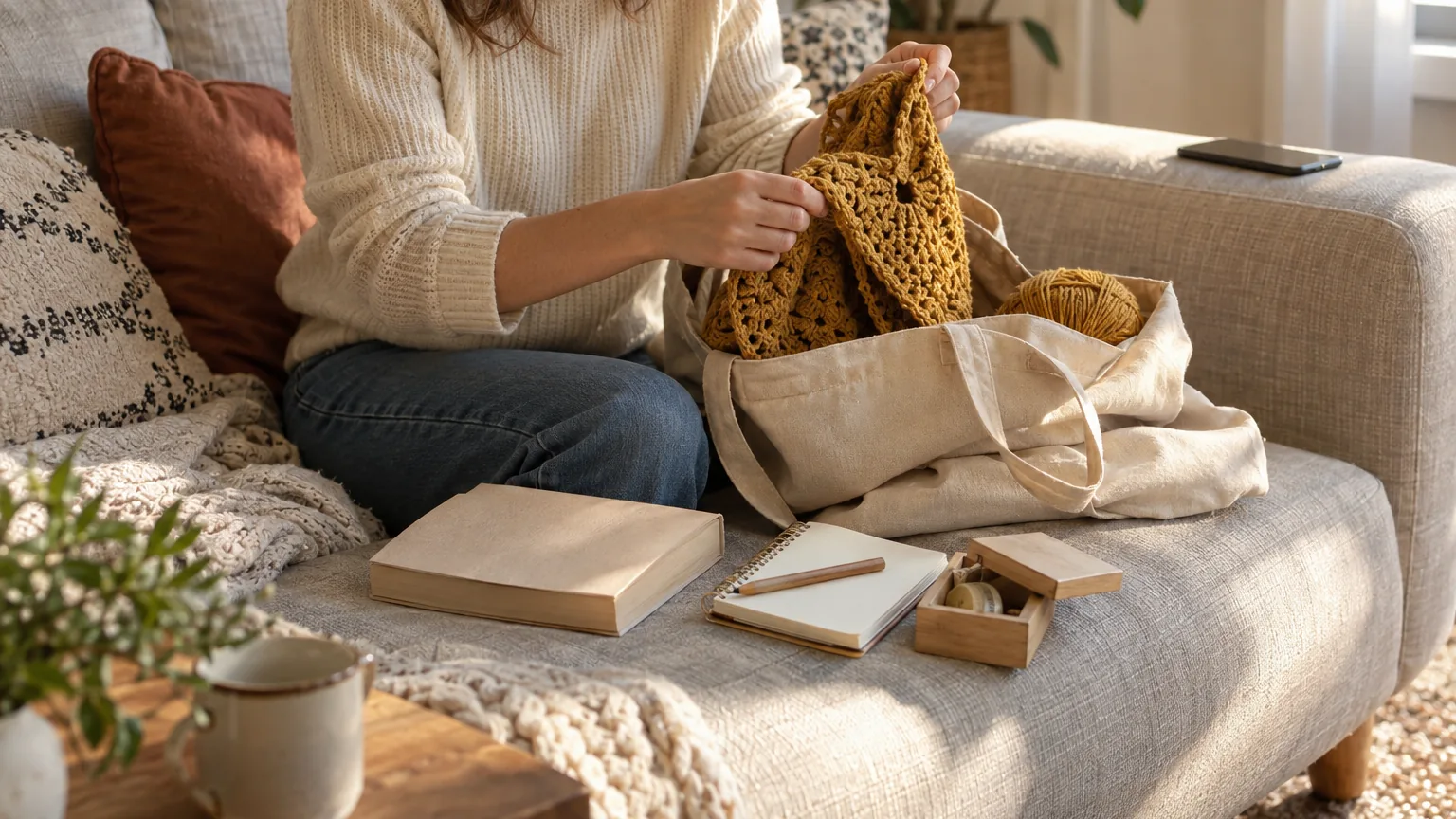
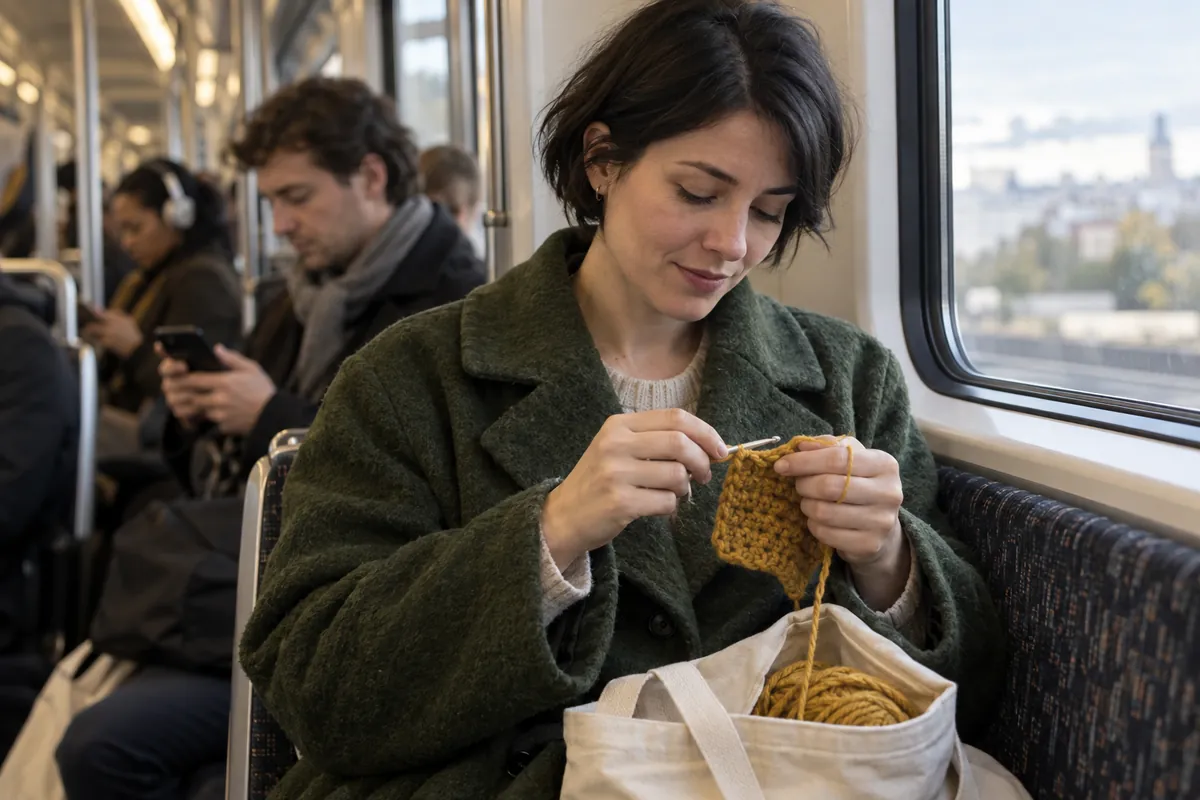
An analog bag is a small tote of offline things, a crochet project, a paperback, a notebook, that you carry so something to do with your hands is as easy to reach as your phone. The pause in your day has to go somewhere: on the train, in the waiting room, on the sofa at 9 p.m. The bag gives it somewhere other than a feed.
What an analog bag is, and where it came from
The name comes from Sierra Campbell, a content creator who decided in May 2025 to get off her phone and go "analog." She swapped scrolling for knitting, watercolors, crossword puzzles and letters to pen pals, and carried a small tote "that made her activities as accessible as a phone in her front pocket, dubbing it her 'analog bag'" [1]. She introduced the idea on TikTok that August, and it spread [1, 2]. Campbell says she has cut her screen time by two to three hours a day [1], which is one person's account, not a measurement.
Her inspiration was a book about habits. "The book, The Power of Habit by Charles Duhigg, talks about how replacing a habit [with another] is the only true way to wean off one, so I made something that mimics my phone's entertainment features without the doomscrolling," she told Marie Claire [1].
The trend isn't a rejection of technology. All the women Business Insider spoke to said the appeal "isn't anti-technology or anti-social media" [2], and one of them, Emily Karst, told Marie Claire it was "much more about intentionality than an anti-tech approach" [1]. The irony isn't lost on critics: as The Irish Times noted, it "remains an online phenomenon aimed at getting people offline" [3]. People learn about analog bags from videos on the very phones they're trying to put down.
Why an analog bag can work
Nobody has run a study of analog bags. But each part of the idea rests on research about habits and self-control.
The reach for your phone is cued by the moment. "If it's you versus your phone, the phone's going to win," Campbell told Business Insider. "Willpower alone won't work" [2]. Habit research explains why. People tend to repeat the same behaviors in the same situations, and once a habit forms it becomes "the efficient, default mode of response" [4]. The pause is the cue. Karst noticed it in herself: "that instinctive pull to grab my phone the second there was a pause in my day" [1]. Our guide to how to break bad habits explains why fighting a cued habit head on so often fails.
Changing the situation beats fighting the urge. Self-control researchers describe a family of strategies that act before temptation has a chance to grow, such as "the student who goes to the library without a cell phone." Because impulses tend to grow stronger over time, these situational strategies "may be especially effective" [5]. An analog bag is one: you decide on a calm morning what the 4 p.m. pause will offer, instead of deciding in the moment. In a week of beeper reports from 205 adults, covering 7,827 moments of desire, situational factors weighed relatively more on the later steps, whether people resisted a desire and whether they acted on it, than on how strongly they felt it [6].
The bag doesn't fight the urge. It gives the urge somewhere better to go.
The feed doesn't cure boredom; it feeds it. In seven experiments with 1,223 people, switching between videos to escape boredom made people more bored, not less, though the effect was less clear outside university samples. The researchers concluded that enjoyment "likely comes from immersing oneself in the videos rather than swiping through them" [7]. A crochet row or a chapter offers exactly that: one thing, long enough to sink into. Our guide to boredom covers why a little of it is worth keeping.
What you do instead seems to matter too. In 93,263 adults aged 65 and over across 16 countries, having a hobby went with fewer depressive symptoms and more happiness and life satisfaction, and further analyses suggested the link held over time, not just at one moment [8]. In a survey of 7,182 adults in England, making art and crafts predicted higher life satisfaction, happiness and a sense that life is worthwhile, beyond known factors such as age, health and employment [9]. Both are observational, so they can't prove the hobbies caused the gains, but they point the same way.
What to put in an analog bag
Campbell's rule of thumb: "make your analog bag compact, take it everywhere, and use it as a physical reminder that you have better things to do than just watching others live their lives on a screen!" [1]. Pack for the pauses you actually have, and keep each thing small enough to start in under a minute.
For your hands:
- A small crochet or knitting project: one ball of yarn and one hook or pair of needles.
- Needlepoint or embroidery on a small hoop.
- A pocket watercolor set and a few postcards to paint.
For your mind:
- A paperback light enough to carry every day.
- A crossword, sudoku or logic puzzle book with a pencil.
- A magazine or a newspaper, for the news without the feed.
For your thoughts and your days:
- A pocket notebook and a pen that you like using.
- A paper planner. Campbell carries one so she isn't tempted to scroll when she needs to check her calendar [2].
For music:
- A harmonica, a kalimba or a small travel ukulele, if a few quiet minutes of practice suit you.
For other people and the moment:
- A deck of cards, which turns any wait with a friend into a game.
- An instant camera, which Campbell uses to ask herself whether she really needs a photo of something [2].
For more ideas, our dopamine menu lists 50 things that beat scrolling.
How to make it stick
- Put it where the phone usually wins. By the sofa, in your work bag, on the passenger seat. The bag only works if it's closer than the habit.
- Match each item to a pause. The crochet rides the commute, the puzzle book waits in your coat for the doctor's office, the paperback lives by the bed.
- Keep one project going. A half-finished square is an invitation; a bag of things you might start someday isn't.
- Refill it when it goes stale. If you keep skipping something, swap it out. The bag only has to beat the phone at the moments you actually reach for it, so let it follow what you enjoy, not what looks good in a video.
- Give it weeks, not days. In a study of 96 volunteers forming a new daily habit, it took between 18 and 254 days for the new behavior to become as automatic as it would get, and missing one day "did not materially affect the habit formation process" [10]. A skipped day isn't a failed bag.
- Make the scroll harder at the same time. The bag is the replacement half of the habit; the other half is friction. A daily limit in Unrotten locks the apps you choose once your minutes are used up, until the day resets, so the pause can't slide back into the feed. And time away from those apps recharges your MindBattery™ in Unrotten, so the hour you spent with your crochet shows up as a fuller battery instead of a gap in your feed.

Start with one pause
You don't need a curated tote or a new hobby to begin. Pick the pause you lose to your phone most often, put one thing in a bag for it tonight, and leave the bag where your phone usually sits. Then give it two weeks. If you find yourself reaching for the bag before you think about the phone, the habit has started to change hands.
And if some days the phone still wins, that's the habit, not a verdict on you. The bag will be there at the next pause.
Questions people ask
What is an analog bag?
An analog bag is a small tote of offline things to do, such as a crochet project, a paperback, a notebook or a puzzle book, that you carry so something to do with your hands is as easy to reach as your phone. The TikTok creator Sierra Campbell named and popularized it in 2025.
What do you put in an analog bag?
Pack for the pauses you actually have: a small craft project such as crochet, knitting or needlepoint, a paperback, a pocket notebook and pen, a puzzle book, a deck of cards or a small sketchbook. A paper planner helps if you usually check your calendar on your phone. Keep it small enough to take everywhere.
Who started the analog bag trend?
Sierra Campbell, a content creator who went analog in May 2025 and introduced her analog bag on TikTok that August. She has said the idea came from Charles Duhigg's The Power of Habit and its argument that replacing a habit works better than quitting it cold.
Does an analog bag really reduce screen time?
No study has tested one. Campbell says she cut her screen time by two to three hours a day, which is one person's account. The idea rests on solid research, though: habits are cued by situations, and changing your situation before an urge builds is one of the most effective forms of self-control.
What are good analog hobbies?
Anything absorbing that uses your hands or your full attention: crochet, knitting, sketching, watercolor, puzzles, reading, journaling, cards or a musical instrument. In large surveys, people with hobbies, and adults who make art or crafts, report more life satisfaction, though those studies can't prove the hobby is the cause.
References
- Childs E. "The Analog Bag Trend Is an Antidote to Algorithm Brain Rot and Doomscrolling." Marie Claire. January 28, 2026. marieclaire.com ↩
- Ahlgrim C. "Tired of doomscrolling? It's time to start using an 'analog bag.'" Business Insider. November 6, 2025. businessinsider.com ↩
- Clarke D. "TikTok's analogue bags: Stuffed with wool, watercolour kits and no shortage of irony." The Irish Times. February 22, 2026. irishtimes.com ↩
- Wood W, Rünger D. "Psychology of Habit." Annual Review of Psychology. 2016;67:289-314. doi:10.1146/annurev-psych-122414-033417 ↩
- Duckworth AL, Gendler TS, Gross JJ. "Situational Strategies for Self-Control." Perspectives on Psychological Science. 2016;11(1):35-55. doi:10.1177/1745691615623247 ↩
- Hofmann W, Baumeister RF, Förster G, Vohs KD. "Everyday temptations: An experience sampling study of desire, conflict, and self-control." Journal of Personality and Social Psychology. 2012;102(6):1318-1335. doi:10.1037/a0026545 ↩
- Tam KYY, Inzlicht M. "Fast-forward to boredom: How switching behavior on digital media makes people more bored." Journal of Experimental Psychology: General. 2024;153(10):2409-2426. doi:10.1037/xge0001639 ↩
- Mak HW, Noguchi T, Bone JK, Wels J, Gao Q, Kondo K, et al. "Hobby engagement and mental wellbeing among people aged 65 years and older in 16 countries." Nature Medicine. 2023;29(9):2233-2240. doi:10.1038/s41591-023-02506-1 ↩
- Keyes H, Gradidge S, Forwood SE, Gibson N, Harvey A, Kis E, et al. "Creating arts and crafting positively predicts subjective wellbeing." Frontiers in Public Health. 2024;12:1417997. doi:10.3389/fpubh.2024.1417997 ↩
- Lally P, van Jaarsveld CHM, Potts HWW, Wardle J. "How are habits formed: Modelling habit formation in the real world." European Journal of Social Psychology. 2010;40(6):998-1009. doi:10.1002/ejsp.674 ↩
Written by
Maren AshbyCOO, Unrotten
Maren Ashby is the COO of Unrotten, the iPhone app that helps people take their attention back from the feed. She writes about the research on phones, sleep and focus, and about the small, practical changes that make a phone easier to put down.