

Blog/Explainer
How to Focus Better When Your Phone Won't Let You
Why you can't focus, and a routine for one hour of real work: where the phone goes, which alerts to mute, when to break and what to do with the urge to check.


In this article
You sit down to work, and twenty minutes later you've answered two messages, opened a feed you didn't mean to open and finished nothing. It's easy to decide you've simply lost the ability to focus.
Focus is less a trait you're missing than a set of conditions, and most of them can be arranged before you start. Here's a routine for one hour of real work, and what the research says about each step.
Why you can't focus
The usual reasons are ordinary ones: a short night, stress, and a phone that interrupts you, or that you interrupt yourself with. (Our guide to short attention span goes through the everyday causes one by one.)
The phone deserves a closer look, because interruptions breed interruptions. Researchers observed 36 people at three technology companies over 889 hours of work and logged every switch between tasks. People interrupted themselves about as often as others interrupted them. Each extra interruption from someone else in one hour went with about 8% more self-interruption in the next, and people who sat in open cubicles interrupted themselves 64% more than people with an office of their own [1].
The more often you're pulled away, the more often you pull yourself away.
The good news is that most of the conditions are yours to set.
Before you start
Pick one task and its finish line
Write down the one thing this hour is for, and what finished looks like: "draft the first two sections", not "work on the report". A finish line tells you when you've drifted and lets you stop cleanly. Switching away from something half done leaves part of your mind behind, which is a big part of why popcorn brain feels so scattered.
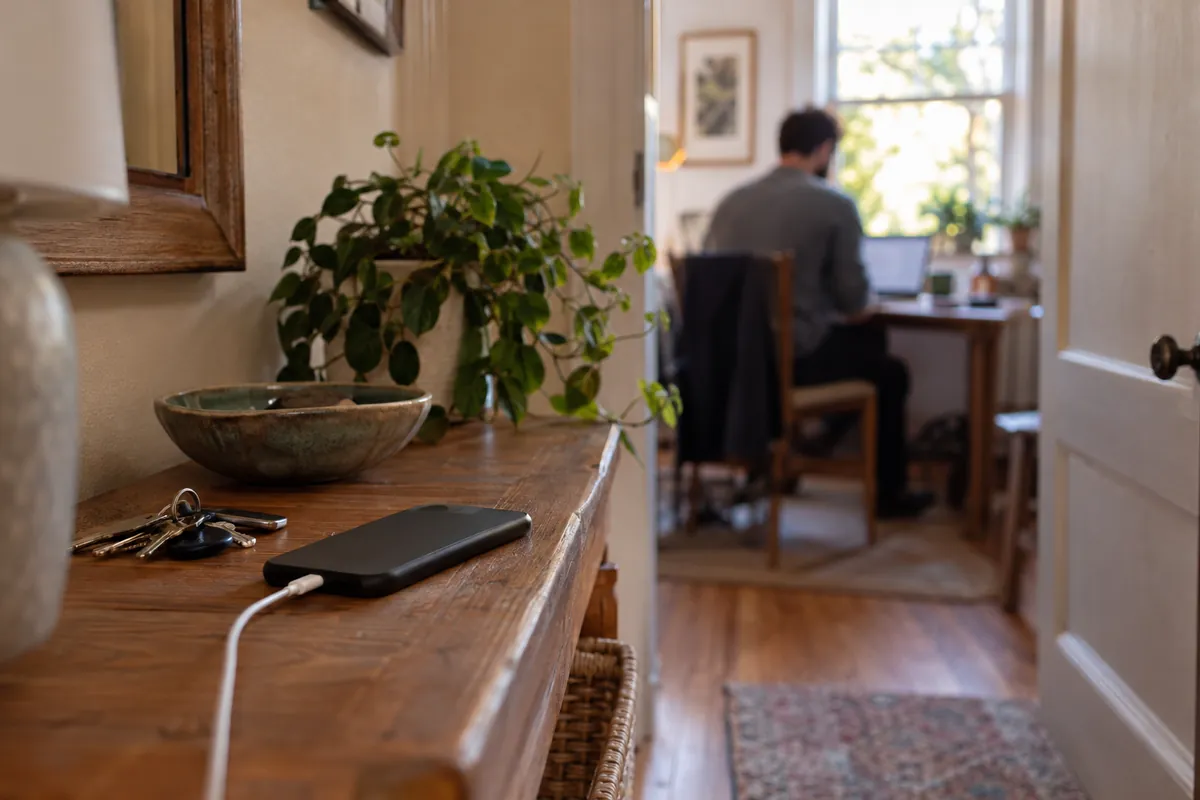
Put your phone in another room
In a 2023 experiment, 42 students took a standard concentration test, crossing out target letters among look-alikes for just under five minutes. All of them switched their phones off first. Half then left the phone face down on the desk, and the other half took it to another room. The students with the phone on the desk worked more slowly and scored lower on attention, though they were just as accurate [2].
The wider evidence is more mixed. A 2024 meta-analysis of 56 studies found that a phone's mere presence reliably affected only working memory, and only a little [3]. Distance helps either way, because it turns a reflex into a decision you'd have to stand up for.
Silence everything that isn't a person
In a field experiment, 221 people spent one week with notification alerts on and their phones within reach, and another week with alerts off and their phones out of the way. In the alerts-on week, they reported more inattention and hyperactivity, and greater inattention went with lower productivity and well-being [4].
Silence doesn't have to mean missing everything. In a two-week experiment with 237 smartphone users, people whose notifications arrived in three batches a day reported less inattention and stress, and felt more productive, than people who got them as usual. Hourly batches made little difference, and getting no notifications at all made people more anxious about missing out [5].
On an iPhone, a Focus mode lets through only the people and apps you choose while it's on, and Scheduled Summary (Settings, then Notifications) collects the rest into the times you set.
While you work
Work in blocks, with breaks set in advance
Decide the length of the block and the break before you start. In a study of 87 university students during a real day of self-study, those who followed a fixed schedule (a 6-minute break after every 24 minutes, the "Pomodoro" pattern, or 3 minutes after every 12) reported less fatigue and distraction, and more concentration and motivation, than students who chose their own breaks. The students who chose their own studied in longer stretches with longer breaks, and got no more done [6].
Breaks also protect focus inside a long, dull task. In a lab experiment with 84 people, performance on a repetitive 50-minute computer task slid steadily as time went on, except in a group that twice had to respond to digits they had memorized beforehand, a brief switch to a different task. They held their performance to the end [7].
Twenty-five minutes of work and five of rest is a good first schedule; stretch the blocks as they get easier. Make the break a real change of scene: stand up, look out of a window, refill your water. A feed makes a poor break, because it rarely ends when the timer does.

When the urge to check hits
The urge will come, often at the first hard sentence. Treat it as information, not an order:
- Write it down. Keep a scrap of paper for the thing you suddenly need to look up or answer, and deal with the list at the break.
- Go back one line. Reread the last sentence you wrote or read. Picking up a thread is easier than starting cold.
- Make giving in harder. If your hand keeps winning, let something else hold the line. A Work or Focus session in Unrotten, started from the + on Home, keeps the apps you chose locked until it ends, with a countdown on your Lock Screen and in the Dynamic Island.
Choose your soundtrack carefully
In a small experiment, 30 students answered reading-comprehension questions in quiet, with instrumental music, with songs they liked and with songs they disliked. They did best in quiet or with instrumental music, and worst with songs that had lyrics, whether they liked those songs or not [8]. For reading and writing, pick quiet or music without words.
When you can't focus on anything
Some days nothing sticks, however well you set up the hour. That's usually a sign to change the size of the task or the place you're doing it, not to push harder.
- Shrink the block. If 25 minutes feels impossible, do 10. A short block you finish sets up the next one better than a long one you abandon.
- Start with the easiest piece. Answer the one email, outline one paragraph, open the file and give it a name. Momentum is easier to keep than to find.
- Change the room. Surroundings matter: in the study of technology workers, people in open cubicles interrupted themselves far more often than people with an office of their own [1]. A quieter corner, a library or a door you can close can do more than willpower.
- Look at the last few nights. If they were short, start there; our guide to short attention span explains why sleep comes before any routine.
Plan your day around your focus
Focus has a daily rhythm. When researchers logged the computer use of 32 office workers for five days and asked them throughout each day how they felt, focus peaked in mid-afternoon, while boredom was highest in early afternoon [9]. Your own peak may differ, so watch your week for a few days, then give your best hours to the work that needs them and leave messages and meetings for the rest.
To keep those hours clear, Unrotten's Focus on what matters goal protects a window of each day from the apps you chose, and its shield has no "ignore limit" button.
Start with the next hour
The whole routine fits on a sticky note:
- One task, with a finish line.
- Phone in another room.
- Alerts from people only, the rest in batches.
- Blocks, with breaks you set in advance.
- Quiet, or music without words.
If you do all of that and still can't focus most days, look at sleep and stress first. If the trouble goes back to childhood and shows up in every part of your life, or comes with low mood, anxiety or sleep problems that don't lift, a doctor can help work out the cause. And to build the capacity itself over the coming weeks, read how to improve your attention span.
Questions people ask
Why can't I focus?
Usually for ordinary reasons: a short night, stress, and a phone that interrupts you or that you keep picking up. Interruptions also breed more of them. In one study of office workers, each interruption from someone else went with more self-interruption in the following hour.
How can I focus better while working or studying?
Pick one task with a clear finish line, put your phone in another room, silence alerts from anything that isn't a person, and work in timed blocks with breaks you set in advance, such as 25 minutes of work and 5 of rest.
Does listening to music help you focus?
It depends on the music and the task. In a small experiment, students understood what they read best in quiet or with instrumental music, and worst with songs that had lyrics, whether they liked those songs or not.
Should I turn off all my notifications to focus?
Not necessarily. In a two-week experiment, people whose notifications arrived in three batches a day reported less inattention and stress, while people who got no notifications at all became more anxious about missing out. Silence what isn't a person and batch the rest.
When should I worry that I can't focus?
If trouble focusing goes back to childhood and affects every part of your life, or comes with low mood, anxiety or sleep problems that don't lift, talk to a doctor, who can help work out the cause.
References
- Dabbish L, Mark G, González VM. "Why do I keep interrupting myself? Environment, habit and self-interruption." Proceedings of the SIGCHI Conference on Human Factors in Computing Systems. 2011:3127-3130. doi:10.1145/1978942.1979405 ↩
- Skowronek J, Seifert A, Lindberg S. "The mere presence of a smartphone reduces basal attentional performance." Scientific Reports. 2023;13(1):9363. doi:10.1038/s41598-023-36256-4 ↩
- Parry DA. "Does the mere presence of a smartphone impact cognitive performance? A meta-analysis of the 'brain drain effect'." Media Psychology. 2024;27(5):737-762. doi:10.1080/15213269.2023.2286647 ↩
- Kushlev K, Proulx J, Dunn EW. "'Silence your phones': smartphone notifications increase inattention and hyperactivity symptoms." Proceedings of the 2016 CHI Conference on Human Factors in Computing Systems. 2016:1011-1020. doi:10.1145/2858036.2858359 ↩
- Fitz N, Kushlev K, Jagannathan R, Lewis T, Paliwal D, Ariely D. "Batching smartphone notifications can improve well-being." Computers in Human Behavior. 2019;101:84-94. doi:10.1016/j.chb.2019.07.016 ↩
- Biwer F, Wiradhany W, Oude Egbrink MGA, de Bruin ABH. "Understanding effort regulation: comparing 'Pomodoro' breaks and self-regulated breaks." British Journal of Educational Psychology. 2023;93(Suppl 2):353-367. doi:10.1111/bjep.12593 ↩
- Ariga A, Lleras A. "Brief and rare mental 'breaks' keep you focused: deactivation and reactivation of task goals preempt vigilance decrements." Cognition. 2011;118(3):439-443. doi:10.1016/j.cognition.2010.12.007 ↩
- Perham N, Currie H. "Does listening to preferred music improve reading comprehension performance?" Applied Cognitive Psychology. 2014;28(2):279-284. doi:10.1002/acp.2994 ↩
- Mark G, Iqbal ST, Czerwinski M, Johns P. "Bored Mondays and focused afternoons: the rhythm of attention and online activity in the workplace." Proceedings of the SIGCHI Conference on Human Factors in Computing Systems. 2014:3025-3034. doi:10.1145/2556288.2557204 ↩
Written by
Maren AshbyCOO, Unrotten
Maren Ashby is the COO of Unrotten, the iPhone app that helps people take their attention back from the feed. She writes about the research on phones, sleep and focus, and about the small, practical changes that make a phone easier to put down.