Blog/Habits & self-control/Explainer
How to Break Bad Habits: Why Willpower Fails and What Works
Habits run on cues, not decisions. How to find yours, break the link and replace the habit, with the phone habit most of us share as the example.


In this article
You've decided to stop before. No phone at dinner, no scrolling in bed, no "just checking" before the first coffee. Then the moment comes and your hand is already there. That isn't a flaw in your character: habits don't run on decisions, so deciding harder rarely breaks them. Here's what does, from the research on how habits work, with the phone habit most of us share as the running example.
Why bad habits are so hard to break
A habit is a shortcut from a cue to an action
Psychologists describe a habit as a response your brain has tied to a context through repetition: the same action in the same place or moment, often enough that the moment itself starts the action [1]. Once that link forms, the habit becomes the efficient, default way to respond, and it runs with very little thought [1].
That's why the phone comes out in the elevator, at the red light and while the kettle boils. Those moments have become cues.
Liking it has little to do with it
A study at a cinema showed how little motivation matters once a habit is strong. People with a strong habit of eating popcorn at the movies ate as much stale popcorn as fresh, and their hunger and how much they liked it made little difference [2]. Two things did break the pattern: eating it somewhere other than a cinema, and eating it with their non-dominant hand. Out of its usual context, or made awkward, the habit lost its grip [2].
Swap the popcorn for a feed you don't even enjoy anymore and you have the most common phone habit there is.
Stress hands the controls to autopilot
In a lab experiment, people who were put under stress before they learned a simple task kept responding out of habit after they had eaten their fill of one of its food rewards, while people who weren't stressed adjusted [3]. It's one lab study, but it matches ordinary experience: the scroll wins on the tired, anxious evenings, exactly when your resolve is weakest.
You don't break a habit by wanting it less. You break the link between the moment and the action.
How long does it take to break a habit?
There's no reliable number for breaking a habit, because studies mostly time how long a new behavior takes to become automatic. That's the useful half anyway, since you usually replace a habit rather than erase it.
In the best-known study, 96 volunteers chose a new eating, drinking or exercise behavior and repeated it daily in the same context, such as after breakfast, for 12 weeks. The time it took to become close to automatic ranged from 18 to 254 days, and missing one day didn't materially affect the process [4]. A 2024 review of 20 studies with 2,601 participants found that, where studies timed it, the median was 59 to 66 days, and individual times ran from 4 to 335 days [5].
So expect about two months, and don't worry if yours takes longer. The famous 21 days isn't what these studies found.
How to break a bad habit: seven steps
1. Find the cue
For a few days, notice where you are, what time it is, what you were doing and how you felt each time the habit happens. For your phone, Screen Time (in Settings) shows how many times a day you pick it up and which apps take the time. Most people find that a handful of moments do most of the damage: waking up, waiting, the evening on the sofa, the moment work gets hard.
2. Watch for the slip as it happens
In two diary studies, people controlled their strong bad habits best with what the researchers called vigilant monitoring: watching carefully for slip-ups and thinking "don't do it" when the urge arrived. No other strategy people used on their own worked as well against strong habits [6]. It sounds simple because it is. Once you know your cues, you can catch the reach.
Unrotten's Fewer app returns goal turns that watching into a number: a daily target for how many times you open the apps that pull you in, so each time you open them counts against something you chose.
3. Change the context
Habits lean on their surroundings. When students transferred to a new university, their habits of exercising, reading the paper and watching TV survived only when parts of the old context came along, such as reading the paper with other people [7]. A move, a new job or a new term breaks many cues at once, which makes it a good moment to change.
You don't need to move house. Charge the phone in the hallway instead of on the nightstand, move the apps that hook you off the Home Screen, and sit in a different chair in the evening. Each change removes a cue.
4. Add friction
Make the habit slower and the urge has time to pass. In a six-week field experiment with 280 people, an app that paused for a moment before their chosen apps opened, and offered a way to back out, cut how often they actually opened those apps by 57% [8]. In a follow-up experiment, the option to back out did the most work and the wait helped too. One of the authors created the app, which our one sec review looks at in detail.
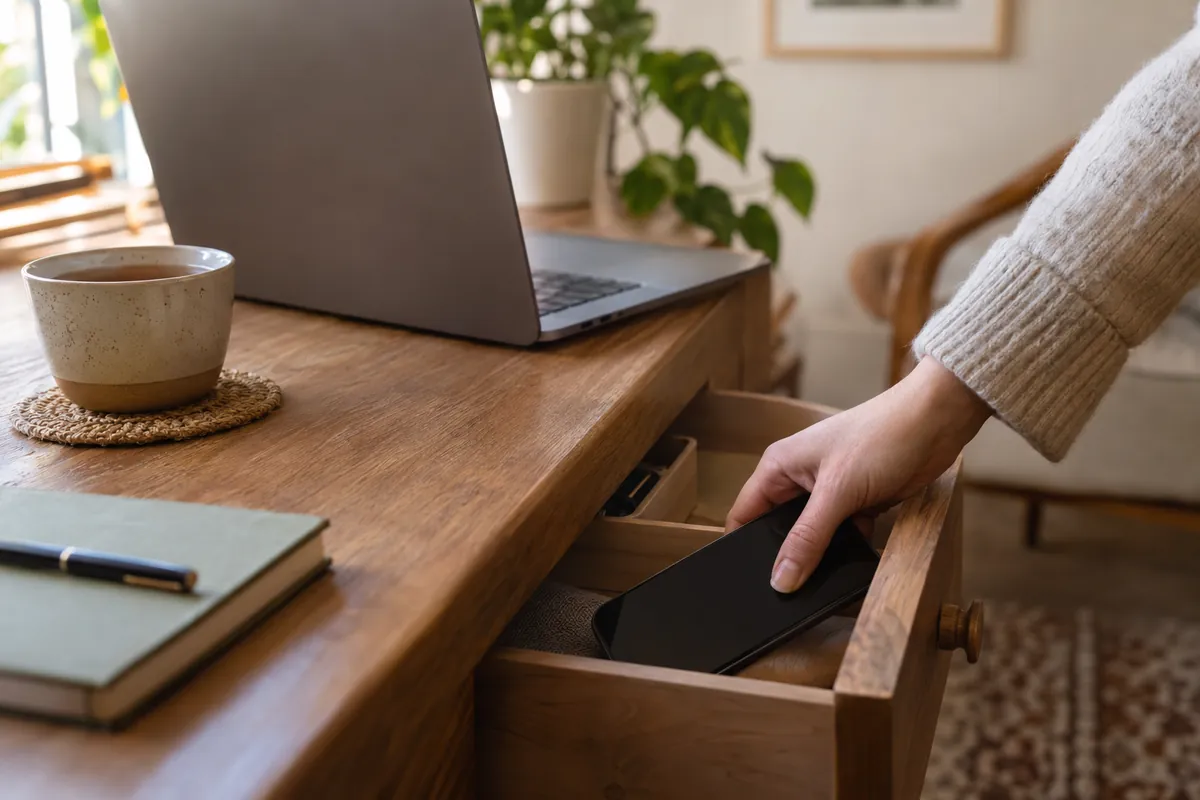
Distance is friction as well. A phone in a drawer or another room takes a decision to reach; a phone in your pocket takes none. Logging out of an app, or deleting it and using the slower website, works the same way.
5. Replace it, don't just remove it
A habit fills a need: rest, company, a break from something hard. Take the habit away and the need stays. Researchers who had people write if-then plans, such as "If I sit on the sofa after dinner, then I'll pick up my book," found that the plans weakened the habit's automatic pull, but that behavior changed only as far as people truly wanted the replacement [9]. So choose something you'd enjoy, not a chore, and plan it for the exact moment the old habit used to fill:
- The first check of the morning: a glass of water and five minutes at the window before the phone comes off the charger.
- The sofa after dinner: a book, a call to a friend, or something for your hands, such as a guitar, a puzzle or a sketchbook.
- The moment work gets hard: stand up, stretch, refill your glass, then go back to the task.
- The scroll in bed: a paper book on the nightstand, with the phone charging in another room.
A small study without a control group shows what happens when you skip this step. Thirty-one young adults kept social media under 30 minutes a day for two weeks, measured by their iPhones' Screen Time. Their use fell from about 130 minutes a day to 25, and they slept better and felt less stressed. But some filled the gap with other screens (chess, Netflix, YouTube, the laptop), and once the limit ended, several described binging for the first few days. Over the two weeks after, their social media time averaged about 117 minutes a day again [10].
A habit you remove leaves a gap. If you don't decide what fills it, the old habit will.
For ideas, a dopamine menu lists dozens of better rewards, and habit stacking shows how to tie a new habit to something you already do every day.

6. Make it hold on the bad days
Stress pushes behavior toward habit [3], so plan for the evening you're exhausted, not the morning you're motivated. Make the decision in advance and put it somewhere it can't be undone in a weak moment. A daily limit in Unrotten does that for the apps you choose: once the minutes you set are used up, Apple's Screen Time shield locks them until the day resets. The shield has no "ignore limit" button, and a raised limit only counts from the next day.
7. Expect slips, and keep going
Missing a single day didn't derail the habits people built in the 12-week study [4]. Treat a slip as information about a cue you missed, adjust the plan for that moment, and carry on. What matters is the next time, not a perfect record.
When it's more than a habit
Most phone habits respond to these steps. If you keep trying and can't cut back, or your phone use comes with low mood, anxiety or sleep problems that last for weeks, a doctor or therapist can help. Our guide to phone addiction covers the signs worth taking seriously.
Start with one cue
Pick the habit that costs you most, find its first cue, and change one thing about that moment this week. Leave the rest for later. Habits were built one repetition at a time, and they come apart the same way.
Questions people ask
How long does it take to break a bad habit?
Expect about two months, with wide variation. Studies mostly time how long a new behavior takes to become automatic: in one study it took from 18 to 254 days, and a 2024 review of 20 studies found median times of 59 to 66 days. Missing a single day didn't derail the process.
What is the best way to break a bad habit?
Work on the cue rather than on your willpower. Find the moments that set the habit off, change them where you can, add friction so the habit takes longer, and plan a replacement you actually want for the same moment. When the urge comes anyway, watch for it and tell yourself not to: in two diary studies, that kind of vigilant monitoring worked best against strong habits.
Why is it so hard to break a habit?
A habit is a learned link between a context and an action, so it runs with little thought and barely depends on how much you want it. In one study, people with a strong popcorn habit at the movies ate as much stale popcorn as fresh. Stress makes it harder, because it pushes behavior toward autopilot.
Is it better to replace a bad habit than to stop it?
Usually, yes. A habit meets a need, and if nothing planned fills its moment, something similar tends to. In a small study, people who limited social media for two weeks often switched to other screens, and their use climbed back once the limit ended.
References
- Wood W, Rünger D. "Psychology of Habit." Annual Review of Psychology. 2016;67:289-314. doi:10.1146/annurev-psych-122414-033417 ↩
- Neal DT, Wood W, Wu M, Kurlander D. "The pull of the past: when do habits persist despite conflict with motives?" Personality and Social Psychology Bulletin. 2011;37(11):1428-1437. doi:10.1177/0146167211419863 ↩
- Schwabe L, Wolf OT. "Stress prompts habit behavior in humans." Journal of Neuroscience. 2009;29(22):7191-7198. doi:10.1523/JNEUROSCI.0979-09.2009 ↩
- Lally P, van Jaarsveld CHM, Potts HWW, Wardle J. "How are habits formed: Modelling habit formation in the real world." European Journal of Social Psychology. 2010;40(6):998-1009. doi:10.1002/ejsp.674 ↩
- Singh B, Murphy A, Maher C, Smith AE. "Time to Form a Habit: A Systematic Review and Meta-Analysis of Health Behaviour Habit Formation and Its Determinants." Healthcare. 2024;12(23):2488. doi:10.3390/healthcare12232488 ↩
- Quinn JM, Pascoe A, Wood W, Neal DT. "Can't control yourself? Monitor those bad habits." Personality and Social Psychology Bulletin. 2010;36(4):499-511. doi:10.1177/0146167209360665 ↩
- Wood W, Tam L, Witt MG. "Changing circumstances, disrupting habits." Journal of Personality and Social Psychology. 2005;88(6):918-933. doi:10.1037/0022-3514.88.6.918 ↩
- Grüning DJ, Riedel F, Lorenz-Spreen P. "Directing smartphone use through the self-nudge app one sec." Proceedings of the National Academy of Sciences. 2023;120(8):e2213114120. doi:10.1073/pnas.2213114120 ↩
- Adriaanse MA, Gollwitzer PM, De Ridder DTD, de Wit JBF, Kroese FM. "Breaking habits with implementation intentions: a test of underlying processes." Personality and Social Psychology Bulletin. 2011;37(4):502-513. doi:10.1177/0146167211399102 ↩
- Coyne P, Woodruff SJ. "Taking a Break: The Effects of Partaking in a Two-Week Social Media Digital Detox on Problematic Smartphone and Social Media Use, and Other Health-Related Outcomes among Young Adults." Behavioral Sciences. 2023;13(12):1004. doi:10.3390/bs13121004 · Read our plain-English summary ↩
Written by
Maren AshbyCOO, Unrotten
Maren Ashby is the COO of Unrotten, the iPhone app that helps people take their attention back from the feed. She writes about the research on phones, sleep and focus, and about the small, practical changes that make a phone easier to put down.