Blog/Screen time for adults/Guide
How to Reduce Screen Time: The Changes That Actually Work
Find where the hours go, pick a number you can hit and change your phone instead of your willpower: what the trials found, step by step.


In this article
You open your weekly Screen Time report, see a number that makes you wince, and promise yourself next week will be better. Next week, the number is the same. That isn't a failure of character. Screen time rarely comes down because you try harder. It comes down when you change what surrounds the habit, and a growing set of trials shows which changes actually move the number.
Here's how to reduce screen time in four steps: find where the hours go, pick a target you can hit, change the phone itself, and make the change last.
Why trying harder doesn't work
Most screen time isn't one long decision. It's dozens of small ones: a check while the kettle boils, a notification that turns into a scroll, the feed that keeps going after the video you meant to watch. Each one feels too short to count, which is exactly why the total surprises you.
Our sense of that total is unreliable. When researchers pooled 47 studies that compared people's estimates of their own screen time with what their devices logged, the two matched only moderately, and the estimates were rarely accurate [1]. You can't cut what you can't see, so the first step is to look.
Good intentions also fade for a reason. From a 12-week experiment with about 2,000 American Android users, economists estimated that self-control problems account for about 31% of social media use [3]. Part of your screen time, in other words, is time you'd choose not to spend if choosing were easy in the moment. The fixes that work make the choice in advance.
Step 1: Find where the hours go
On an iPhone, Screen Time in Settings shows your daily average, the apps you use most, how often you pick the phone up and which apps send the most notifications. Our guide to seeing your screen time on iPhone walks through each number.
Look for three things:
- The top two or three apps. Those are the ones to work on. Leave maps, music and messages alone.
- Pickups. Many short checks add up, and each one is a chance to fall into a feed.
- When it happens. If much of it falls late at night or right after you wake up, start there: a window of time is easier to protect than a whole day.

Step 2: Pick a target you can hit
"Less" isn't a target. A number is, and it doesn't have to be dramatic, because smaller cuts hold up well.
- One hour less a day. In a German experiment, 619 smartphone users either gave up their phone for a week, used it one hour less each day, or carried on as before. Both changes helped, with fewer symptoms of depression and anxiety and more time being active, and the hour less a day held up better four months later [4].
- About 30 minutes of social media. In a trial at the University of Pennsylvania, students who cut Facebook, Instagram and Snapchat to 10 minutes each a day for three weeks felt less lonely and less depressed than a control group [5].
If you're not sure what a healthy total looks like, our guide to how much screen time is too much puts the numbers in context. Then write your target down per app, not just as a total: "Instagram, 20 minutes" is easier to keep than "less phone".
You don't need less phone. You need less of two or three apps, at the hours that matter to you.
Step 3: Change the phone, not your willpower
This is where screen time actually comes down. Most of the changes below have been tested in trials, and you can combine them.
Set limits before you need them
A limit you set on a calm Sunday morning beats a decision you make at 11 p.m. with the feed already open. In the 12-week experiment, 78% of the people offered an app for setting daily limits on their own phones set limits that bit, and their time on social media, browsers and YouTube fell by 22 minutes a day, or 16% [3]. Our guide to locking apps on iPhone shows how to set limits up with Screen Time.
One catch: Apple's own limits come with an "ignore limit" button, and at the end of a long day that button is easy to tap. A daily limit in Unrotten locks the apps you choose with Apple's Screen Time shield once the day's time is used, until the day resets, and its shield has no "ignore limit" button.
Make the phone less tempting
Color, badges and endless thumbnails are part of the pull. In a study of 161 college students, the 73 who switched their screens to grayscale for 8 to 10 days cut their total screen time by about 38 minutes a day, with less time on social media and web browsing [6]. Our guide to grayscale on iPhone shows how to turn it on.
Then make the feeds harder to reach. Move them off your Home Screen into a folder on the last page, or delete the apps and use the website on the rare occasions you need them. Each extra step is a moment to decide.
Tame notifications instead of killing them
Every buzz is an invitation back into the feed. In a two-week field experiment with 237 people, those whose notifications arrived in three batches a day felt more attentive, more productive and more in control of their phones than people who got notifications as usual. People who got no notifications at all felt more anxious and more afraid of missing out [7]. So keep calls and messages from people, and batch or silence the apps that only want you back.
Take a few changes from the menu
You don't have to pick one trick. In a randomized trial at McGill University in Montreal, young adults chose from a menu of ten simple changes, such as turning off non-essential notifications, switching to grayscale and sometimes leaving the phone at home. Their screen time fell by 57 minutes a day, against 11 minutes for a group that only tracked it, and their sleep improved [2]. Two weeks in, they were still following about seven of the ten. Turning off notifications was the easiest change to keep; grayscale and leaving the phone at home were the hardest.
Move the charger out of the bedroom
The hour before sleep is an easy place for screen time to grow, because nothing ends it. Charge the phone outside the bedroom and put a cheap alarm clock by the bed, so the phone isn't the last thing you touch at night and the first in the morning. Screens and sleep also feed each other over time: in a study that followed 31,361 UK adults for about seven years, heavy TV and leisure computer use predicted worse sleep later, and poor sleep predicted more screen time [10].
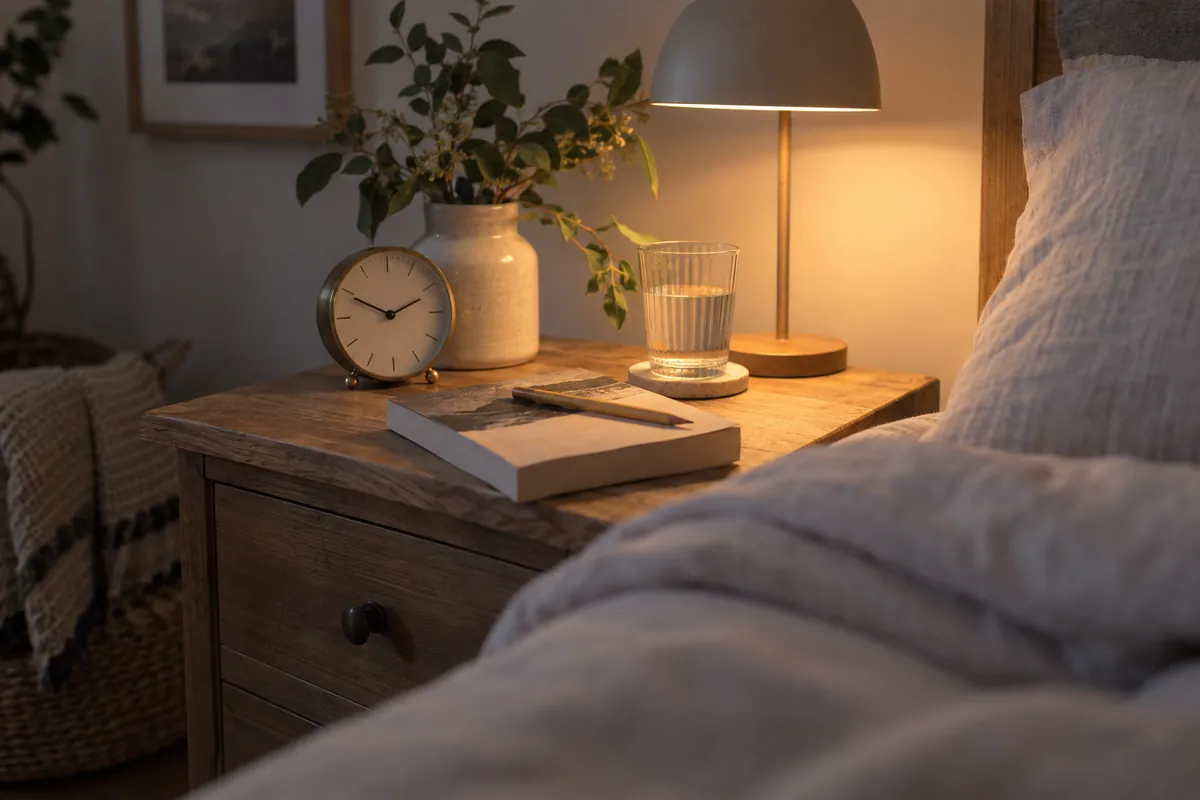
Plan what fills the gap
Taking time away from screens doesn't automatically put something better in its place. In a Danish trial, 45 of 89 families cut their leisure screen use to three hours a week each for two weeks. Their children moved about 46 more minutes a day than children in the families that carried on as usual, but the adults' activity didn't change significantly, and the researchers think they mostly swapped screens for other ways of sitting [9]. Decide in advance what the freed hour is for: a walk after dinner, a book on the nightstand, the call you keep meaning to make.
Step 4: Make the change last
Expect the number to creep back. In a trial that capped students' smartphone use at two hours a day for three weeks, they slept better and reported less stress, fewer symptoms of depression and higher well-being than a control group, small to medium improvements. Once the cap ended, their screen time climbed back toward where it started [8]. A limit helps most while it's still there.
So keep the changes that worked, and look at the weekly report on the same day each week. Seeing the cost as it happens helps too. In Unrotten, the MindBattery™, a score from 0 to 100 on your Lock Screen and in the Dynamic Island, drains while you use the apps you chose and recharges with sleep, movement and time away from them. If long sessions are your problem rather than many short checks, Shorter scroll sessions makes those apps take a break once a session runs past the length you set.
What you get back
The trials above measured more than minutes. The benefits of less screen time were mostly about how people felt and slept:
- Better sleep. In the McGill trial and the two-hour trial, sleep improved [2, 8].
- A lighter mood. Students who kept social media to about 30 minutes a day felt less lonely and less depressed [5], and people who used their phones an hour less a day reported fewer symptoms of depression and anxiety and more life satisfaction [4].
- Less stress. The two-hour cap lowered stress as well [8].
Most of these effects were small to medium, and they came from cutting back, not from quitting. If low mood, anxiety or poor sleep stay with you even after you've cut back, a doctor or therapist can help.
Start with this week
Open your report, find the top app, set one limit on it and make one change from Step 3. Next week, look at the number again. Then add the next change. Screen time comes down a few steps at a time, and it stays down when the steps stay in place.
Questions people ask
What is the best way to reduce screen time?
Change your phone rather than relying on willpower. In trials, the changes that worked were limits set in advance, a less tempting phone (grayscale, fewer notifications, feeds off the Home Screen) and a plan for the time you free. In one randomized trial, young adults who picked from a menu of ten such changes cut their screen time by 57 minutes a day.
How much should I cut my screen time?
Aim for less, not zero. In a German experiment with 619 smartphone users, using the phone one hour less a day helped, and its benefits held up better over four months than a week without the phone. For social media, a trial that capped it at about 30 minutes a day found that people felt less lonely and less depressed.
What are the benefits of less screen time?
In randomized trials, people who cut back on their phones reported better sleep, less stress, fewer symptoms of depression and higher well-being, mostly small to medium improvements. In a study that followed 31,361 UK adults for about seven years, heavy leisure screen time and poor sleep each predicted the other.
Why does my screen time go back up?
Because the pull of the apps doesn't change when your resolution fades. In a three-week trial that capped phone use at two hours a day, screen time climbed back toward its old level once the cap ended. Limits help most while they stay in place, so keep the ones that work.
References
- Parry DA, Davidson BI, Sewall CJR, Fisher JT, Mieczkowski H, Quintana DS. "A systematic review and meta-analysis of discrepancies between logged and self-reported digital media use." Nature Human Behaviour. 2021;5(11):1535-1547. doi:10.1038/s41562-021-01117-5 · Read our plain-English summary ↩
- Olson JA, Sandra DA, Chmoulevitch D, Raz A, Veissière SPL. "A Nudge-Based Intervention to Reduce Problematic Smartphone Use: Randomised Controlled Trial." International Journal of Mental Health and Addiction. 2023;21(6):3842-3864. doi:10.1007/s11469-022-00826-w · Read our plain-English summary ↩
- Allcott H, Gentzkow M, Song L. "Digital Addiction." American Economic Review. 2022;112(7):2424-2463. doi:10.1257/aer.20210867 ↩
- Brailovskaia J, Delveaux J, John J, et al. "Finding the 'sweet spot' of smartphone use: Reduction or abstinence to increase well-being and healthy lifestyle?! An experimental intervention study." Journal of Experimental Psychology: Applied. 2023;29(1):149-161. doi:10.1037/xap0000430 · Read our plain-English summary ↩
- Hunt MG, Marx R, Lipson C, Young J. "No More FOMO: Limiting Social Media Decreases Loneliness and Depression." Journal of Social and Clinical Psychology. 2018;37(10):751-768. doi:10.1521/jscp.2018.37.10.751 · Read our plain-English summary ↩
- Holte AJ, Ferraro FR. "True colors: Grayscale setting reduces screen time in college students." The Social Science Journal. 2023;60(2):274-290. doi:10.1080/03623319.2020.1737461 ↩
- Fitz N, Kushlev K, Jagannathan R, Lewis T, Paliwal D, Ariely D. "Batching smartphone notifications can improve well-being." Computers in Human Behavior. 2019;101:84-94. doi:10.1016/j.chb.2019.07.016 · Read our plain-English summary ↩
- Pieh C, Humer E, Hoenigl A, et al. "Smartphone screen time reduction improves mental health: a randomized controlled trial." BMC Medicine. 2025;23(1):107. doi:10.1186/s12916-025-03944-z · Read our plain-English summary ↩
- Pedersen J, Rasmussen MGB, Sørensen SO, et al. "Effects of Limiting Recreational Screen Media Use on Physical Activity and Sleep in Families With Children: A Cluster Randomized Clinical Trial." JAMA Pediatrics. 2022;176(8):741-749. doi:10.1001/jamapediatrics.2022.1519 · Read our plain-English summary ↩
- Sampasa-Kanyinga H, Chaput JP, Huang BH, Duncan MJ, Hamer M, Stamatakis E. "Bidirectional associations of sleep and discretionary screen time in adults: Longitudinal analysis of the UK biobank." Journal of Sleep Research. 2023;32(2):e13727. doi:10.1111/jsr.13727 · Read our plain-English summary ↩
Written by
Maren AshbyCOO, Unrotten
Maren Ashby is the COO of Unrotten, the iPhone app that helps people take their attention back from the feed. She writes about the research on phones, sleep and focus, and about the small, practical changes that make a phone easier to put down.