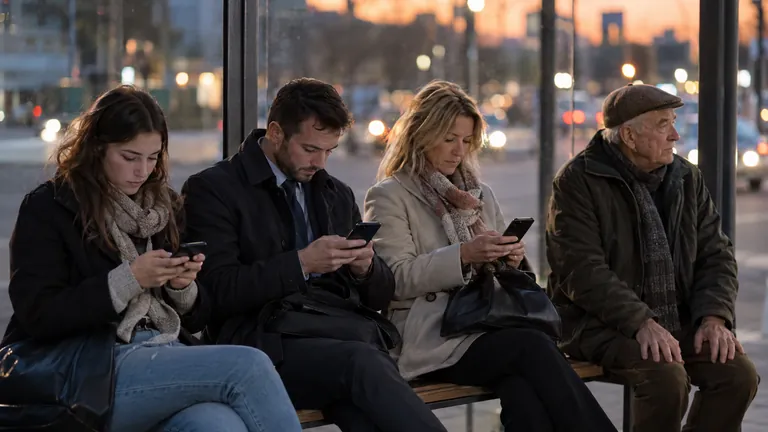

Blog/Explainer
How Much Screen Time Is Too Much for Adults?
There's no official limit for grown-ups. The research points somewhere more useful: what your hours replace, how they leave you and whether you can stop.


In this article
Your phone's weekly report says 5 hours and 12 minutes a day. Is that too much? For adults there's no official answer, and the honest one is more useful than a number: screen time is too much when it crowds out sleep, movement and people, when you keep going after you meant to stop, and when it leaves you feeling worse.
Here's what the research says about hours, the signs that matter more than hours, and how to set a limit that fits your life.
Is there a recommended screen time for adults?
No. Children get numbers; grown-ups don't. When the World Health Organization updated its guidelines on physical activity and sedentary behaviour in 2020, it recommended that people of every age cut down on time spent sitting, but its experts found the evidence too thin to say how much is too much [1].
That leaves adults with a fair question and no official line. It also makes sense. Eight hours in front of a spreadsheet, an hour on a video call with your parents and two hours of short videos in bed all count as screen time, and they don't do the same things to you.
So the better question isn't how many hours. It's what those hours cost you. If you're curious how your own number compares with other people's, we gathered the figures in our guide to average screen time for adults.
What studies link with heavy screen time
The research on adults can't draw a safe line, but it does show where trouble tends to start.
Long evenings of TV. A meta-analysis pooled data from more than a million adults to look at sitting, TV and death rates. Watching TV for 3 hours or more a day went with higher mortality however active people were, with one exception: in the most active quarter, people who got roughly 60 to 75 minutes of moderate activity a day, the higher risk appeared only at 5 hours of TV a day or more [2]. These are associations, and TV stands in for long, still evenings on the couch. Movement softened the link but didn't erase it.
Four to six hours and mood. In a US national health survey of 3,201 adults, people who spent 4 to 6 hours a day watching TV or using a computer had about 1.9 times the odds of moderate or severe depression compared with people who spent less than 4 hours; above 6 hours, the odds were 2.3 times as high [3]. The survey was a snapshot, so it can't say whether the screens came first or the low mood did. Probably some of both.
Time alone explains little. A meta-analysis of 61 studies with nearly 20,000 people found only a weak link between more time on social networking sites and lower well-being: an average correlation of 0.07, where 0 means no relationship and 1 a perfect one [4]. Two people with the same daily number can feel very differently about their phones.
Losing control matters more. What does track with distress is problematic use: wanting to cut back and not managing to, reaching for the phone without deciding to, use that gets in the way of daily life. A systematic review of 23 studies found that problematic smartphone use was consistently related to how severe people's depression was, with at least medium effects, and to anxiety, with smaller ones [5]. Those studies were correlational too, but read together with the last point they say something useful: how you use your phone tells you more than how long.
Phones after lights out. In a survey of 844 adults aged 18 to 94, six in ten took their phone into the bedroom. Those who texted or took calls after turning off the lights reported worse sleep, and bedtime phone use went with more insomnia symptoms and more fatigue [6].
Signs your screen time is too much for you
Because hours on their own tell you so little, look at what they do. Your screen time is probably too much if:
- It costs you sleep. You go to bed later than you meant to, or the phone is the last thing you see at night and the first thing you reach for in the morning.
- It replaces movement. There was no time for a walk today, but there were two hours for videos.
- It gets between you and people. Someone has to repeat a question, or dinner happens around a screen.
- You keep going after you meant to stop. Five minutes in the driveway turns into twenty.
- You feel worse afterward. Flat, anxious, behind or annoyed with yourself, rather than rested.
- The real number surprises you. If your weekly report makes you wince, take it seriously. People's estimates of their own use agree only moderately with what their devices record and are rarely accurate [7], so most of us don't know our number until we look.
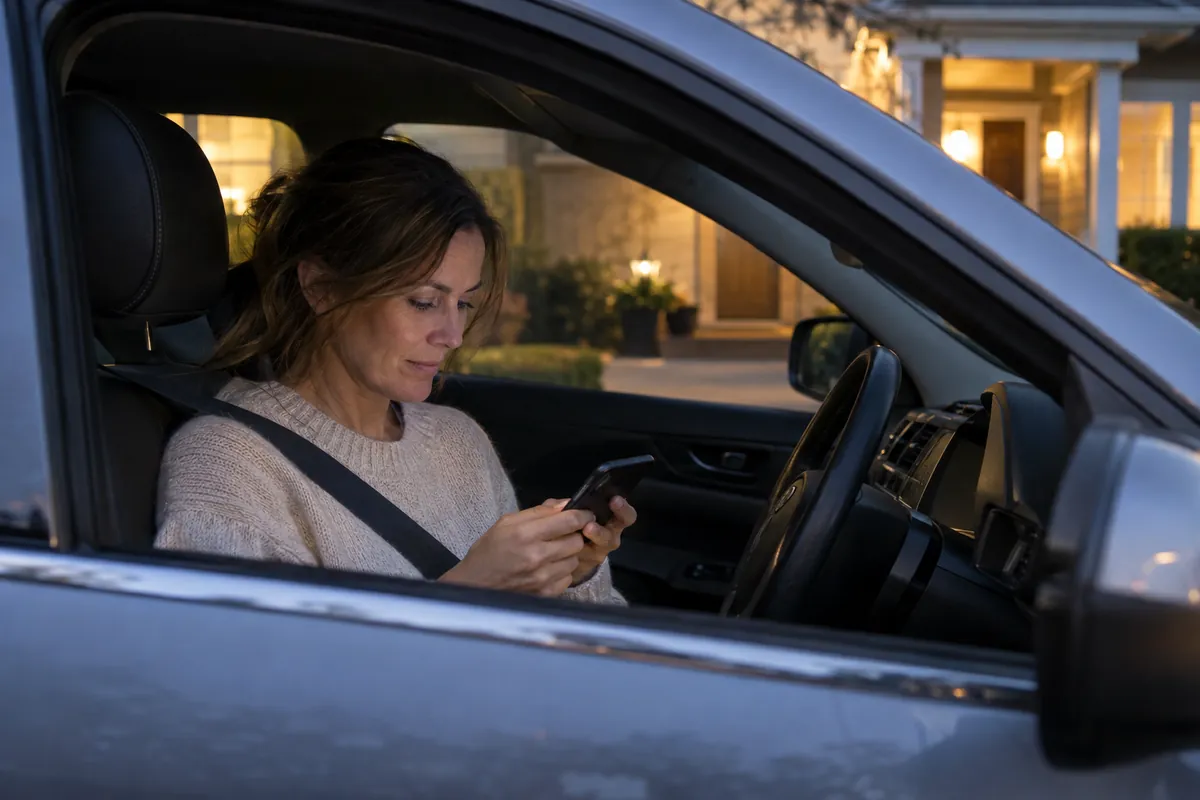
One or two of these now and then is ordinary life. Several, most days, is a pattern worth changing. And if low mood, anxiety or poor sleep stay with you for weeks, whatever your screen time, a doctor or therapist can help.
What happens when adults cut back
The strongest evidence comes from experiments, where people are randomly asked to use their phones less and compared with people who carry on as usual. Three of them, in short:
- A two-hour cap. 111 students who averaged about 4.6 hours a day on their phones were split into two groups. Those who kept their smartphone screen time to 2 hours a day for three weeks reported fewer depressive symptoms, less stress, better sleep and more well-being than the control group, small to medium effects. Six weeks later, their screen time was nearly back where it started [8].
- Thirty minutes of social media. 143 undergraduates who limited Facebook, Instagram and Snapchat to 10 minutes each a day for three weeks felt less lonely and less depressed than students who used them as usual [9].
- One hour less. In Germany, 619 smartphone users either gave up their phone for a week, used it one hour less each day, or carried on as before. Both changes helped, and the hour less a day held up better four months later [10].
No study has found a magic number. They all point the same way: less than you use now, from wherever you start.
Notice the rebound in the first trial, too. The students felt better while the limit was in place and drifted back once it was gone. A number you choose on a Sunday needs something to hold it on a Thursday night.
How to find your own limit
- Read your real number. Open Settings, then Screen Time, and look at a full week: your daily average, your pickups and the two or three apps at the top.
- Split it in two. Subtract the hours you'd keep: work, calls with people you love, maps, the book on your reading app. What's left is the time you'd like back, and that's the number to work on.
- Pick a target the studies support. One hour a day less than now. A two-hour daily cap on the phone time your job doesn't need. Thirty minutes a day for the feeds that cost you most.
- Protect the three things screens push out. Keep the phone out of bed, so it can't take your sleep. Fit in the 150 to 300 minutes of moderate activity a week the WHO recommends for adults [1], ten minutes at a time if that's what you have. And give the people in the room your eyes.
- Make the limit hold. By default, Apple's own Screen Time limits come with an "Ignore Limit" button. With the Less scrolling goal in Unrotten, the apps you choose lock with Apple's Screen Time shield once your daily limit is used up, until the day resets, and there's no "ignore limit" button.

If evenings are where the hours go, Unrotten's Calmer evenings goal protects a window every evening without your chosen apps, and our guide to revenge bedtime procrastination explains why the last hour of the day is so hard to give up. For seven research-backed ways to cut back, see our guide on how to stop doomscrolling.
A number on a report is easy to ignore. Unrotten's MindBattery makes the cost visible as it happens instead: a score from 0 to 100 on your Lock Screen and in the Dynamic Island that drains while you use the apps you chose and recharges with sleep, movement, mindful minutes and time away from them.
A better question than how many hours
"How much screen time is too much?" has no answer that fits everyone. "Is my phone taking time I'd rather spend on something else?" does, and you already know it. Check your real number this week, take an hour off it, and spend that hour on sleep, a walk or a person. Then see how you feel a month from now.
Questions people ask
How much screen time is too much for an adult?
There's no official limit for adults. The World Health Organization advises everyone to cut down on sitting but found the evidence too thin to set a number. In studies, trouble shows up with 3 or more hours of TV a day, with 4 hours or more of TV and computer time, and above all when screens push out sleep, movement and people or feel hard to stop.
Is 5 hours of screen time a day bad?
Not by itself. It depends on what the hours are and what they replace. Work, a video call with family and two hours of scrolling in bed aren't the same thing. In one trial, students who averaged about 4.6 hours a day on their phones and cut to 2 hours for three weeks reported less stress, fewer depressive symptoms and better sleep.
How many hours of screen time is healthy for adults?
No study has found one healthy number. The experiments that helped people feel better cut leisure phone use to 2 hours a day, cut social media to about 30 minutes a day, or simply took an hour a day off what people used before.
Does screen time for work count?
It counts as sitting, so break it up and move. But most research on mood and sleep is about leisure use, such as social media and phones in bed. When you judge your own number, separate the hours your job needs from the hours you'd like back.
References
- Bull FC, Al-Ansari SS, Biddle S, Borodulin K, Buman MP, Cardon G, et al. "World Health Organization 2020 guidelines on physical activity and sedentary behaviour." British Journal of Sports Medicine. 2020;54(24):1451-1462. doi:10.1136/bjsports-2020-102955 ↩
- Ekelund U, Steene-Johannessen J, Brown WJ, Fagerland MW, Owen N, Powell KE, et al. "Does physical activity attenuate, or even eliminate, the detrimental association of sitting time with mortality? A harmonised meta-analysis of data from more than 1 million men and women." The Lancet. 2016;388(10051):1302-1310. PMID: 27475271 ↩
- Madhav KC, Sherchand SP, Sherchan S. "Association between screen time and depression among US adults." Preventive Medicine Reports. 2017;8:67-71. doi:10.1016/j.pmedr.2017.08.005 ↩
- Huang C. "Time Spent on Social Network Sites and Psychological Well-Being: A Meta-Analysis." Cyberpsychology, Behavior, and Social Networking. 2017;20(6):346-354. doi:10.1089/cyber.2016.0758 ↩
- Elhai JD, Dvorak RD, Levine JC, Hall BJ. "Problematic smartphone use: A conceptual overview and systematic review of relations with anxiety and depression psychopathology." Journal of Affective Disorders. 2017;207:251-259. doi:10.1016/j.jad.2016.08.030 ↩
- Exelmans L, Van den Bulck J. "Bedtime mobile phone use and sleep in adults." Social Science & Medicine. 2016;148:93-101. doi:10.1016/j.socscimed.2015.11.037 ↩
- Parry DA, Davidson BI, Sewall CJR, Fisher JT, Mieczkowski H, Quintana DS. "A systematic review and meta-analysis of discrepancies between logged and self-reported digital media use." Nature Human Behaviour. 2021;5(11):1535-1547. doi:10.1038/s41562-021-01117-5 ↩
- Pieh C, Humer E, Hoenigl A, Schwab J, Mayerhofer D, Dale R, et al. "Smartphone screen time reduction improves mental health: a randomized controlled trial." BMC Medicine. 2025;23(1):107. doi:10.1186/s12916-025-03944-z ↩
- Hunt MG, Marx R, Lipson C, Young J. "No More FOMO: Limiting Social Media Decreases Loneliness and Depression." Journal of Social and Clinical Psychology. 2018;37(10):751-768. doi:10.1521/jscp.2018.37.10.751 ↩
- Brailovskaia J, Delveaux J, John J, Wicker V, Noveski A, Kim S, et al. "Finding the 'sweet spot' of smartphone use: Reduction or abstinence to increase well-being and healthy lifestyle?! An experimental intervention study." Journal of Experimental Psychology: Applied. 2023;29(1):149-161. doi:10.1037/xap0000430 ↩
Written by
Maren AshbyCOO, Unrotten
Maren Ashby is the COO of Unrotten, the iPhone app that helps people take their attention back from the feed. She writes about the research on phones, sleep and focus, and about the small, practical changes that make a phone easier to put down.