Blog/Habits & self-control/Explainer
How to Read More: Getting Back Into Books When Your Phone Wins
Fewer Americans read for pleasure every year. Why the book keeps losing to the phone, and how to make reading the easy choice again.

In this article
You used to read before bed. Now you open a book, read the same paragraph three times and reach for your phone. Nothing is wrong with you, and you haven't forgotten how to read: the book just has to compete with the easiest thing in the room.
Here's what has happened to reading, what counts as reading (audiobooks included), and how to make a book the easy choice again.
Fewer people read on any given day
Americans are reading less, and it shows in the most direct measure there is: what people actually do with their day. In the American Time Use Survey, a nationally representative sample of more than 236,000 people over two decades recorded what they did on a given day. The share who read for pleasure that day fell from 28% in 2004 to 16% in 2023, a drop of about 3% a year [1].
Yearly surveys tell the same story. In 2022, 48.5% of American adults said they had read any book in the past year, down from 54.6% in 2012, and 37.6% had read a novel or short story, the lowest share the survey has recorded [2].
The surprising part is what happens once people start. In 2023, the people who read for pleasure on the survey day spent 1 hour and 37 minutes reading on average, and an hour at the median [1]. The decline is in how many people open a book at all, not in how long readers keep going.
Did phones cause the decline? The researchers didn't test it. They note that the idea of other media displacing reading has been debated, that the drop in reading goes along with more use of digital media, and that testing whether devices are to blame "was beyond the scope of our study" [1].
Why the book keeps losing to the phone
A phone and a book compete on very unequal terms. The phone is already in your hand, it starts in a second and every swipe brings something new. A book asks for a few minutes of warming up before the story pulls you in, and in those few minutes the phone is right there.
It's tempting to blame a ruined attention span. Our guide to attention span looks at the famous goldfish claim and at what researchers actually measure.
If you can still lose an hour in a story once it gets going, your attention isn't broken. The phone is just closer.
Paper, screen or audiobook: what counts?
If a Kindle or a reading app is what gets you reading again, that's fine for stories. In a meta-analysis of 33 randomized studies, people understood informational texts a little better on paper than on screens, but there was no difference for narrative texts such as novels [3]. Readers also judged their own understanding more accurately on paper [3]. Our summary of The Shallows looks at the paper versus screen research in more depth.
Audiobooks count too. A meta-analysis of 46 studies with 4,687 people found no reliable overall difference between understanding by reading and by listening [4]. Reading had a small edge when people could go at their own pace, and on questions that asked them to read between the lines [4]. The studies covered several age groups, so take the details lightly, but a novel in your ears on a walk is still a novel.
The real catch with reading on a phone has nothing to do with comprehension. Your feed is one swipe away. A paper book or a separate e-reader removes that temptation entirely.
Make the book win at bedtime
Bedtime is where a book has a real advantage. In a sleep lab study, 12 young adults read for about four hours before bed on an iPad or in a printed book, five evenings of each. After the tablet, they took about 10 minutes longer to fall asleep, their evening melatonin was 55% lower and they felt sleepier the next morning [5]. That was a heavy dose, four hours at full brightness in a dim room, so everyday effects are likely smaller, but the direction is clear.
The phone in bed costs more than light. In a small randomized trial, 38 young adults who slept poorly stopped using their phones for the 30 minutes before bed, for four weeks. Compared with a group that changed nothing, they fell asleep faster, slept longer and felt calmer at bedtime [6].
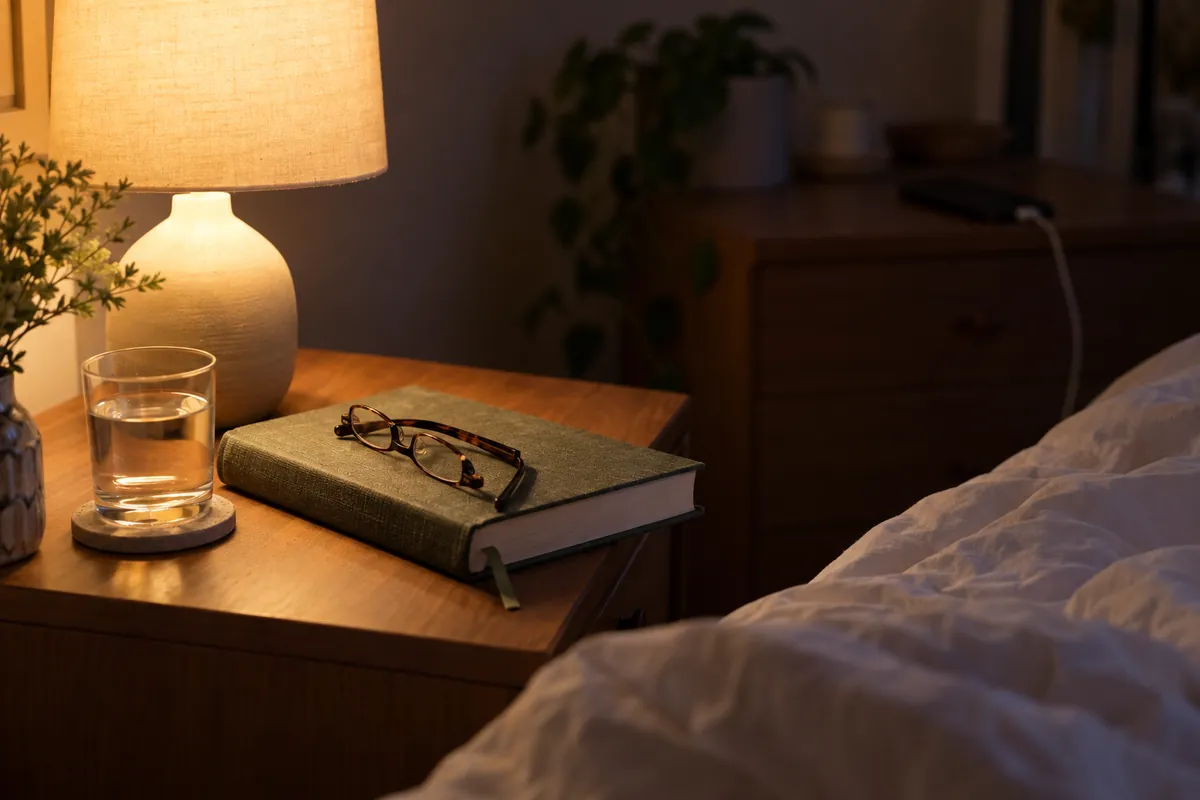
A book is the natural thing to put in the phone's place. Charge the phone outside the bedroom and leave a book on the nightstand. Our guide to blue light and sleep covers the light side of the story.
How to read more: what actually helps
Put the book where the phone usually is
Make the book the closest thing to your hand. Leave one on the nightstand, one in your bag and one on the arm of the sofa, and give the phone a spot that's slightly out of the way, such as a charger in the kitchen.
Tie reading to a moment you already have
Decide exactly when and where you'll read: "When I get into bed, I read ten pages," or "When I sit down on the bus, I open my book." Plans written that way, which psychologists call implementation intentions, helped people follow through on their goals across 642 tests, with larger effects when the plan took an if-then form [7]. Our guide to habit stacking has more ways to hook a new habit onto an old one.

Start smaller than you think
Ten pages, or fifteen minutes. Remember the time-use numbers: on the days people read for pleasure, the typical reader kept going for about an hour [1].
You don't need willpower for the hour. You need it for the first page.
Read what you want to read
Choose the book you'd read for fun, not the one you think you should finish. Quitting a book you don't enjoy is allowed. The habit matters more than any single title, and the next good book will do more for it than another week of guilt.
Let audiobooks fill the gaps
Walks, chores and drives are listening time. A story you hear still counts [4].
Give the phone a closing time
The simplest way to make room for reading is to take the phone out of reading time altogether. A Reading session in Unrotten does exactly that. Start it from Home's + button, and it locks your rot apps (the apps you've chosen as your biggest time sinks) until it ends, with a countdown on your Lock Screen and in the Dynamic Island, and a soft alarm or a gentle vibration when time's up. If the evening scroll is what eats your reading time, Calmer evenings in Unrotten keeps a protected window each evening without those apps, so the book is the most interesting thing left.
Why it's worth the effort
The payoff of reading is mostly the reading itself: the story, the ideas, the quiet. The research on longer-term benefits is encouraging, but modest.
In a study that followed 3,635 people in the Health and Retirement Study, a national study of older Americans, for up to 12 years, book readers had a 20% lower risk of dying during that time than people who didn't read books, after adjusting for age, education, wealth, health and more [8]. It's observational, so healthier or more curious people may simply read more.
Fiction may also sharpen how well you read other people. A meta-analysis of 14 experiments found that reading fiction, compared with nonfiction or no reading, led to a small improvement on tests of social understanding [9]. Small is the honest word: the authors call for stronger tests and for checking whether the gain carries over into real life [9].
Your first week back
You don't need a reading challenge or a goal of fifty books. You need a week of small wins:
- Day 1: put a book on your nightstand and charge your phone in another room.
- Day 2: read ten pages in bed, and keep going only if you want to.
- Day 3: take the book in your bag and read on the commute or at lunch.
- Day 4: if the book isn't grabbing you, swap it for one that does.
- Day 5: try an audiobook on a walk or while you cook.
- Days 6 and 7: notice when you reach for the phone, and reach for the book instead, once.
By the end of the week, reading won't feel like a project anymore. It will be the thing you do when you get into bed.
Questions people ask
How can I read more books?
Make reading the easy choice. Keep a book where your phone usually is, tie reading to a moment you already have (getting into bed, sitting down on the bus), start with ten pages, pick books you actually want to read and leave the phone in another room while you read.
How do I get back into reading after years of scrolling?
Start smaller than you think, with a book you would enjoy rather than one you feel you should read. In a large US survey of how people spend their days, those who read for pleasure on a given day read for about an hour at the median, so the hard part is usually starting, not keeping going.
Do audiobooks count as reading?
For understanding what you take in, mostly yes. A meta-analysis of 46 studies found no reliable overall difference in comprehension between reading and listening, although reading had a small edge when people could set their own pace and for questions that needed inference.
Is reading on a phone or an e-reader as good as reading on paper?
For stories, it seems to make little difference: a meta-analysis of randomized studies found no difference for narrative texts, while paper had an edge for informational ones. The bigger problem with reading on a phone is that the feed is one swipe away, and bright screens late in the evening can delay sleep.
How much should I read a day to build the habit?
There's no magic number. Pick an amount small enough for a tired day, such as ten pages, and plan exactly when and where you'll read. Across hundreds of tests, plans that spell out when and where helped people follow through on what they meant to do.
References
- Bone JK, Bu F, Sonke JK, Fancourt D. "The decline in reading for pleasure over 20 years of the American Time Use Survey." iScience. 2025;28(9):113288. doi:10.1016/j.isci.2025.113288 ↩
- National Endowment for the Arts. "Arts Participation Patterns in 2022: Highlights from the Survey of Public Participation in the Arts." 2023. arts.gov ↩
- Clinton V. "Reading from paper compared to screens: A systematic review and meta-analysis." Journal of Research in Reading. 2019;42(2):288-325. doi:10.1111/1467-9817.12269 ↩
- Clinton-Lisell V. "Listening Ears or Reading Eyes: A Meta-Analysis of Reading and Listening Comprehension Comparisons." Review of Educational Research. 2022;92(4):543-582. doi:10.3102/00346543211060871 ↩
- Chang AM, Aeschbach D, Duffy JF, Czeisler CA. "Evening use of light-emitting eReaders negatively affects sleep, circadian timing, and next-morning alertness." Proceedings of the National Academy of Sciences. 2015;112(4):1232-1237. doi:10.1073/pnas.1418490112 · Read our plain-English summary ↩
- He JW, Tu ZH, Xiao L, Su T, Tang YX. "Effect of restricting bedtime mobile phone use on sleep, arousal, mood, and working memory: A randomized pilot trial." PLOS ONE. 2020;15(2):e0228756. doi:10.1371/journal.pone.0228756 · Read our plain-English summary ↩
- Sheeran P, Listrom O, Gollwitzer PM. "The when and how of planning: Meta-analysis of the scope and components of implementation intentions in 642 tests." European Review of Social Psychology. 2025;36(1):162-194. doi:10.1080/10463283.2024.2334563 ↩
- Bavishi A, Slade MD, Levy BR. "A chapter a day: Association of book reading with longevity." Social Science & Medicine. 2016;164:44-48. doi:10.1016/j.socscimed.2016.07.014 ↩
- Dodell-Feder D, Tamir DI. "Fiction reading has a small positive impact on social cognition: A meta-analysis." Journal of Experimental Psychology: General. 2018;147(11):1713-1727. doi:10.1037/xge0000395 ↩
Written by
Maren AshbyCOO, Unrotten
Maren Ashby is the COO of Unrotten, the iPhone app that helps people take their attention back from the feed. She writes about the research on phones, sleep and focus, and about the small, practical changes that make a phone easier to put down.