Blog/Phone addiction/Explainer
ADHD and Phone Addiction: Why Your Phone Is Harder to Put Down
What research says about ADHD and problem phone use, why feeds grip an ADHD brain so hard, and the phone habits that help.


In this article
You pick up your phone to check one thing, and forty minutes later you surface from a feed with no memory of deciding to stay. If you have ADHD, or wonder whether you do, you may feel your phone has a stronger grip on you than on the people around you. The research suggests you're not imagining it. Here's what's known about ADHD and phone use, why feeds may hold on harder, and the habits that help. This is about phone habits: diagnosing or treating ADHD is a job for a doctor.
Is phone addiction more common with ADHD?
The link shows up again and again. A 2025 meta-analysis pooled 15 studies with 35,223 participants and found a moderate correlation, 0.36, between ADHD symptoms and problematic social media use [1]. On a scale where 0 means no link and 1 a perfect match, that's a clear relationship. (Problematic use means use that feels hard to control and gets in the way of daily life.)
Individual studies fill in the picture:
- In a survey of 408 Hungarian university students, higher smartphone addiction scores went with more ADHD symptoms, alongside procrastination, low mood and boredom with studies [2].
- In a survey of 563 Chinese college students, ADHD symptoms went with problematic short-video use, and much of the link ran through boredom proneness and emotional distress [3].
All of these are snapshots: questionnaires filled in once. They can't tell whether ADHD makes phone problems more likely, whether heavy phone use worsens attention problems, or both. Most also measure symptoms, not diagnoses, so they include people who have never been assessed.
Can your phone cause ADHD?
No study has shown that a phone can give you ADHD. What the research does show is subtler.
Heavy use came before more symptoms in teens
A study followed 2,587 students at 10 high schools in Los Angeles County who had no significant ADHD symptoms at the start. Over two years, each additional digital media activity they did many times a day came with slightly higher odds of reporting ADHD symptoms later. About 4.6% of teens who used no media that intensely reported symptoms, compared with 9.5% of those who used seven activities that often [4]. The authors called the association statistically significant but modest, and said more research is needed to know whether it's causal.
Notifications make anyone more scattered
Experiments point the same way, in the short term. In a two-week study with 221 people from the general population, people spent one week with notification alerts on and their phones within reach, and another with alerts off and their phones put away. With alerts on, they reported more inattention and more hyperactivity, and the inattention in turn predicted lower productivity and well-being [5].
In a much smaller, not fully randomized experiment, 37 healthy undergraduates who followed simple instructions to cut smartphone distractions for a week reported fewer hyperactive symptoms than a comparison group, especially those whose phone use was most problematic. Their inattention and working memory didn't change [6].
So a phone that's always buzzing can produce ADHD-like scatter in people without ADHD, and quieting it helps some of it. If you have ADHD already, you start with less margin for that noise.
Why your phone is harder to put down with ADHD
Boredom hits harder
In one study of 88 young adults, those with ADHD traits were far more prone to boredom than their peers, a very large difference. Weaker attention control and working memory explained a small part of the gap [7]. In the short-video study, boredom proneness and emotional distress were among the paths that linked ADHD symptoms to problem use, and for inattention in particular, the path ran through boredom [3].
A feed is the fastest cure for boredom ever built. It never runs out, it always has something new, and it asks nothing of you. Our guide to boredom looks at why sitting with it has become so hard for everyone.
Interruptions cost more
Every buzz is an invitation to switch tasks, and switching back is the hard part when attention is already the struggle. The notification experiment above found that alerts raised inattention even in people without ADHD [5].
Willpower in the moment is the weakest tool
The moment you most need to stop scrolling is the moment you're least able to choose. That's true for everyone, and with ADHD it can be truer still. The habits below share one idea: decide once, ahead of time, and let the setup do the work.
Don't count on stopping in the moment. Build the stop before the moment comes.
Phone habits that help with ADHD
Turn off everything that isn't a person
Keep notifications for calls and messages from people, and turn the rest off. On an iPhone, Settings, then Notifications, lets you switch apps off one by one, and Scheduled Summary collects the rest into a few deliveries a day. In the notification experiment, a single week with alerts off was enough to make a difference [5].
Put the phone out of reach while you work
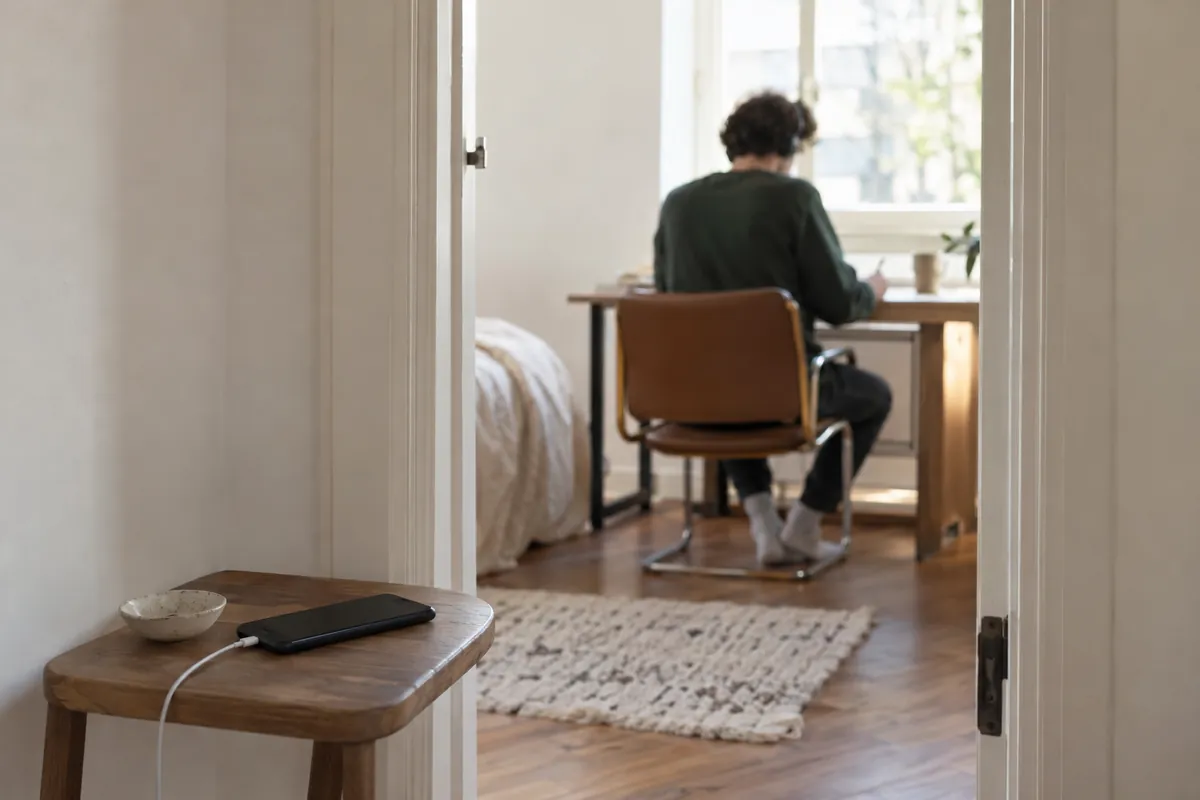
The "off" week in that experiment also meant keeping the phone away [5]. Charge it in another room while you work or study, and make getting it a walk rather than a reach.
Use limits that lock instead of reminders you can dismiss
A reminder you can wave away asks for willpower at the worst possible moment. A daily limit in Unrotten doesn't: once the minutes you set for the apps you choose are used up, Apple's Screen Time shield locks them until the day resets, and the shield has no "ignore limit" button. For the scroll that swallows an hour, Unrotten's Shorter scroll sessions goal sets a session length, and past it the apps take a break before they open again.
Work in short, phone-free blocks
Short sprints with a clear end are easier to start than an open afternoon. Pick a block you can manage, 25 minutes or an hour, and lock the distraction out for exactly that long. Unrotten's phone-free sessions do this from Home's + button: a Work, Focus or Reading session locks the apps you chose until it ends, with a countdown on the Lock Screen and in the Dynamic Island and a soft alarm or a gentle vibration at the end. For more on protecting a work block, see how to focus better.
Move
In a randomized one-week experiment with 278 employees in Germany, cutting an hour a day of non-work phone use, adding 30 minutes of physical activity, or doing both all lowered depressive symptoms and raised people's sense of control. The groups that cut phone time also reported less problematic phone use and more satisfaction with work [8]. The study wasn't about ADHD, but movement is one of the few rewards that competes with the feed and leaves you better off, not worse.

Have a menu for the bored moments
Boredom is a common trigger, so prepare for it. Write a short list of quick things that feel good and need no screen: a song you love, a snack, five minutes outside, a stretch, a glass of water. The dopamine menu idea came out of the ADHD community, and it works for exactly this: when the urge hits, you pick from the list instead of the feed.
When to talk to a doctor
If you think you might have ADHD, or ADHD makes daily life hard, a doctor can assess it and talk through the options. Phone habits are worth working on either way, but they're not a treatment for ADHD. Unrotten helps with the phone part; it doesn't diagnose or treat ADHD. And if your phone use comes with low mood or anxiety that lasts, a doctor or therapist can help with that too.
Make the easy thing the right thing
You can't out-willpower a feed designed never to end, and with ADHD you shouldn't have to. Put the decisions outside your head: notifications off, the phone in another room, limits that lock, a timer with an end. Then the easiest thing to do in the moment becomes the thing you actually wanted.
Questions people ask
Are people with ADHD more likely to be addicted to their phones?
Research links ADHD symptoms with problem phone and social media use. A 2025 meta-analysis of 15 studies with more than 35,000 people found a moderate correlation between ADHD symptoms and problematic social media use. Those studies are surveys, so they can't say which comes first.
Can social media cause ADHD?
No study has shown that phones or social media cause ADHD. In a study of Los Angeles teens, those who used more digital media many times a day were slightly more likely to report ADHD symptoms later, but the authors stressed that the link was modest and not shown to be causal. Experiments do show that a week of constant notifications made people without ADHD report more inattention and hyperactivity.
How do you stop doomscrolling with ADHD?
Rely on structure you set up in advance rather than willpower in the moment: notifications off for anything that isn't a person, the phone out of reach while you work, limits that lock the apps when your time is used up, short phone-free blocks with a timer, movement, and a list of quick non-phone rewards for the bored moments.
Why is it so hard to put my phone down with ADHD?
Boredom is a big part of it. In one study, young adults with ADHD traits were far more prone to boredom than their peers, and in another, boredom proneness and emotional distress helped explain why ADHD symptoms went with problematic short-video use. A feed offers instant relief from boredom and never runs out.
References
- Ding J, Liu Z, Chao M. "The association between problematic social media use and attention deficit/hyperactivity disorder symptomatology: a systematic review and meta-analysis." Journal of Psychiatric Research. 2025;189:544-553. doi:10.1016/j.jpsychires.2025.07.009 ↩
- Müller V, Mellor D, Piko BF. "How to Procrastinate Productively With ADHD: A Study of Smartphone Use, Depression, and Other Academic Variables Among University Students With ADHD Symptoms." Journal of Attention Disorders. 2023;27(9):951-959. doi:10.1177/10870547231171724 ↩
- Xu C, Gu Z, Yan J, Lock M, Chen S, Zhuang Q. "The Separation of Adult ADHD Inattention and Hyperactivity-Impulsivity Symptoms and Their Association with Problematic Short-Video Use: A Structural Equation Modeling Analysis." Psychology Research and Behavior Management. 2025;18:461-474. doi:10.2147/PRBM.S491731 ↩
- Ra CK, Cho J, Stone MD, De La Cerda J, Goldenson NI, Moroney E, et al. "Association of Digital Media Use With Subsequent Symptoms of Attention-Deficit/Hyperactivity Disorder Among Adolescents." JAMA. 2018;320(3):255-263. doi:10.1001/jama.2018.8931 ↩
- Kushlev K, Proulx J, Dunn EW. "'Silence Your Phones': Smartphone Notifications Increase Inattention and Hyperactivity Symptoms." Proceedings of the 2016 CHI Conference on Human Factors in Computing Systems. 2016:1011-1020. doi:10.1145/2858036.2858359 ↩
- Wasmuth JM, Reinhard I, Hill H, Alpers GW, Shevchenko Y, Kiefer F, et al. "A Smarter Way to Use Your Smartphone: An Intervention to Limit Smartphone-Related Distractions Reduces Hyperactivity but Not Inattention Symptoms." European Addiction Research. 2022;28(4):255-266. doi:10.1159/000521693 ↩
- Orban SA, Blessing JS, Sandone MK, Conness B, Santer J. "Why Are Individuals With ADHD More Prone to Boredom? Examining Attention Control and Working Memory as Mediators of Boredom in Young Adults With ADHD Traits." Journal of Attention Disorders. 2026;30(1):8-22. doi:10.1177/10870547251356723 ↩
- Brailovskaia J, Siegel J, Precht LM, Friedrichs S, Schillack H, Margraf J. "Less smartphone and more physical activity for a better work satisfaction, motivation, work-life balance, and mental health: An experimental intervention study." Acta Psychologica. 2024;250:104494. doi:10.1016/j.actpsy.2024.104494 · Read our plain-English summary ↩
Written by
Maren AshbyCOO, Unrotten
Maren Ashby is the COO of Unrotten, the iPhone app that helps people take their attention back from the feed. She writes about the research on phones, sleep and focus, and about the small, practical changes that make a phone easier to put down.