Blog/Digital minimalism/Comparison
Light Phone III Review: Is It Worth $899, or Will an App Do?
What the $899 minimalist phone does and doesn't do, its catches, and when a $59 Brick or an app on the iPhone you already own is the better fit.


In this article
- The Light Phone III at a glance
- What the Light Phone III does
- What it costs, and when you'd get it
- Will it work with your carrier and your iPhone friends?
- The Light Phone II and Light's next phone
- The catch: your life still runs on apps
- Does going light actually work?
- Light Phone, Brick or an app: who each one fits
- Light Phone vs Brick vs an app, side by side
- Is the Light Phone III worth $899?
The Light Phone III is an $899 phone that its maker says is "designed to be used as little as possible": calls, texts, a camera, directions and a short list of tools, with nothing to scroll. New orders are expected in late December, and it takes away more than the feed. Whether it's worth it depends on what else your phone does for you, and on whether a $59 Brick or an app on your iPhone would get you most of the way.
Disclosure: Unrotten, one of the options compared below, is made by the team behind this blog. We checked the Light Phone III on November 26, 2026 (first on November 7), against Light's website, store and help center, and Brick against its website and US App Store listing. We haven't lab-tested anything: every price, date and feature here comes from those pages.
The Light Phone III at a glance
- What it is: a small 5G phone (often searched as the Light Phone 3) from Light, a Brooklyn company, with a black-and-white interface on a 3.92-inch matte AMOLED screen. It first shipped in March 2025.
- Price and delivery: $899 unlocked, or $59 a month on a two-year Light Service contract (US only), in November 2026; new pre-orders are expected to deliver in late December 2026.
- What it does: calls and texts (group and picture messages included), a camera, directions, music, podcasts, rideshare, weather, two-factor codes and a hotspot. In Light's words, it will never have social media, internet browsing, email, news or ads.
- Best for: people ready to leave the smartphone behind for most of the day.
- Watch out for: no WhatsApp, Signal or Spotify, an English-only keyboard, and returns only for manufacturer defects.
What the Light Phone III does
The phone is a short menu of tools you manage on Light's dashboard website (its login page is called Dash), where you also import contacts and, on Light's own service, activate the SIM card. Each tool is built for its black-and-white LightOS. Today's tools are an alarm, calculator, calendar, directory, directions, hotspot, music, notes and voice memos, podcasts, rideshare (Lyft and Uber), weather, an authenticator for two-factor codes, and a timer. Light says future tools will always be optional, never pre-installed, and it has opened a developer program so users can build tools of their own; in October it said a library of community-made tools, installed from the dashboard, would go live in November.
The camera
The camera works like a point-and-shoot: a two-step shutter button (half-press to focus, full press to shoot), center focus and a fixed focal length of about 28 mm (equivalent). It takes 12 MP photos from a 50 MP sensor, plus an 8 MP front camera. The interface is black and white, but the photos are in color, and you can send and receive them by text.
Music, podcasts and Spotify
There's no Spotify, and no way to call or message on Signal or WhatsApp. Light says these "may be possible in future software updates," and that it's building its own Signal tool, with no date yet. The Music tool is a one-playlist player for audio files you upload through the dashboard (up to 20 GB), and the Podcast tool streams or downloads episodes from the iTunes podcast library.
Rides, codes and the rest
The Rideshare tool books Uber or Lyft through Tremp, a text-based ride service that adds a 10% fee (at least $2) to each ride, waived for your first five rides within 30 days. The Authenticator shows two-factor codes, and the hotspot can put a laptop or tablet online. Light expects its 1,800 mAh battery to last through a full day of normal use.
What it costs, and when you'd get it
In November 2026, Light sells it two ways:
- Unlocked, $899 before tax and shipping, for any compatible carrier.
- On contract, $59 a month for two years with Light's own service (1 GB of data, unlimited US calls and texts), or $89 with unlimited data. That's $1,416 over two years for phone and plan, before taxes and fees. Read the contract first: the phone is SIM-locked to Light for 24 months, there's no risk-free trial, and leaving early costs $99 plus the $899 retail price, less $35 for each month paid.
Bought unlocked, it can run on Light's own service at $25 a month (unlimited calls and texts, 1 GB of data) or $45 with unlimited data, plus tax, with no contract.
The bigger catch is the return policy. Light accepts returns only for manufacturer defects, and says it can't take a phone back "for simply being disappointed in the product or no longer interested." A pre-order can be canceled for a full refund, and a phone still in its shrink wrap can be refunded. Once you open it, it's yours.
Will it work with your carrier and your iPhone friends?
Light's compatibility checker lists the Light Phone III as working in the US with Light's service, AT&T, T-Mobile, Noble Mobile, Mint, US Mobile (Light Speed only) and Verizon, where certification is "in progress." It names Google Fi, Cricket, Spectrum and Xfinity among the carriers it doesn't work with, and Light won't take a return for a carrier not on its list.
Coming from an iPhone adds two hurdles. Light says to turn off iMessage and RCS for your number before switching, or you may miss messages. And you can't move one SIM card between the phones if your iPhone is eSIM-only (Light names the iPhone 14 and later), while the Light Phone III's own eSIM is still a beta that doesn't yet work with Verizon.
The Light Phone II and Light's next phone
The Light Phone II ($299), with an E Ink screen and no camera, was marked sold out on Light's store when we checked, in both colors and in its North American model (the International model, which doesn't work in the US, wasn't marked), with a note that a limited quantity is available from Verizon. Light says it has no plans to stop producing or supporting it.
Light's next phone, the Light Flip, is a flip phone with predictive T9 typing: $349 unlocked or from $39 a month on a two-year Light contract. Its first two batches are sold out, and the next ships in May 2027. For other phones like the Light Phone, see our guide to the best dumb phones.
The catch: your life still runs on apps
The Light Phone III can call you a ride, guide you across town and show your two-factor codes. What it can't run is anything that lives in an app or a browser. Its tools are built for LightOS, with no browser or email, so your bank's app, the family WhatsApp group, a boarding pass and your work chat all need another device.
Light's own page describes owners who use a laptop, a tablet or their old smartphone on Wi-Fi, and others who swap one SIM card between a smartphone and the Light Phone, or give each phone its own number. Researchers who interviewed 13 dumbphone users and two dumbphone developers found the phones served as tools for mental and physical health, among other things. But opting out took a kind of privilege and brought interpersonal complications, in a world where government systems, businesses and relationships lean on smartphones [1].
A Light Phone doesn't only ask whether you can live without the feed. It asks whether you can live without everything else that lives in apps.
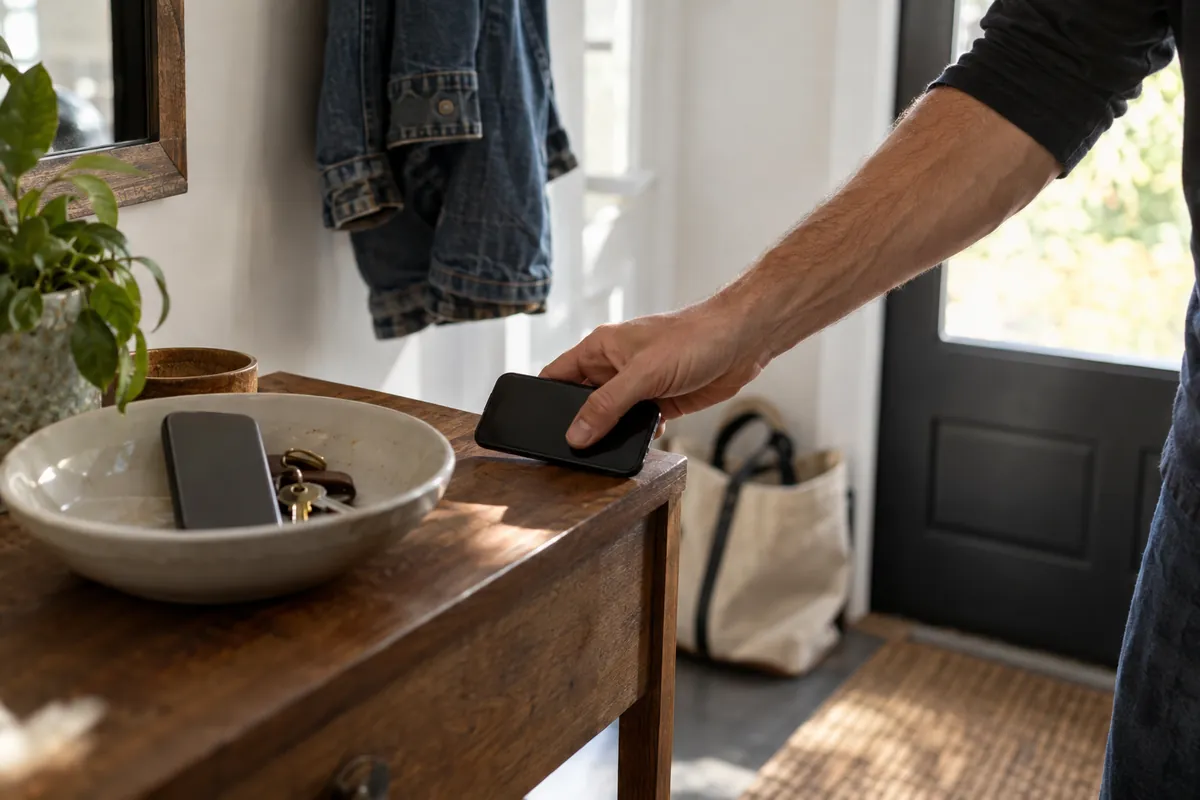
Two phones can work, as long as the smartphone is the one that stays home. If it rides in your bag "just in case," you've paid $899 for a second phone and kept the first one's pull.
Does going light actually work?
We found no trial of the Light Phone itself, but one experiment comes close. In a randomized trial, an app blocked all mobile internet on people's smartphones for two weeks while calls and texts kept working. Mental health, well-being and sustained attention improved, and 91% of participants improved on at least one of the three, partly because they spent more time socializing in person, exercising and in nature [2].

The same trial shows the hard part: of the 467 people who committed to the block, only 119, about a quarter, kept it on for at least 10 of the 14 days [2]. A phone that can't scroll at all solves that, and it's the strongest argument for the Light Phone. Scope matters too. In an experiment with 338 students, those who cut their smartphone use to the essentials for about eight days reported higher life satisfaction and less loneliness and stress than the comparison groups, while those who quit only social media gained little and reported more negative emotions than people who changed nothing [3].
But you don't have to quit. In a German study of 619 smartphone users, most benefits were stronger, and lasted longer over four months, with an hour less of phone use a day than with a week without the phone [4]. In one small study, 37 healthy undergraduates given specific instructions to cut their phone's distractions showed considerable reductions in hyperactive symptoms after a week compared with a control group, though not in inattention or working memory [5]. And limits set in advance help: when economists let people set limits on their future screen time, use fell substantially, and the researchers estimate that self-control problems cause 31% of social media use [6]. A Brick and a blocking app both rest on that idea: a choice made while you're calm that holds when you're tired.
Light Phone, Brick or an app: who each one fits
A Light Phone can't be talked out of its limits, a Brick has to be walked to, and an app can be switched off by the same thumb that wants to scroll.
The strongest lock is the one you can't open. The right one is the one you'll still be using next month.
Replace the phone: the Light Phone III
Best for: people who want the decision made once, and whose banking, WhatsApp and web errands can wait for a laptop at home. Watch out for: no returns because it didn't suit you, Verizon still being certified, and group chats on WhatsApp, Signal or iMessage that go on without you.
Keep the iPhone, lock apps behind a key: Brick
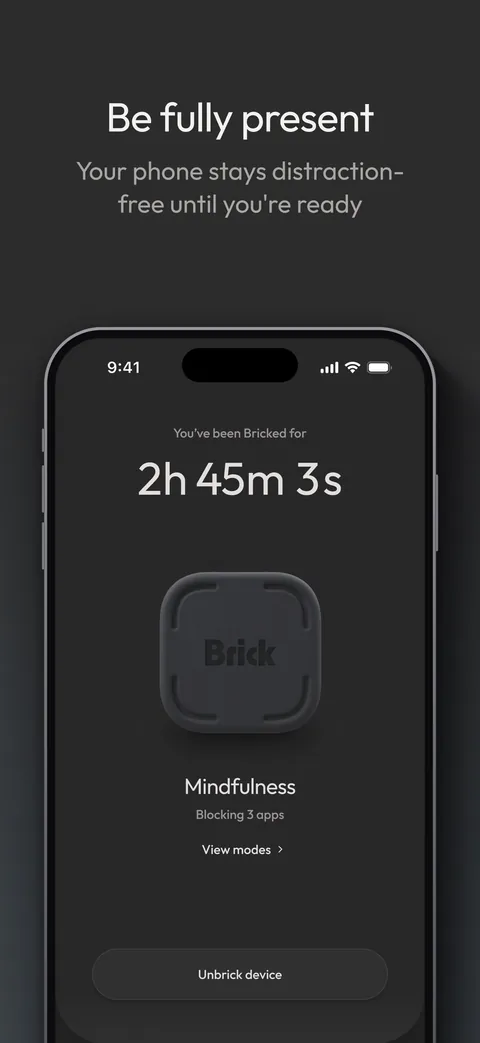
Brick moves the off switch out of your iPhone. You choose what to block in its free app (any app except the phone dialer, plus Safari websites), then tap your phone on the Brick, a small $59 device. The apps and their notifications disappear until you tap it again, so a Brick on the fridge puts a walk between you and the feed. It needs iOS 18 or later (or Android 12), includes five emergency unbricks and a 30-day money-back guarantee, and its app is rated 4.9 from 61,394 US ratings. Brick Night ($129) does the same in your bedroom, by Bluetooth. More in our Brick review.
Best for: people who need their apps but keep tapping past their own limits. Watch out for: it's only as far away as the place you leave it.
Keep the iPhone, lock apps with an app: Unrotten
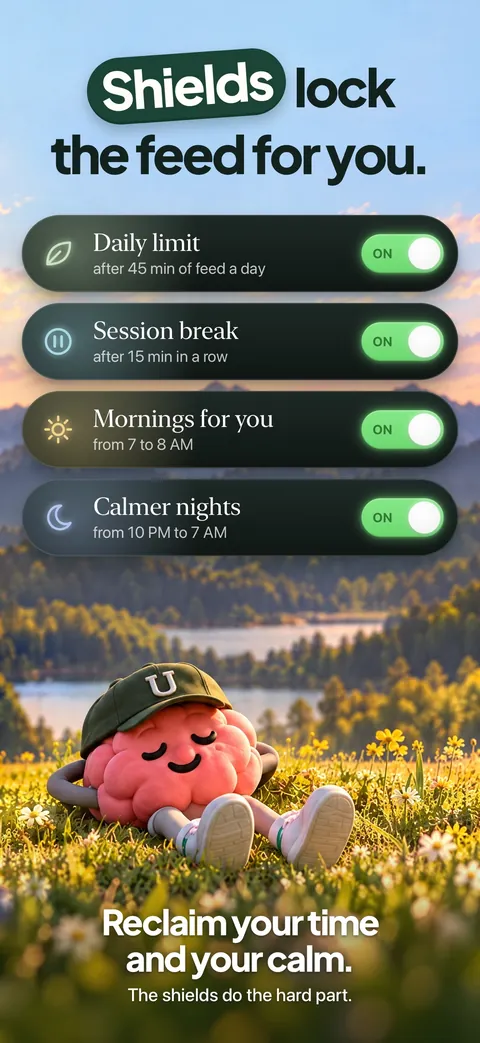
Unrotten locks the feed and leaves the rest of your phone alone. You choose your rot apps, the ones that eat your time, and it locks them with Apple's Screen Time shield according to your goals: a daily limit (Less scrolling), a break after a session length you set (Shorter scroll sessions), and protected windows like Mornings for yourself and Calmer evenings. The shield has no "ignore limit" button, and everything you didn't choose keeps working, from calls and maps to your bank and your group chats.
To go light for an hour, start a phone-free session from Home's + button, with your rot apps locked until it ends. An AI Coach sends a morning message, checks in on the plans you share and nudges you when scrolling runs fast. It costs $49.99 a year or $9.99 a month, each starting with a 7-day free trial, and needs iOS 17 or later.
Best for: people who want the calm without losing the apps that run their life, and a reason to stop, not just a wall. Watch out for: it's a commitment device, not a vault: turning a goal off, or removing Unrotten's Screen Time access, lifts its shield. It's new (on the App Store since October 14, 2026), with no free tier and no Android version.
Light Phone vs Brick vs an app, side by side
| Option | Price (US) | How it limits you | What you give up | Free version | App Store rating (US) |
|---|---|---|---|---|---|
| Light Phone III | $899, or $59/mo on a two-year contract | Replaces your smartphone: no browser, email or social media | WhatsApp, Spotify, banking apps | No | Not an app |
| Brick | $59 once; free app | Tap the Brick to lock chosen apps, tap again to unlock | Nothing while unlocked; needs iOS 18 | No (needs the device) | 4.9 (61.4K ratings) |
| Unrotten | $49.99/yr or $9.99/mo, each with a 7-day free trial | Screen Time shields on chosen apps: daily limit, session breaks, protected hours | Only the apps you choose, when your goals say | No (7-day free trial) | New (October 2026) |
| iPhone Screen Time | Free, built in | Limits and schedules in Settings; on iOS 26 a limit can be ignored once reached, by default | Nothing | Yes | Built into iOS |
Checked November 26, 2026, on Light's website and help center, Brick's website and the US App Store.
Is the Light Phone III worth $899?
Buy it if you're ready to change how you live, not just what's on your screen. If your carrier is on Light's list, you can live with $899 and no returns, and you'd rather decide once than every evening, it's worth it: nothing on it can pull you into a feed.
Choose a Brick if you need your iPhone but keep breaking your own limits: $59 buys a barrier you have to walk to. And if you want the calm without the trade, Unrotten's shields and Coach lock only the apps that eat your time, on the phone you already have.
Before you spend anything, run a two-week test. Clear your Home Screen of every app a Light Phone couldn't run, turn off their notifications and switch the screen to grayscale: in one trial, nudges like these cut screen time and improved sleep compared with simply tracking use [7]. Our guide to turning your smartphone into a dumb phone has the settings, and our list of dumb phone apps for iPhone shows the launchers that turn the Home Screen into plain words. Note each time you reach for something a Light Phone can't do. If the list stays short, pre-order. If it fills up with your bank, your WhatsApp groups and your boarding passes, keep the iPhone and lock the feed.
Questions people ask
How much does the Light Phone III cost?
In November 2026 it costs $899 unlocked, or $59 a month on a two-year Light Service contract with 1 GB of data and unlimited calls and texts ($89 a month with unlimited data). New pre-orders are expected to deliver in late December 2026, and once it's opened, Light accepts returns only for manufacturer defects.
Does the Light Phone III have WhatsApp or Spotify?
No. Light says there is currently no music streaming tool for platforms like Spotify and no way to call or message on Signal or WhatsApp, though these may be possible in future software updates, and it is building its own Signal tool. Its Music tool plays audio files you upload through Light's dashboard website, and its Podcast tool streams or downloads episodes.
Does the Light Phone III have a camera?
Yes. It has a dedicated two-step shutter button, center focus and a fixed focal length of about 28 mm, and it takes 12 MP photos from a 50 MP sensor, with an 8 MP front camera. The interface is black and white, but the photos are in color and can be sent in text messages.
Is the Light Phone II still available?
Light lists the Light Phone II at $299, but in late November 2026 its store marked both colors and the North American model sold out (the International model, which doesn't work in the US, wasn't marked), with a note that a limited quantity is available from Verizon. Light says it has no plans to stop producing or supporting it.
What is the Light Phone dashboard?
It's Light's website for managing your phone; its login page is called Dash. There you import contacts and add or remove the phone's tools, and if you use Light's own service, you activate the SIM card and choose a plan.
Light Phone or Brick: which should I choose?
The Light Phone III replaces your smartphone for $899, and your smartphone apps go with it, the useful ones included. Brick costs $59 once and keeps your iPhone, locking the apps you choose until you tap the device again. Choose the Light Phone if you're ready to live without apps, and Brick if you need them but keep breaking your own limits.
References
- Rothschild A, Lindqvist J. "Swapping 5G for 3G: Motivations, Experiences, and Implications of Contemporary Dumbphone Adoption." Proceedings of the ACM on Human-Computer Interaction. 2024;8(CSCW1):1-40. doi:10.1145/3637402 ↩
- Castelo N, Kushlev K, Ward AF, Esterman M, Reiner PB. "Blocking mobile internet on smartphones improves sustained attention, mental health, and subjective well-being." PNAS Nexus. 2025;4(2):pgaf017. doi:10.1093/pnasnexus/pgaf017 · Read our plain-English summary ↩
- Walsh LC, Regan A, Okabe-Miyamoto K, Lyubomirsky S. "Does putting down your smartphone make you happier? the effects of restricting digital media on well-being." PLOS ONE. 2024;19(10):e0306910. doi:10.1371/journal.pone.0306910 · Read our plain-English summary ↩
- Brailovskaia J, Delveaux J, John J, et al. "Finding the 'sweet spot' of smartphone use: Reduction or abstinence to increase well-being and healthy lifestyle?! An experimental intervention study." Journal of Experimental Psychology: Applied. 2023;29(1):149-161. doi:10.1037/xap0000430 · Read our plain-English summary ↩
- Wasmuth JM, Reinhard I, Hill H, Alpers GW, Shevchenko Y, Kiefer F, Leménager T. "A Smarter Way to Use Your Smartphone: An Intervention to Limit Smartphone-Related Distractions Reduces Hyperactivity but Not Inattention Symptoms." European Addiction Research. 2022;28(4):255-266. doi:10.1159/000521693 ↩
- Allcott H, Gentzkow M, Song L. "Digital Addiction." American Economic Review. 2022;112(7):2424-2463. doi:10.1257/aer.20210867 ↩
- Olson JA, Sandra DA, Chmoulevitch D, Raz A, Veissière SPL. "A Nudge-Based Intervention to Reduce Problematic Smartphone Use: Randomised Controlled Trial." International Journal of Mental Health and Addiction. 2023;21(6):3842-3864. doi:10.1007/s11469-022-00826-w · Read our plain-English summary ↩
Written by
Maren AshbyCOO, Unrotten
Maren Ashby is the COO of Unrotten, the iPhone app that helps people take their attention back from the feed. She writes about the research on phones, sleep and focus, and about the small, practical changes that make a phone easier to put down.