Blog/Social media & mental health/Explainer
Facebook Addiction: Why It's Hard to Log Off, and How to Cut Back
Why Facebook keeps pulling you back, what happened when people stepped away in experiments, and how to cut back without losing your people.

In this article
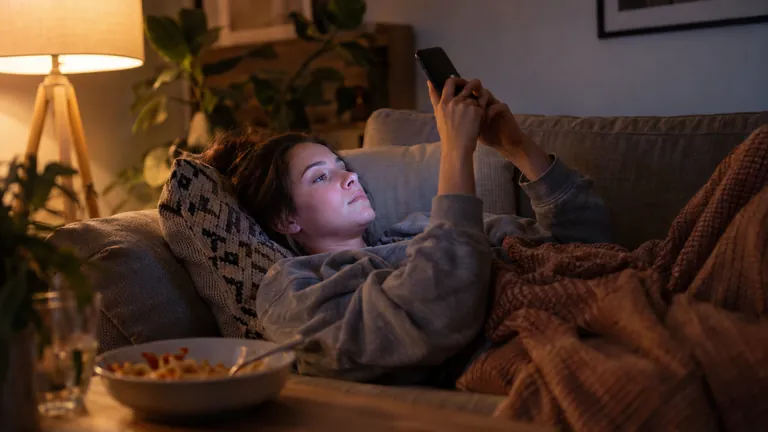
You open Facebook to check one post in a group, and forty minutes later you've watched three videos, scrolled past a cousin's vacation and read an argument between two strangers to the end. If that happens most days, you're not imagining the pull. Facebook addiction isn't an official diagnosis, but researchers can measure it, and the experiments on stepping away from Facebook are some of the best evidence there is on social media.
Here's why Facebook in particular is hard to put down, what happened when people logged off for a while, and how to cut back without losing the people you go there for.
Is Facebook addiction real?
Not as a diagnosis. Facebook addiction isn't recognized in the DSM-5 or the ICD-11, any more than social media addiction is; our guide to social media addiction covers that debate. But researchers have measured it for more than a decade.
In 2012 a team in Norway built the Bergen Facebook Addiction Scale around the six core elements of addiction: salience, mood modification, tolerance, withdrawal, conflict and relapse [1]. In everyday words, that's Facebook on your mind when you're not on it, opening it to change how you feel, needing more of it over time, restlessness when you can't check, the habit crowding out work or people, and failing when you try to cut back. In the 423 students the scale was first tested on, higher scores went with later bedtimes and later rising times [1]. A high score doesn't diagnose anything, but it does tell you the habit is costing you something.
And it's not a niche habit. In Pew Research Center's 2026 survey, 70% of US adults said they use Facebook, second only to YouTube, including 78% of adults aged 30 to 49 and 59% of those 65 and older [2].
Why Facebook is so hard to put down
Your people are there
Unlike a feed of strangers, Facebook is your family's photos, your town's news, the group for your running club, the neighbor selling a bike. There's always a good reason to open it, and the feed is waiting behind every one of those reasons.
That's also why leaving feels costly. In the largest experiment on stepping away, which we'll get to below, about 80% of the people who deactivated Facebook said it had been good for them, and yet they also became more likely to think people would miss Facebook if they used it less [3].
Scrolling, more than connecting, seems to be what hurts
How you use Facebook seems to matter. In a two-week study that texted young adults five times a day, the more people used Facebook at one point, the worse they felt the next time they were asked, and the more they used it over the two weeks, the more their life satisfaction fell. Interacting with people directly didn't predict those drops [4].
A pair of later studies found that passive use, scrolling without posting or talking, lowered people's mood over time, and pointed to envy as the reason [5]. And in a national panel of 5,208 US adults followed over three years, more liking, link clicking and status updating went with slightly worse self-reported mental health, including a year later [6].
The line between passive and active use isn't settled, though. The large deactivation experiment found little evidence that people who mostly comment and post got more good out of Facebook than people who mostly scroll [3].
The habit outlives the reason
In another experiment, the economists Hunt Allcott, Matthew Gentzkow and Lena Song paid people to use social media less for a few weeks. Their use stayed lower after the payments stopped, a sign that social media use is habit forming. When people could set limits on their own future screen time, they used substantially less, a sign of self-control problems, which by the researchers' estimate account for 31% of social media use [7].
Most of your trips to Facebook aren't decisions. They're the habit deciding for you.
What happened when people stepped away
The best evidence on Facebook comes from experiments in which people were randomly assigned to take a break.
- One week off. In Denmark, 1,095 people were split into a group that took a week off Facebook and a group that kept using it. The group that stepped away ended the week more satisfied with their lives and with more positive emotions, and the gains were largest for heavy users, passive users and people who tended to envy others on Facebook [8].
- Four weeks off. In a US experiment before the 2018 midterm elections, people paid to deactivate Facebook for four weeks gained about 60 minutes a day. They spent more of it offline, including with friends and family (and watching TV alone), and their overall well-being rose by a small amount, about 25 to 40% of the effect of therapy-style programs in an earlier analysis. They also followed the news less closely and became less polarized. Weeks after the experiment ended, their use of the Facebook app was still about 22% lower than the comparison group's, and about 80% said deactivating had been good for them [3].
- A limit, not a break. In a three-week trial, 143 college students were asked to cap Facebook, Instagram and Snapchat at 10 minutes each a day, or to use them as usual. The capped group grew less lonely and less depressed than the group that changed nothing [9].
Stepping away didn't cut people off. In the month-long experiment, the hour a day they won back went to life offline, friends and family included.

How to cut back on Facebook
You don't have to delete your account. These steps work in roughly this order:
- See your real number. Screen Time shows how long Facebook takes each day and how often you pick up your phone; our guide to seeing your screen time on iPhone shows where to look.
- Turn off its notifications. Every birthday, group post and "memory" is a reason to open the app. Our guide to turning off notifications on iPhone takes about ten minutes, and you can keep messages from the people who matter.
- Go in for one thing. Decide what you're opening it for, the group, the listing, the message, and close it when that's done.
- Move it off your Home Screen. One extra step between your thumb and the feed is often enough to catch the automatic opens. If you delete the app, you can still use Facebook in a web browser when you need it.
- Prune what you see. Leave the groups you no longer read and stop following the pages that wind you up, so the feed has less to pull you in with.
- Try a week or a month off. The experiments above are a good template. A deactivation keeps your account and photos, and our guide to deleting social media explains the difference between deactivating and deleting.
- Set a limit that holds. Ten minutes a day helped in a trial [9], but a limit you can dismiss at 11 p.m. tends to lose. A daily limit in Unrotten locks the apps you choose once your minutes are used up, behind Apple's Screen Time shield with no "ignore limit" button. Shorter scroll sessions gives a single session an end, and Fewer app returns sets a daily target for how many times you open them.
If Facebook use comes with low mood, anxiety or poor sleep that lasts, a doctor or therapist can help.
Your people will still be there
The pull of Facebook is built from good things: family, friends, the groups you care about. You don't need to give those up to stop losing evenings to the feed. Cut the notifications, go in for one thing at a time, and put a limit on the rest.
When the limit wobbles, Unrotten's Coach checks in on the plans you share with it and nudges you when your scrolling runs fast, so the hour the experiments found is yours to keep.
Questions people ask
Is Facebook addiction real?
It isn't an official diagnosis in the DSM-5 or the ICD-11, but researchers can measure it. In 2012 a team in Norway built the Bergen Facebook Addiction Scale around six classic signs of addiction, such as using it to change your mood and failing to cut back. In experiments, people who stepped away from Facebook felt a little better and used it less afterward.
Why is Facebook so addictive?
Your family, friends and groups are there, so there's always a good reason to open it, and the feed is waiting behind every one of those reasons. Studies suggest the scrolling, rather than talking with people, is the part that tends to leave people feeling worse, and experiments show the habit carries on after the reason to open the app is gone.
What happens when you quit Facebook?
In a US experiment, people paid to deactivate Facebook for four weeks gained about an hour a day, spent more time offline, including with friends and family, and reported slightly higher well-being. Weeks later, their use of the Facebook app was still about 22% lower, and about 80% said deactivating had been good for them.
Should I limit Facebook or quit?
Both helped in trials. In a three-week experiment, students who capped Facebook, Instagram and Snapchat at 10 minutes each a day became less lonely and less depressed than students who used them as usual. A limit you can keep is often a better start than quitting for good.
How do I stop being addicted to Facebook?
Check your real time in Screen Time, turn off Facebook's notifications, open it for one purpose at a time, take it off your Home Screen, try a week or a month off, and set a daily limit that holds when you're tired. You don't have to delete your account to cut back.
References
- Andreassen CS, Torsheim T, Brunborg GS, Pallesen S. "Development of a Facebook Addiction Scale." Psychological Reports. 2012;110(2):501-517. doi:10.2466/02.09.18.PR0.110.2.501-517 ↩
- Pew Research Center. "Americans' Use of Social Media in 2026." Pew Research Center. October 19, 2026. pewresearch.org ↩
- Allcott H, Braghieri L, Eichmeyer S, Gentzkow M. "The Welfare Effects of Social Media." American Economic Review. 2020;110(3):629-676. doi:10.1257/aer.20190658 · Read our plain-English summary ↩
- Kross E, Verduyn P, Demiralp E, Park J, Lee DS, Lin N, et al. "Facebook use predicts declines in subjective well-being in young adults." PLOS ONE. 2013;8(8):e69841. doi:10.1371/journal.pone.0069841 · Read our plain-English summary ↩
- Verduyn P, Lee DS, Park J, Shablack H, Orvell A, Bayer J, et al. "Passive Facebook usage undermines affective well-being: Experimental and longitudinal evidence." Journal of Experimental Psychology: General. 2015;144(2):480-488. doi:10.1037/xge0000057 · Read our plain-English summary ↩
- Shakya HB, Christakis NA. "Association of Facebook Use With Compromised Well-Being: A Longitudinal Study." American Journal of Epidemiology. 2017;185(3):203-211. doi:10.1093/aje/kww189 ↩
- Allcott H, Gentzkow M, Song L. "Digital Addiction." American Economic Review. 2022;112(7):2424-2463. doi:10.1257/aer.20210867 ↩
- Tromholt M. "The Facebook Experiment: Quitting Facebook Leads to Higher Levels of Well-Being." Cyberpsychology, Behavior, and Social Networking. 2016;19(11):661-666. doi:10.1089/cyber.2016.0259 ↩
- Hunt MG, Marx R, Lipson C, Young J. "No More FOMO: Limiting Social Media Decreases Loneliness and Depression." Journal of Social and Clinical Psychology. 2018;37(10):751-768. doi:10.1521/jscp.2018.37.10.751 · Read our plain-English summary ↩
Written by
Maren AshbyCOO, Unrotten
Maren Ashby is the COO of Unrotten, the iPhone app that helps people take their attention back from the feed. She writes about the research on phones, sleep and focus, and about the small, practical changes that make a phone easier to put down.