Blog/Social media & mental health/Explainer
Does Social Media Cause Depression? What the Evidence Shows
What studies that follow people for months, a natural experiment and randomized trials found, who seems most affected, and how to test it on yourself.

In this article
- The short answer
- Why it's so hard to prove
- What happens when you follow people over time
- What a natural experiment found
- What the trials found
- When social media is most likely to drag your mood down
- How to test it on yourself
- What to change if it's dragging you down
- When to get help
- What the evidence adds up to
If your mood sinks after an evening of scrolling, it's fair to wonder whether social media is part of the reason. The research gives a careful answer: it can contribute to depression, mostly through particular ways of using it, but the evidence that it causes depression on its own is weaker and more mixed than the headlines suggest. Here's what each kind of study shows, and how to find out what it's doing to you.
The short answer
- It can contribute. Some studies that follow adults for months find that heavy use comes before new depressive symptoms, and a natural experiment found that Facebook's arrival on college campuses harmed students' mental health [1, 2, 3].
- The effect is small on average. When people cut back in randomized trials, their depressive symptoms ease, a little [4, 5].
- How you use it matters more than how long. Compulsive use tracks low mood far more closely than hours do, and passive scrolling seems to do more harm than taking part [6, 7].
Why it's so hard to prove
Most studies measure social media use and mood at the same moment, and they find that the two go together, weakly (our overview of social media and mental health walks through those numbers). But a link like that can run three ways:
- Social media could pull mood down.
- Low mood could drive the scrolling: when you feel flat, a feed asks nothing of you.
- Something else could drive both, such as loneliness, stress or short nights.
To tell these apart, researchers use three kinds of evidence: they follow the same people over time, they look for natural experiments, and they run randomized trials.
What happens when you follow people over time
If social media causes depression, heavy use should come first and the low mood after. Some studies find exactly that.
- Young adults. A US study recruited people aged 18 to 30 to match the national population and followed them for six months. Of the 990 who weren't depressed at the start, 9.6% were six months later. Those in the top quarter for social media use had 2.77 times the odds of becoming depressed compared with the bottom quarter, while being depressed at the start didn't predict heavier use later [1]. The authors call that timing an important criterion for causality; on its own, it isn't proof.
- All adults. In monthly US surveys from May 2020 to May 2021, 5,395 adults with an average age of 56 started out without depressive symptoms. By the next survey, 8.9% had a marked rise in symptoms, and the odds were higher among people who used Snapchat, Facebook or TikTok [2]. The authors say their data can't explain why.
Other studies find nothing. When researchers surveyed 1,132 university students every year for six years, social media use didn't predict later depressive symptoms in men or women. In a younger group of teenagers, it was low mood that came first: girls with more depressive symptoms went on to use social media more often [8].
So the long-term studies disagree, and where they do find a link, it shows up mostly among the heaviest users.
What a natural experiment found
Facebook didn't arrive everywhere at once. In the mid-2000s it opened to American colleges a few at a time, which let economists compare students at colleges where it had just arrived with students at colleges where it hadn't yet. Its arrival harmed students' mental health and made more of them say poor mental health was hurting their schoolwork. The evidence pointed to unfavorable comparisons with other students as the reason [3].
It's one of the strongest designs in this research. It's also about a version of Facebook from twenty years ago, used by college students.
What the trials found
Randomized trials are the most direct test: one group cuts back, another carries on, and the researchers compare how both feel.
- A three-week cap. At the University of Pennsylvania, researchers split 143 students at random: one group kept Facebook, Instagram and Snapchat to 10 minutes each a day, the other carried on as usual. Three weeks later, the capped group was less depressed and less lonely than the rest [4].
- A month off Facebook. In a US experiment with paid deactivation before the 2018 midterms, an index of well-being that included depression, anxiety, happiness and loneliness rose by a small amount, about a quarter to two-fifths of what the authors cite for therapy-style programs [9].
- The trials pooled. When a 2025 meta-analysis combined 10 randomized trials with 1,491 people, cutting back lowered depressive symptoms by a small amount (an effect size of 0.25), and the trials that set limits did at least as well as the ones that asked people to quit. The trials were short, one to three weeks, so nobody yet knows how long the benefit lasts [5].
Social media is rarely the whole story of a low mood. But it's the part you can change tonight.
When social media is most likely to drag your mood down
Use you can't control
A 2021 meta-analysis of 62 studies with more than 450,000 people separated time on social media from problematic use, the kind that's hard to control. Time went with depressive symptoms only weakly, a correlation of 0.11 on a scale where 1 is a perfect match. Problematic use went with them at 0.29, almost three times as strongly, whatever people's age or gender [6].
Scrolling without taking part
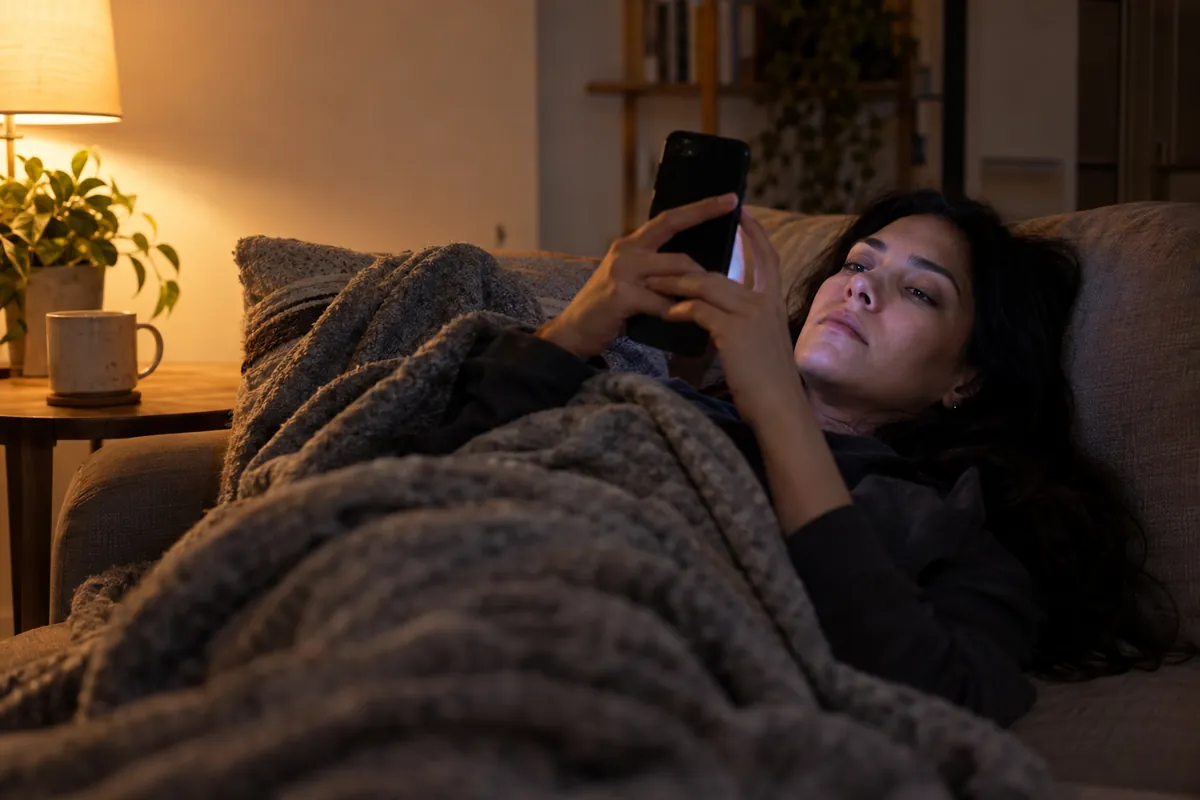
In a laboratory experiment, people asked to browse Facebook passively, reading without posting or chatting, felt worse later than people asked to use it actively. A second study, which checked in with people several times a day as they went about their lives, found the same pattern and an explanation: passive browsing lowered mood by stirring envy [7]. You can feel the difference yourself: ten minutes of messaging a friend is not the same activity as ten minutes of watching strangers' lives.
Comparing yourself with everyone
The college study pointed the same way: the harm seemed to come from students comparing themselves unfavorably with peers who looked like they were doing better [3].
If you're already low
People who are struggling may have the most to gain. In a 2025 US study of 18 to 24 year olds, the 295 who chose a week away from Facebook, Instagram, Snapchat, TikTok and X saw their depressive symptoms drop by about a quarter, and those who started out most depressed improved the most. Nobody was randomly assigned, though, so the study can't prove the week caused the change [10].
How to test it on yourself
Averages describe crowds. A simple two-week experiment tells you about you.
- Week one: watch. Use social media as usual, and each evening rate your mood from 1 to 10 and note your time on the apps. Your iPhone keeps the count (here's how to see your screen time).
- Week two: cut. Keep messaging people, but hold the feeds to about 30 minutes a day, the dose from the Penn trial [4]. A daily limit in Unrotten can hold that budget for you: once the time is used up, Apple's Screen Time shield locks the apps you chose until the day resets.
- Compare. If your evenings, sleep or mood are better in week two, you have your answer, whatever the averages say.
If week two changes nothing, that's useful too: your feeds may not be what's weighing on you, and it's worth looking at sleep, stress, work or the people around you instead.
What to change if it's dragging you down
- Talk, don't lurk. Message the people you'd scroll past, and mute or unfollow the accounts that leave you comparing.
- Break the long sessions. The hour-long scroll is usually the passive kind. Unrotten's Shorter scroll sessions goal puts a break on any session that runs past the length you set.
- Give sleep the last hour. Short nights drag mood down on their own. Charge your phone outside the bedroom, or use Unrotten's Calmer evenings goal to keep a window each evening free of the apps you choose.
- Trade one scroll for one person. The people paid to leave Facebook for a month spent part of the hour they got back with friends and family [9]. Book one coffee, one walk or one call a week in the time the feed used to take.

When to get help
Changing your feeds can make a hard stretch easier, but depression is a health condition with many causes, and a new phone habit isn't a treatment for it. If low mood, a loss of interest in things you used to enjoy or trouble sleeping lasts for weeks, a doctor or therapist can help. If you ever have thoughts of harming yourself, call or text 988, the Suicide & Crisis Lifeline in the US, at any hour.
What the evidence adds up to
Social media probably isn't the main cause of most people's depression, and for some it may be no cause at all. But for heavy, compulsive and passive users, the evidence points to a real if modest effect, and the cure costs little to try: less scrolling, more people, better nights.
Questions people ask
Does social media cause depression?
It can contribute, but the evidence that it causes depression on its own is mixed. Some studies that follow adults over time find heavy use comes before new depressive symptoms, and trials in which people cut back find small improvements. Other long-term studies find no link at all.
Can quitting social media help depression?
It may ease symptoms a little. A 2025 meta-analysis of 10 randomized trials found that reducing social media lowered depressive symptoms by a small amount, and limits worked at least as well as quitting. It isn't a treatment for depression: if low mood lasts, a doctor or therapist can help.
How does social media cause depression?
The likeliest paths are compulsive use that's hard to stop, passive scrolling that breeds envy, comparison with other people's best moments, and lost sleep. Across 62 studies, problematic use was linked to depressive symptoms almost three times as strongly as time spent.
Why do I feel depressed after scrolling?
Often because of the kind of scrolling it is. In an experiment, people asked to browse Facebook passively ended up in a worse mood than people asked to use it actively, and in daily life, passive browsing lowered mood by stirring envy.
References
- Primack BA, Shensa A, Sidani JE, Escobar-Viera CG, Fine MJ. "Temporal Associations Between Social Media Use and Depression." American Journal of Preventive Medicine. 2021;60(2):179-188. doi:10.1016/j.amepre.2020.09.014 ↩
- Perlis RH, Green J, Simonson M, Ognyanova K, Santillana M, Lin J, et al. "Association Between Social Media Use and Self-reported Symptoms of Depression in US Adults." JAMA Network Open. 2021;4(11):e2136113. doi:10.1001/jamanetworkopen.2021.36113 ↩
- Braghieri L, Levy R, Makarin A. "Social Media and Mental Health." American Economic Review. 2022;112(11):3660-3693. doi:10.1257/aer.20211218 ↩
- Hunt MG, Marx R, Lipson C, Young J. "No More FOMO: Limiting Social Media Decreases Loneliness and Depression." Journal of Social and Clinical Psychology. 2018;37(10):751-768. doi:10.1521/jscp.2018.37.10.751 · Read our plain-English summary ↩
- May W, Malouff JM, Meynadier J. "Reducing Social Media Use Decreases Depression Symptoms: A Meta-Analysis of Randomised Controlled Trials." European Journal of Investigation in Health, Psychology and Education. 2025;15(11):222. doi:10.3390/ejihpe15110222 · Read our plain-English summary ↩
- Cunningham S, Hudson CC, Harkness K. "Social Media and Depression Symptoms: a Meta-Analysis." Research on Child and Adolescent Psychopathology. 2021;49(2):241-253. doi:10.1007/s10802-020-00715-7 ↩
- Verduyn P, Lee DS, Park J, Shablack H, Orvell A, Bayer J, et al. "Passive Facebook usage undermines affective well-being: Experimental and longitudinal evidence." Journal of Experimental Psychology: General. 2015;144(2):480-488. doi:10.1037/xge0000057 · Read our plain-English summary ↩
- Heffer T, Good M, Daly O, MacDonell E, Willoughby T. "The Longitudinal Association Between Social-Media Use and Depressive Symptoms Among Adolescents and Young Adults: An Empirical Reply to Twenge et al. (2018)." Clinical Psychological Science. 2019;7(3):462-470. doi:10.1177/2167702618812727 ↩
- Allcott H, Braghieri L, Eichmeyer S, Gentzkow M. "The Welfare Effects of Social Media." American Economic Review. 2020;110(3):629-676. doi:10.1257/aer.20190658 · Read our plain-English summary ↩
- Calvert E, Cipriani M, Dwyer B, Lisowski V, Mikkelson J, Chen K, et al. "Social Media Detox and Youth Mental Health." JAMA Network Open. 2025;8(11):e2545245. doi:10.1001/jamanetworkopen.2025.45245 · Read our plain-English summary ↩
Written by
Maren AshbyCOO, Unrotten
Maren Ashby is the COO of Unrotten, the iPhone app that helps people take their attention back from the feed. She writes about the research on phones, sleep and focus, and about the small, practical changes that make a phone easier to put down.